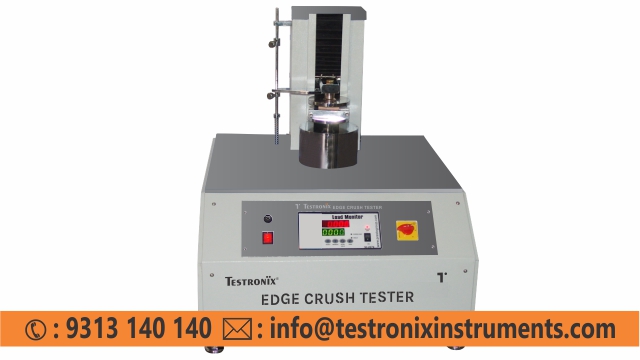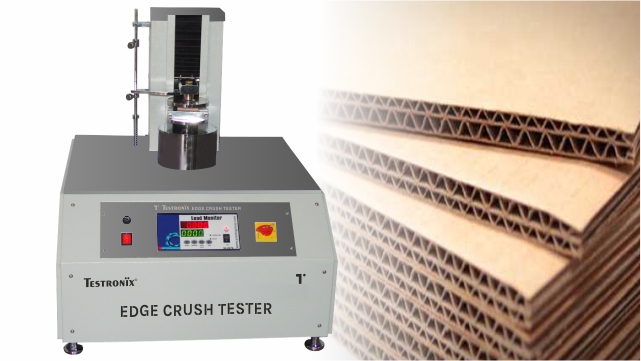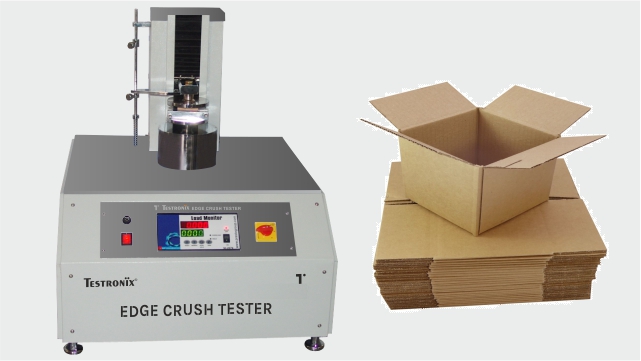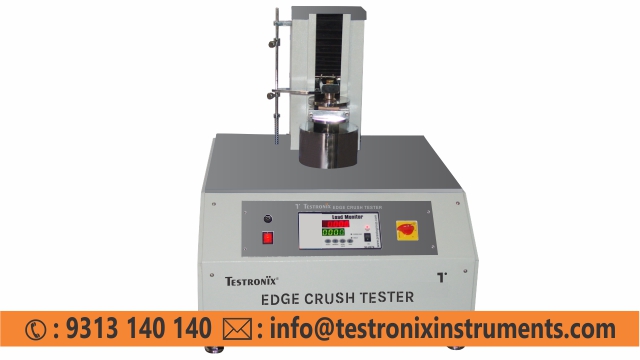
The edge crush strength of corrugated boxes will help you to make sure that the boxes delivered are of high quality. You can easily test the edge crush strength of corrugated boxes with the help of the Testronix edge crush tester. This lab testing instrument helps you to measure the edge-wise compression strength of boxes with ease.
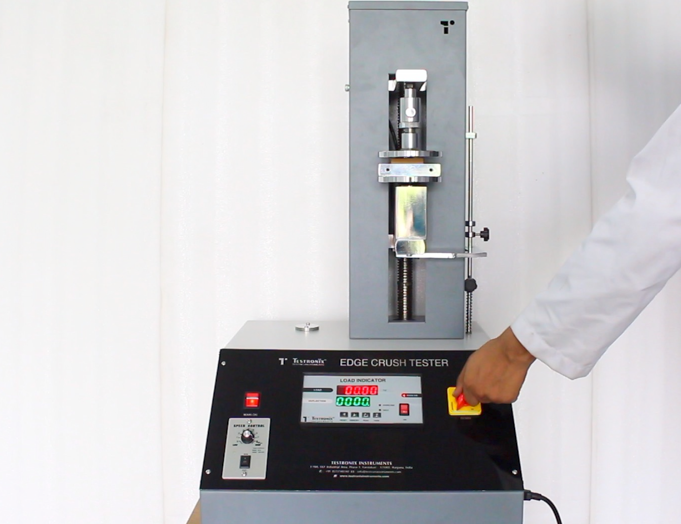
Here in this blog, we are going to provide you with the importance of an edge crush tester and how this lab testing equipment is helpful in testing the quality of corrugated boxes. We will also discuss the importance of the edge crush test in the paper and packaging industry.
What is Edge Crush Test for Corrugated Boxes?
Edge crush test (ECT) measures the edgewise compressive strength of a corrugated box. The ECT test evaluates the stacking strength of a box by determining exactly how much weight a box can withstand along its edges before it collapses. The higher the ECT value of a corrugated box, the higher its load-bearing capacity. In this test, a small section of the corrugated material is placed vertically in a testing machine, and a compressive load is applied until the sample buckles or fails.
The ability to measure the stacking strength makes the edge crush test a crucial tool for modern supply chains and e-commerce shipping. Instead of guessing how much weight a package can handle, companies use this specific value to choose the right materials for their inventory. Designing a box based on its actual edge strength protects products during transit while saving money on unnecessary, over-engineered packaging.
What Edge Crush Test Measure?
The Edge Crush Test (ECT) measures the edgewise compressive strength of corrugated board. Specifically, it assesses how much force the board can withstand when pressure is applied to its edge, which is the most critical area during stacking. In this test, a small section of the corrugated material is placed vertically in a testing machine, and a compressive load is applied until the sample buckles or fails.
Formula of Edge Crush Test
The Edge Crush Test (ECT) formula is:
ECT = Force Applied (N) / Sample Width (mm)
Here,
-
Force Applied (N): This is the peak force needed to crush the sample before collapse.
-
Sample Width (mm): This is the sample width of the corrugated being tested.
-
ECT Value: The calculated value that signifies the edge crush strength of the material.
This calculates the ability of a material, specifically corrugated cardboard, to resist collapsing under edge-wise compression. ECT, measured in pounds per inch (lb/in) or kilonewtons per meter (kN/m), reflects the strength and endurance of a material when stacked.
What is Edge Crush Test Calculator?
An Edge Crush Test calculator calculates a material’s edge crush strength – the resistance to collapsing when compressed along its edges. Such calculators usually require as input the force applied in testing and the dimensions of the sample, and then calculate the ECT value, usually in terms of pounds per inch or kgf/cm.
ECT calculators simplify the process of calculation by automating the formula to find the ECT value. They usually integrate the formula of ECT = Force applied / Sample width.
The use of a calculator is time-saving and provides accuracy and consistency in ECT calculations.
Example:
For instance, a corrugated board sample is 100 mm in width. In an ECT test, the maximum force used to crush the edge is 400 Newtons (N).
Force used (N): 400 N
Sample width (mm): 100 mm
Calculation:
ECT = 400 N/100 mm = 4 N/mm or 4000 N/m
How to Calculate ECT of Corrugated Board
The ECT value of corrugated board is calculated by placing a small sample of the corrugated board vertically into a compression tester. A steady downward force is applied until the edges begin to collapse. The peak force required to crush the sample is then divided by the width of the specimen. This calculation is formally expressed through the formula:
ECT = Force (in Newtons)/Sample Width (in millimeters)
It is to be noted that the test measures resistance in Newtons per millimeter; the final result is typically converted into pounds per linear inch (lb/in) for standard packaging specifications. This final number gives a precise look at how much vertical weight the board can support when stacked.
Edge Crush Test Procedure
-
Cut the Sample: To start the ECT test, the very first step is to cut a small strip of the corrugated board to standard dimensions, typically 2 x 2 inches or 25 mm wide. Ensure the edges are cut perfectly straight, as uneven edges will ruin the test results.
-
Position the Board: Place the sample vertically on its edge between the two flat plates of a compression testing machine. The internal waves of the cardboard must stand upright to mimic how a box sits on a pallet.
-
Apply the Pressure: Start the machine to apply a steady downward force at a constant speed. The machine will continue pushing until the cardboard sample wrinkles, buckles, or completely collapses.
-
Record and Calculate: Note the exact peak force applied right before the board failed. Divide this maximum force by the width of your sample to get your final ECT value which is usually measured in pounds per inch.
Common Edge Crush Test Standards
The most common edge crush testing (ECT) standards are DIN EN ISO 3037, TAPPI T811, ISO 13821, TAPPI T838, and TAPPI T839. These are the standards for testing the edgewise compressive strength of corrugated fiberboard, which is important in verifying the stackability and durability of corrugated packaging.
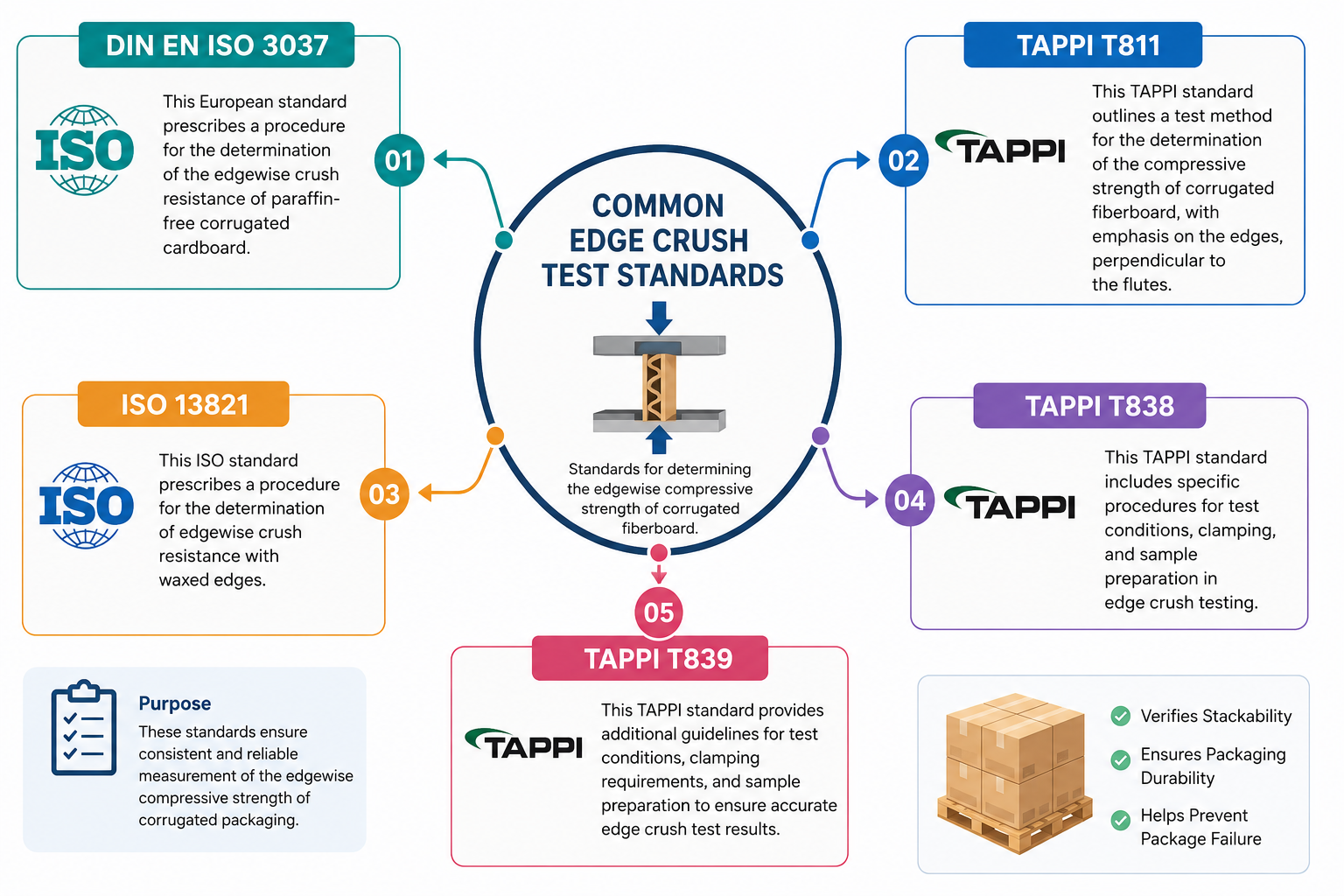
DIN EN ISO 3037: This European standard prescribes a procedure for the determination of the edgewise crush resistance of paraffin-free corrugated cardboard.
TAPPI T811: This TAPPI standard outlines a test method for the determination of the compressive strength of corrugated fiberboard, with emphasis on the edges, perpendicular to the flutes.
ISO 13821: This ISO standard prescribes a procedure for the determination of edgewise crush resistance with waxed edges.
TAPPI T838 and TAPPI T839: TAPPI standards are also applied in edge crush testing and include specific procedures for test conditions, clamping, and sample preparation.
ECT Grades & Box Capacities
Common ECT grades dictate the maximum weight a corrugated box can safely hold and how high it can be stacked without collapsing. Choosing the right grade matters as over-optimization may lead to wastage and under-optimization can make the box vulnerable.
|
Board Wall Type |
ECT Rating |
Max Recommended Box Content Weight |
|
Single Wall |
23 ECT |
Up to 20 lbs (9 kg) |
|
Single Wall |
32 ECT |
Up to 65 lbs (29 kg) |
|
Single Wall |
44 ECT |
Up to 95 lbs (43 kg) |
|
Double Wall |
48 ECT |
Up to 100 lbs (45 kg) |
|
Double Wall |
51 / 55 ECT |
Up to 140 lbs (63 kg) |
|
Triple Wall |
71–112+ ECT |
240 to 300+ lbs |
Edge Crush Test vs Burst Strength
The edge crush test (ECT) and burst strength test are utilized to assess the strength of corrugated cardboard, but they test different characteristics. ECT tests how much a corrugated board resists crushing along its edges and is mostly testing stacking strength. On the other hand, burst strength tests how much the board resists puncture or bursting and how much internal pressure the board can withstand.
Here is the key difference between the edge crush test and the burst strength:
| Feature | Edge Crush Test (ECT) | Burst Strength Test |
| Purpose | Measures edge crushing resistance | Measures puncture resistance or bursting strength |
| Focus | Stacking strength | Internal pressure and puncture resistance |
| Test Method | Compression force applied to the edge | Pressure is applied to the bulging diagram |
| Significance | Determines how much weight a stack can hold | Determines how well the box resists internal punctures |
Introduction about edge crush test
The edge crush test is used to determine how well cardboard resists cross-sectional crushing pressures. The edge crush tester aids in determining the box's edge-wise strength, which is important since the box's edges are designed to be strong in order to provide protective strength against compressive pressures. As a result, the edge crush tester assists the maker in delivering the best box while assuring the material's protective potential.
This test done by the edge crush tester testing instrument will help you to determine the strength and quality of corrugated boxes that can be crushed at the time of transportation and handling. Testronix offers a high-quality edge crush tester digital model that makes it easy for you to conduct the test. Below we have mentioned the features you will get with the help of this lab testing instrument.
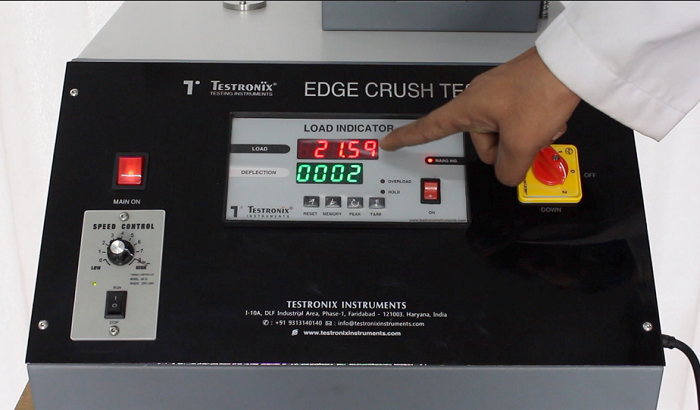
Features of Testronix edge crush tester
Testing the stacking ability of a box's edge is the most feasible and repeatable approach to measure how well it will hold its form under vertical weight during transit. For many years, many corrugated box manufacturers in the packaging business have relied on this lab testing instrument to ensure that their consumers receive reliable products.
Below we have listed the features you will get with this lab testing instrument:
- Microprocessor-based display for accurate test results
- Display for compression strength of test specimen
- Separate fixtures for ring crush, edge crush, and flat crush test.
- Highly accurate test results under a compression force
- Feather touch controls RCT/FCT/Edge Crush Tester reveals the crushing resistance in terms of Kg/Unit length.
- Load Cell Capacity 100 Kgf
- Accuracy ±2% at full load (with master load)
- Least Count/Resolution 0.01 Kgf Power 220V, Single phase, 50 Hz Test Speed 12.5± 2.5 mm/min
Highlights:
- Safety Switch Upward & Downward Limit Switches
- Material Mild Steel Powder coated body
- Dimensions 600x500x863 mm
- Computerized model available on request
- Thermal printer connectivity optional feature
Technical Specifications of Testronix edge crush tester digital
- Maximum Load range: 100 kgf
- Test Speed Range: 12.5 ± 2.5 mm/min
- Load Monitoring: Peak Load indicator with digital readout and peak hold feature
- Load Sensor: S-type Load Cell.
- Load accuracy: ±3% full scale (with the master load.)
- Deflection: ±3% full scale
- Least count: 100 kgf/ 100gm
- Load Cell Overload safety: 80% of the total load.
- Motor: ¼ HP, 30 rpm single phase motor.
- Safety Feature: Up and down fixed and movable limit switch rings.
- Over Load relay contact rating: Potential free relay 5 Amp. 220 V AC single phase
- Earthing Required: Proper Earthing is required corresponding to not more than 4 V AC with respect to neutral.
- Sample Size for ECT: 50 + 1 mm X 30 + 1 mm
- Block size: 20*20 mm
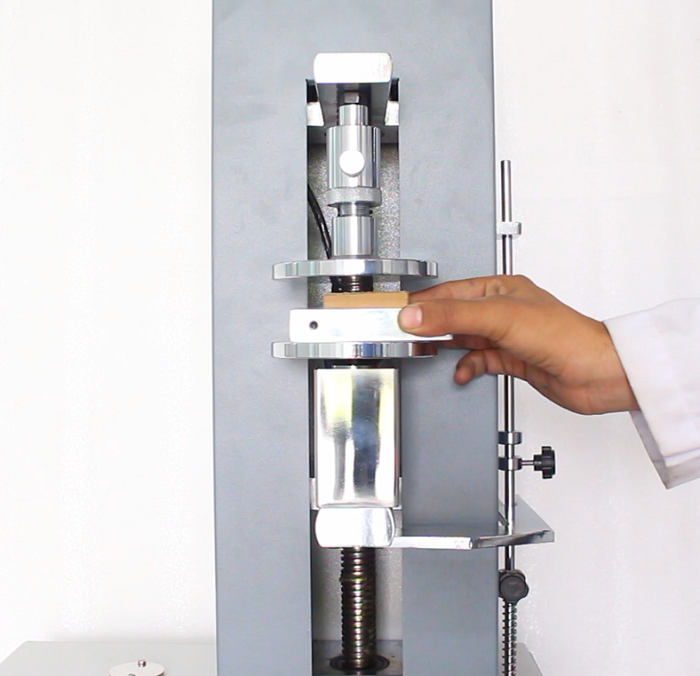
With these features and technical specifications, it will be easy for you to conduct the test using the Testronix edge crush tester. Whenever you buy an edge crush tester then you can simply maintain it with these 5 easy tips. At Testronix, our instruments will be designed by keeping all industry standards in the mind. The ECT, or Edge Crush Test, evaluates corrugated cardboard's capacity to protect products during storage or transit.
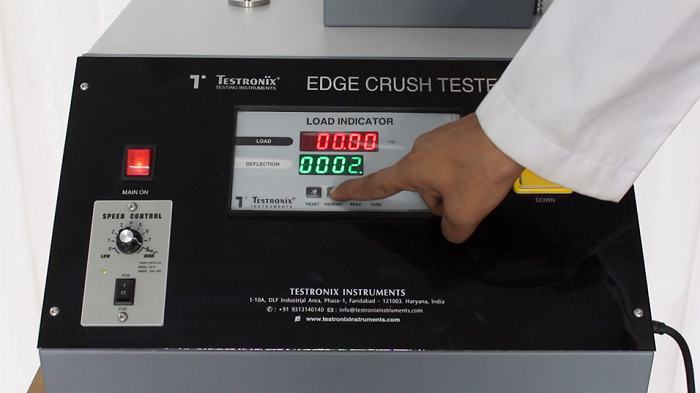
It is crucial in the paper and packaging business since it aids in determining the compression forces that a box can withstand in order to ensure the safety of goods and products. To know about the edge crush tester price, or want to conduct an online demo for this lab testing equipment, give us a call at +91 9313140140 or email us at info@testronixinstruments.com. Our team of technical experts will assist you with all your queries.