Pharma products like medicines are very sensitive to manufacturing and transporting safely to major hubs. For this purpose, robust packaging cartons are manufactured by reputable production companies. But the process does not end there; these pharma packages must be tested and verified in real-world conditions and this is where pharma blister pack testing plays a significant role.
In this article, we will discuss what is pharma blister pack testing and why pharmaceutical industries must implement it throughout their manufacturing process. Along with that, we will also find out what is the standard method of blister leak test and what the important standards are to be followed.
What is Pharma Blister Pack Testing?
Pharma blister pack testing is a set of quality control procedures used to verify the seal integrity and barrier strength of push-through packaging. It checks whether pinholes, channel leaks, or weak heat seals exist between the formed cavity tray and the backing foil.
Blister packaging typically consists of two main components. The first is the forming film which is shaped into pockets to contain individual tablets or capsules. The second is the important one - a lidding material. In most cases, it is a thin aluminum coated foil. In production, these two layers are bonded together with heat and pressure that generate a robust packaging material.
Lower temperature or uneven sealing pressure results in micro gaps being formed around the perimeter of the seal. Take a standard batch of tablets for pain relief packaged in PVC-aluminum blisters. If a microscopic gap exists around one pocket, ambient humidity enters over time. The tablet absorbs water vapor, softening and degrading the chemical structure. Blister testing identifies these invisible micro defects before batches leave the manufacturing facility.
Blister Leak Test Procedure: Method of Pharma Blister Testing
The blister leak test procedure includes a methylene blue dye leak test that uses vacuum pressure to pull air out of defective blister pockets while immersed in colored liquid. When atmospheric pressure returns, liquid gets sucked into any compromised cavities, making leaks visible as dark blue spots inside the pockets.
-
Proper preparation and good instructions are required for a good vacuum leak test. Operators visually inspect samples before running the machine to remove crushed blisters or major physical damage.
-
The testing process uses a vacuum chamber filled with a solution of blue dye (usually methylene blue in water). The technician places sealed blister strips directly into the solution in the desiccator jar. The samples are covered with a perforated retaining disk to hold the samples in full immersion in liquid during the test run.
-
Once the operator seals the lid, the vacuum pump kicks in and starts drawing air out of the chamber. Pressure inside gradually drops to a set point—usually somewhere around 15-20 inches of mercury. As that happens, any air trapped in defective blister cavities expands and pushes its way out through micro-leaks, bubbling into the liquid. This stage is held steady for about 2-3 minutes to give any leaks enough time to reveal themselves.
-
After the vacuum hold cycle finishes, atmospheric pressure is restored quickly. This sudden pressure change forces the blue dye solution back into any open microchannels or pinholes. The operator opens the chamber, removes the blister packs, rinses off surface dye with fresh water, and dries them off.
-
Final inspection happens by peeling open each individual blister pocket. If dye appears inside a pocket or on the tablet surface, that cavity failed seal integrity. If all cavities inside stay completely dry and clean, the blister pack passes quality control.
Important Standards for Testing Pharma Blister Packs
Regulatory compliance standards also define the vacuum levels, time and sample size that must be met for blister testing to be valid. Compliance with these standards ensures international acceptance of pharmaceutical products.
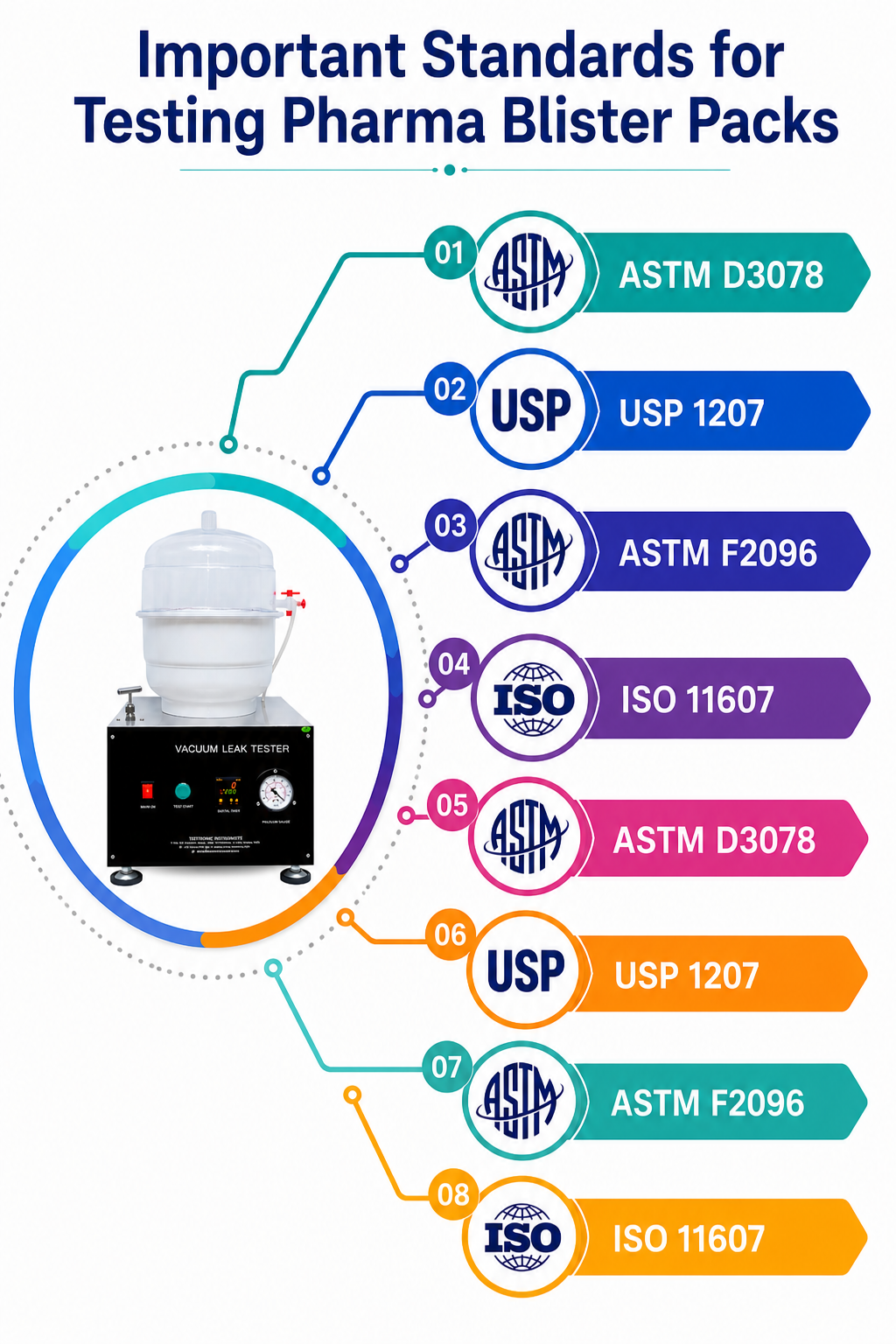
Regulatory bodies enforce strict testing criteria to maintain package uniformity. Below are key standards governing pharmaceutical blister pack testing:
-
ASTM D3078: Standard Test Method for Determination of Leaks in Flexible Packaging by Bubble Emission. It establishes fundamental vacuum levels and the methods of observing bubbles in flexible packages.
-
USP 1207: USP 1207 offers a unique set of testing standards that is known as the package integrity evaluation. The standard is mainly applied to leak testing of sterile and non-sterile pharmaceutical products.
-
ASTM F2096: Internal pressurization is frequently used to detect gross leaks in packaging to assess seal strength.
-
ISO 11607: Primarily outlines the requirements for packaging and sterility of materials, including sterile barrier systems and packaging validation.
-
ASTM D3078: This is a standard test method for determination of leaks in flexible packaging by Bubble Emission. It defines basic vacuum levels and bubble observation methods for flexible packs.
-
USP 1207: United States Pharmacopeia standard focusing on Package Integrity Evaluation. It details deterministic and probabilistic leak test methodologies for sterile and non-sterile pharmaceutical products.
-
ASTM F2096: Standard Test Method for Detecting Gross Leaks in Packaging by Internal Pressurization, commonly applied when evaluating package seal strength under internal pressure.
-
ISO 11607: Packaging for terminally sterilized medical devices, outlining requirements for materials, sterile barrier systems, and packaging validation.
Testronix Vacuum Leak Tester: Best Equipment for Pharma Blister Testing
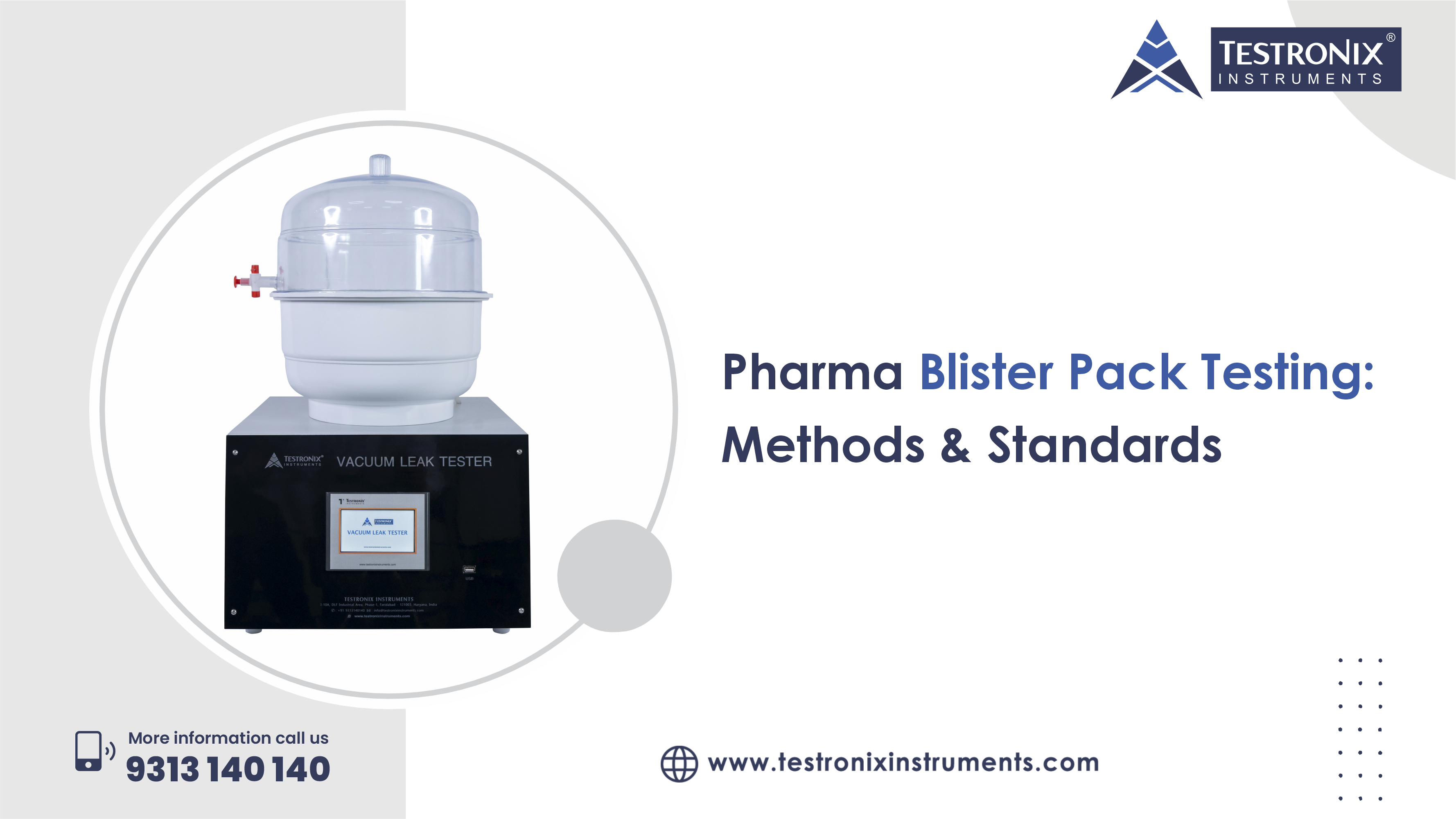
The Testronix Vacuum Leak Tester is a high-precision instrument built specifically for checking seal integrity in pharmaceutical packages. It combines controlled digital vacuum management with a durable acrylic chamber to deliver consistent testing results.
The laboratory equipment should deliver repeatable results without complex setups. The Testronix Vacuum Leak Tester makes routine quality testing on production lines easy. The clear acrylic desiccator chamber provides operators 100% visibility from all sides when they are conducting a bubble emission test.
The unit is operated with a digital microprocessor and the setup-specific vacuum levels and hold times are easily accomplished. The instrument is designed with rugged industrial components to resist chemical degradation of dye solutions and heavy use in any busy QA laboratory.
Conclusion
Leak-free blister packaging is critical for the safety and shelf-life stability of pharmaceuticals. Regular testing with reliable equipment ensures that quality failures are avoided and all regulatory requirements are met.
Testing of packages is good, as it stops bad batches of drugs from getting to consumers. QA teams use formalized dye penetration and vacuum test protocols to verify the integrity of product seals. Durable equipment that lasts long term is a huge factor for accuracy and efficiency in the lab. Testronix is a leading manufacturer of vacuum leak equipment. Testronix provides reliable instruments for the demanding environment of pharmaceutical packaging.