Corrosion is a common issue with industrial equipment. It can damage components, reduce their life and cause costly maintenance and downtime. What manufacturers struggle to determine is how well a new paint, plating or coating will perform without waiting years for outdoor exposure. A typical test for this purpose is the ASTM B117 Salt Spray Test.
ASTM B117 is one of the most popular standards in many industries including automotive, aerospace and others, for salt spray testing. In this guide, you will learn the scope of ASTM B117, how to perform the test, the important parameters that are essential to track during the test, and the indications to watch for during reliable salt spray testing.
What is ASTM B117 Salt Spray Test?
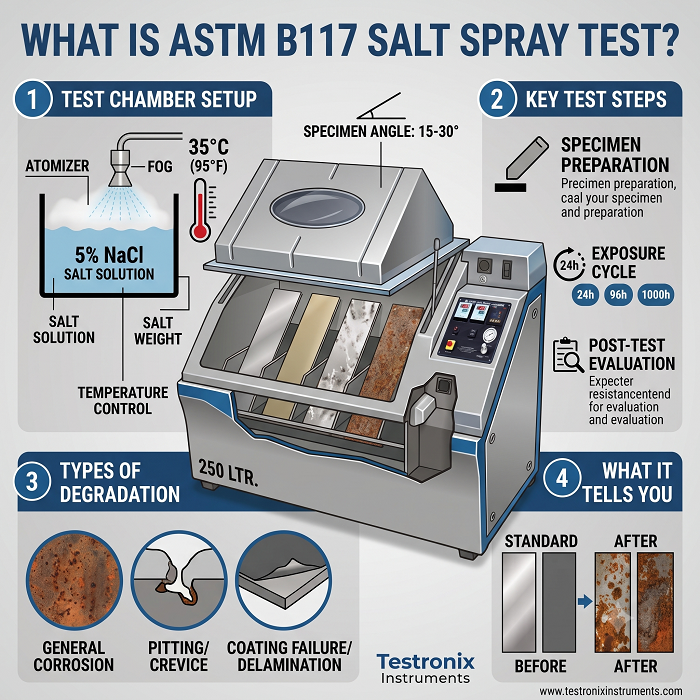
ASTM B117 Salt Spray Test is a standardized laboratory test to evaluate the performance of metallic materials and protective surface coatings. The test is conducted by exposing prepared test specimens to a continuously generated salt spray using a sodium chloride solution under specified conditions.
For the standard neutral salt spray test, the solution is typically prepared with 5% sodium chloride by mass. The test environment is maintained at approximately 35°C, and the solution pH is controlled within the specified range.
ASTM B117 is not a pass or fail standard. It won't tell you "this part must last 500 hours." It only tells you how to run the chamber correctly. Your customer specs or internal engineering standards decide the actual target hours and failure criteria. What it really gives you is repeatability. A shop in Ohio and a lab in Germany can run the same test and get results that actually line up.
Purpose and Scope of ASTM B117 for Salt Spray Testing
The primary purpose of ASTM B117 is to provide a reliable benchmark to compare corrosion resistance between different batches or coating types. It acts as a fast screening tool for factory quality control.
If your plant switches powder coat suppliers or tweaks an electroplating line, you need feedback fast. You can't guess. Placing old samples next to new ones in the salt spray cabinet gives you a quick, relative head-to-head comparison.
The standard is applicable to various materials including painted sheet metal, anodized aluminum, zinc plating, conversion coatings, and protective lacquers. It is to be understood that salt spray is not an ideal way to simulate natural atmospheric aging outdoors. But for fast quality checks and catching batch defects before parts ship, it remains the best option.
ASTM B117 PDF Download
You can download ASTM B117 PDF for free to get detailed guidelines for salt spray test parameters and step-by-step operating limits. It helps you to find the official documentation, complete chamber layout schematics, and nozzle positioning guidelines for your lab setup.
Parameters and Conditions for ASTM B117 Salt Spray Test
Keeping chamber conditions stable is everything in this test. Drift too far on temperature or salt concentration, and your whole test run becomes completely invalid.
Even small shifts in pH or cabinet heat mess with rust rates. That matters a lot because uneven salt spray distribution gives false readings on your sample panels. Lab techs have to log these numbers every single day without skipping.
|
Test Parameter |
Required Specification |
Operational Purpose |
|
Salt Solution Concentration |
5 percent sodium chloride (±1%) |
Keeps the chloride attack aggressive and consistent |
|
Salt Solution pH Range |
6.5 to 7.2 (tested from collected spray fallout) |
Stops acid or alkaline bias from skewing rust rates |
|
Chamber Exposure Temp |
35°C / 95°F (+1.1°C / -1.7°C) |
Holds steady thermal energy inside the cabinet |
|
Saturation Tower Temp |
46°C to 49°C / 114°F to 120°F |
Heats incoming air so it doesn't dry out the chamber |
|
Spray Collection Rate |
1.0 to 2.0 mL per hour per 80 cm² funnel |
Confirms the salt spray fallout is dense and even |
|
Compressed Air Pressure |
12 to 18 psi (83 to 124 kPa) |
Pulls solution smoothly through the misting nozzle |
ASTM B117 Procedure & Standard Practice for Salt Spray Test
Running a proper test breaks down into five basic steps that follow the ASTM B117 standard practice. The standard procedure steps are: Setting up the cabinet, placing the specimens, running the spray continuously, and cleaning up for final inspection.
Test Specimen Preparation
First off, clean your test pieces thoroughly. Oils or fingerprints ruin spray contact and throw off test results. If you have raw cut edges or mounting holes, seal them with heavy tape, wax, or paint so rust doesn't creep in from the sides early.
Specimen Placement
Next, mount the specimen or sample on non-metallic racks. Plastic or coated wooden slots work best. Slant panels at a 15 to 30 degree angle from vertical, pointing them parallel to the main spray flow direction. Never stack samples or let runoff from an upper tray drip onto parts sitting below them.
Salt Spray Test Initiation
Once everything is racked, seal the cabinet lid, bring the heaters up to temp, and kick on the air supply to start the salt spray. Exposure runs usually last anywhere from 24 hours to over 1000 hours depending on what you are testing.
Specimen Removal & Evaluation
When time is up, pull the parts out carefully. Wash off leftover salt crust with clean water at or below 38°C, dry them right away, and hand them over for inspection. You're looking for creep around scribes, surface blistering, or the percentage of red rust coverage.
Testronix Instruments: A Trusted Partner for ASTM B117 Salt Spray Test
To achieve consistent, audit-ready, and accurate ASTM B117 results, you need the right and accurate testing machine. Testronix Instruments builds heavy-duty salt spray testers made for round-the-clock industrial testing with excellent accuracy.
Running a cabinet continuously for weeks puts serious stress on heaters, air towers, and nozzles. If a component fails mid-run, you waste hundreds of hours of testing time. Testronix Instruments uses thick corrosion-resistant fiberglass bodies and rock-solid temperature controls built to handle brutal salt environments without breaking down.
Our salt spray chamber features automated tower controls, stable atomizing nozzles, and precision collection funnels to keep your spray fallout within the target range. For QA managers who can't afford questionable test data, relying on hardware from Testronix Instruments takes the guesswork out of compliance.
Conclusion
ASTM B117 remains the standard for checking coating durability and rust prevention. Keeping tight control over solution pH, cabinet heat, and spray fallout gives manufacturers real data to catch coating failures before products hit the field.
A trustworthy testing process always starts with reliable equipment. Contact Testronix Instruments today to check out their ASTM B117 salt spray chambers and get your quality control lab running on solid footing.