Almost everything you buy, from a bottle of medicine to a phone charger, has passed through rigorous testing before it left the factory. Sometimes it's a quick visual scan and other times, it's a full lab test. Either way, that check is the only thing standing between a working product and a defective one landing in someone's hands.
This is where quality control comes in because a missed defect can mean a recall, an angry customer, a safety complaint, or, in worse cases, all three at once. Manufacturers who cut corners here usually end up paying more later anyway, through returns, rework, or just losing customers who won't come back after one terrible experience.
This article covers what quality control means, its different types, the methods used for quality control day-to-day, and the benefits of quality control.
What is Quality Control (QC)?
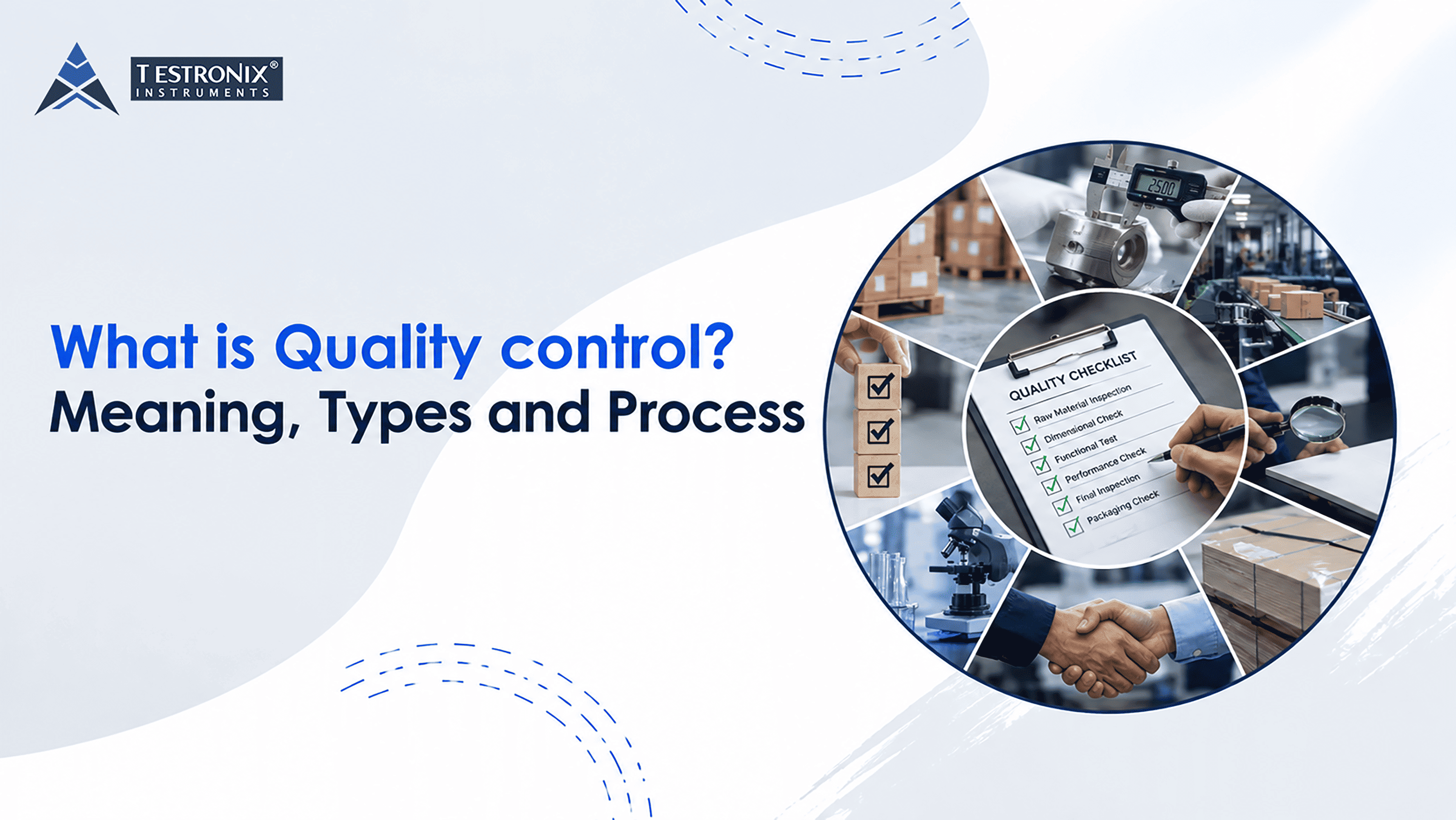
Quality control (QC) is the process of checking products or services against a set standard to catch defects before they reach the customer. It usually involves inspection, testing, and comparison against predefined specifications at different stages of production.
In other words, QC is the practical aspect of quality management. Companies take a sample from the production line or perform tests by checking whether the goods actually conform to the specifications. This checking may be performed either upon receiving the raw materials, at some stage of production, or right before packing the product in boxes. The general idea is to identify the problem at its early stages to fix it with minimum costs.
Most manufacturing setups have a dedicated quality control team whose entire job revolves around inspecting, measuring, and testing, using everything from a basic caliper to a fairly advanced testing instrument depending on the industry.
Here's the thing: trust takes years to build and about five minutes to destroy. If you're a buyer, a distributor, or a regulator, you need to know that what you're getting today is going to be just as reliable as what you got last month. Lose that confidence, and good luck getting it back.
This gets even more serious in industries like pharma, food, or electronics. A flaw there isn't just annoying; it can genuinely hurt people. And honestly, there's a simpler reason too: money. Catching a bad batch of raw material costs you way less than finding out something's wrong after you've already built the whole product around it. Good quality control isn't just about dodging disaster. It's about not wasting time and money on stuff you'll end up throwing away anyway.
Businesses that maintain a disciplined approach to quality control over time safeguard their reputation in the marketplace and adhere to regulations; in many industries, this compliance component cannot be neglected.
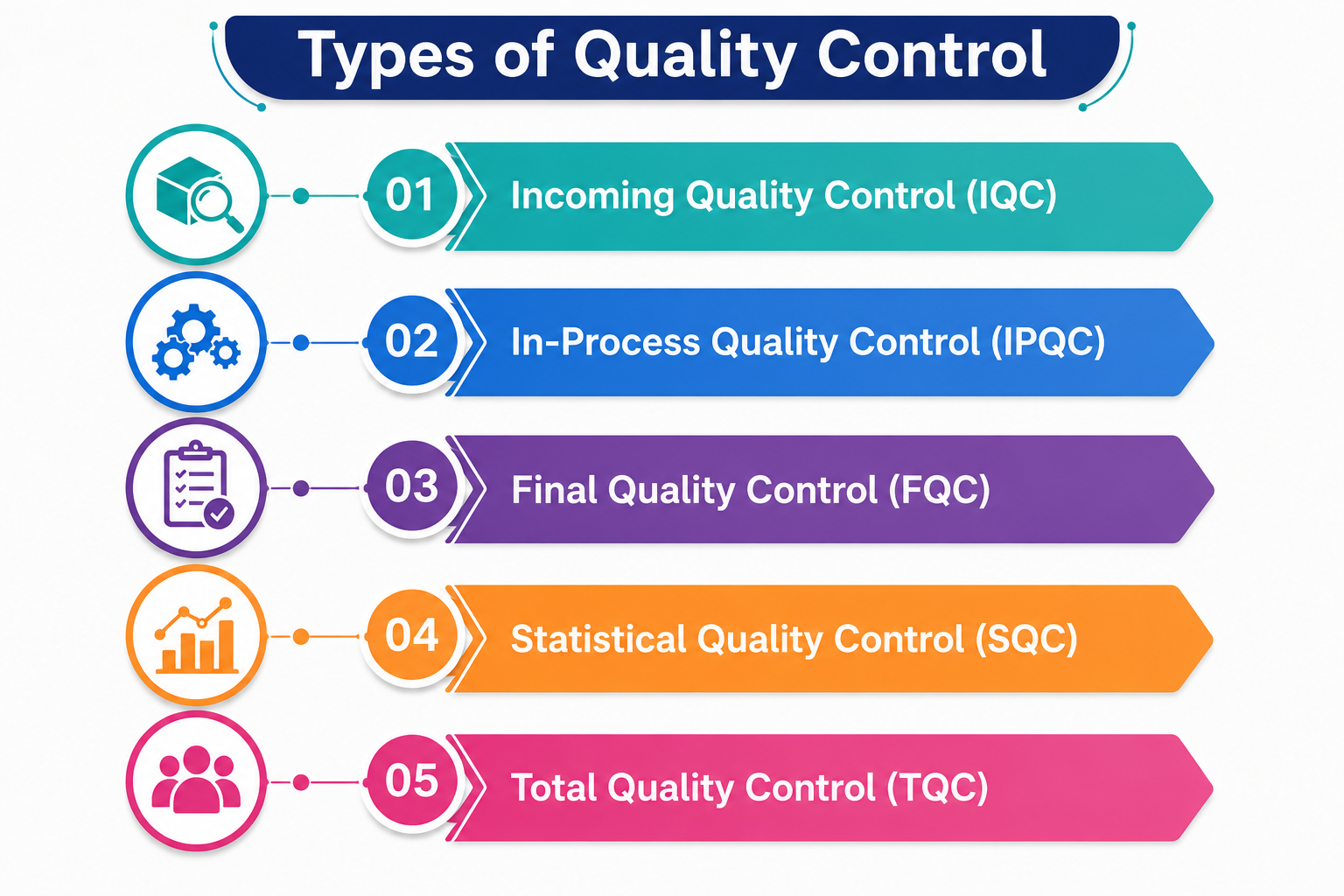
Types of Quality Control
Incoming Quality Control (IQC)
It addresses raw materials and components prior to first use on the production line. If the supplier sends defective parts and no one catches the defect at this stage then the defect becomes embedded in all the downstream units. IQC is actually the initial checkpoint, and one of the more common reasons that whole batches are flawed.
In-Process Quality Control (IPQC)
It manages products when they are in process or still being built. Rather than waiting till the very end to discover something's off, IPQC checks the product at multiple points during assembly. Catching an issue mid-process is usually far easier and cheaper than fixing a finished unit.
Final Quality Control (FQC)
It is also called outgoing QC and is the last stop before the product ships out. This is where the finished item gets tested one more time against the full spec sheet. Since it's the last chance to catch anything, this stage tends to be pretty thorough, sometimes to the point of feeling excessive, but that's kind of the point.
Statistical Quality Control (SQC)
Among several methods of floor quality control, SQC stands out since it operates on the principles of sampling and statistical analysis, rather than testing every unit. In its stead, tests are carried out using a sample that is representative of the batch, as a result of which the retrieved data can be applied in the evaluation of the total batch.
Total Quality Control (TQC)
It goes beyond just manufacturing parts and covers quality across every department involved, not just the production floor. Design, procurement, logistics, etc play a role in keeping the final product consistent, and TQC treats quality as something owned by the whole organization rather than one team.
Quality Control Methods
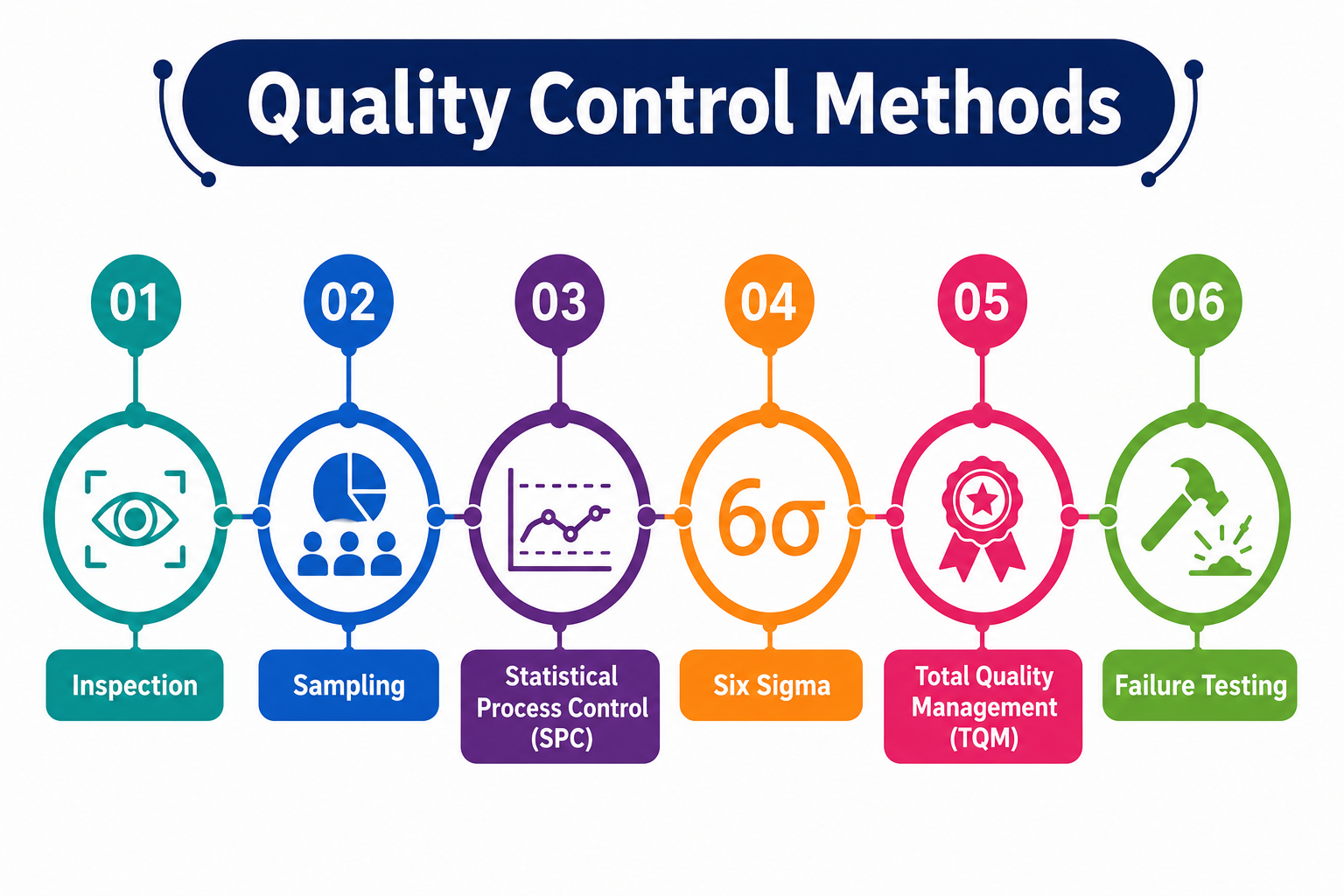
The following are the most commonly used quality control methods in industries:
Inspection
Inspection is the simplest and most common QC method around. In this, products get physically or visually examined for defects. The product inspector can be a trained person doing it by hand or an automated vision system on a fast-moving line. This is usually the first stage of inspection and takes care of the obvious problems such as wrong dimensions, scratches on the surface, missing parts, etc.
Sampling
When sampling, the sample is just a small group taken from a larger processing batch, as opposed to examining each individual item. It's very time-saving and cost-effective, particularly when producing many batches, and provides a fairly accurate indication of the batch as a whole. The hard part is selecting the number and method of sampling that will truly reflect the entire lot, otherwise, the findings are of little value.
Statistical Process Control (SPC)
SPC is based on statistical tools and relies on control charts predominantly to monitor a production process in real time. It alerts when a process begins to wander from the normal limits, before the defective parts begin to be produced. It is possible for teams to anticipate the trend and fix it before there is any damage.
Six Sigma
Think of Six Sigma as the "let's stop guessing and look at the numbers" approach to fixing problems. The goal is pretty extreme too, basically wiping out defects almost entirely as only 3.4 defects per million remain. But what makes it work isn't the target. It's the process behind it: Define, Measure, Analyze, Improve, Control, or DMAIC for short. You're not slapping a bandage on the obvious problem. You're tracing it back to why it's happening in the first place, then fixing that. So no, this isn't something you do once before a big audit and forget about. It's a habit you build into how the business runs.
Total Quality Management (TQM)
TQM treats quality as everyone's job, not just something the QC department deals with. It is based on customer satisfaction and continuous improvement principles. Everyone from senior management to the shop floor employee has to be involved in maintaining standards.
Failure Testing
Failure testing is when you deliberately push a product past its normal limits to see exactly how and when it breaks. It sounds counterintuitive, testing something by trying to destroy it, but that's the point. Engineers need to know a product's actual breaking point, not just how it performs under normal conditions. So they stress it, overload it, or run it way past its limits until it fails, then study what caused that failure. That way, when the product ships, it's built with enough of a safety margin that everyday use never comes close to that limit. This is especially important in electronics, cars, and construction materials, because if something fails there, it's not just a bad customer experience. It could actually hurt someone.
Benefits of Quality Control in Manufacturing Industry
Cost Saving
Cost savings top the list. Catching a defect during raw material checks or mid-production is dramatically cheaper than dealing with a recall after the product's already out in the market. Rework, scrapped material, returns, etc. add up quickly, and steady QC keeps those numbers from spiraling.
Customer Satisfaction
When a product just works the way it's supposed to, every single time, customer satisfaction basically takes care of itself. When a user buys and uses a product and found is genuinely useful, they come back again and again as it is highly satisfied. It's simple, really: get the quality right, and you keep customers around longer while dealing with a lot fewer complaints along the way.
Regulatory Compliance
Regulatory compliance is another big one, especially in pharma, food processing, and automotive. Fail an audit or breach a safety standard and you're looking at heavy fines, or in serious cases, a shutdown. Solid QC processes keep a business on the right side of that line.
Quality Control vs. Quality Assurance
Quality control is about identifying defects in the actual product. Quality assurance is about improving and standardizing the process that makes the product in the first place. QC is reactive and product-focused; QA is proactive and process-focused. If you want the full breakdown of where these overlap and where they don't, read our dedicated guide on Quality Control vs. Quality Assurance and implement the process to make your products better.
Testronix: Driving Quality Control Excellence
Precision drives effective quality control, moving beyond assumptions to data-backed certainty. By partnering with Testronix Instruments, manufacturers can leverage specialized equipment like Box Compression Testers and UTM Machines to ensure their products withstand the rigors of stacking, handling, and transit. These advanced testing solutions enable labs to achieve repeatable and consistent results, which is critical for maintaining high standards and ensuring product safety.
Thanks to Testronix's innovative technologies, quality experts can minimize material losses and rejections by identifying issues at an early stage of production, including defective film batches and bonding issues. Hence, it helps companies switch from reactive quality control that involves identification of problems after the goods were shipped to proactive quality control that increases the effectiveness of the supply chain and builds the reputation of the company.
Conclusion
Quality control is not a one-and-done application! It's a process that's continuous; it's integrated in almost every part of the production process from the moment the raw material enters, all the way to the product going out the door for shipping. Every type and method of defect prevention that is discussed here contributes to the effort of ensuring that defects never reach a customer.
None of the quality checks and methods work well without the right tools, though, and that's where a company like Testronix Instruments becomes truly helpful. Our testing equipment gives manufacturers a practical way to maintain quality without sacrificing standards. Contact us to get a quote. You can start from scratch or improve an existing QC process. It is important to get these basics right before you start looking at your industry specifics.