Packaging failure during transit is one of those problems that quietly costs companies a lot more than assumed. A box that looks perfectly fine on the shelf can still collapse under stacking pressure during storage or shipping. This is not a problem on the material or manufacturing side but on the testing side.
This is where ASTM D642 comes into play and fills the exact gap to test the compression resistance of packaging with a box compression tester. It's a standardized test method that measures how much compressive load a shipping container can withstand before it deforms or fails. It gives packaging manufacturers and quality teams a consistent, repeatable way to evaluate box strength instead of relying on guesswork.
In this article, we will break down what ASTM D642 actually covers, why it matters for anyone shipping palletized goods, and how the test procedure works in practice. We will also look at the equipment used to run this test, since the accuracy of your results depends heavily on the machine behind them.
What is ASTM D642?
ASTM D642 is a standard test method published by ASTM International that measures the compressive resistance of shipping containers, boxes, and similar packaging under a top-to-bottom load. In simple terms, it tells you how much weight a box can take before it starts to buckle or collapse.
Before ASTM D642, the manufacturing industry followed irregular box sizes and frequent failures. If one manufacturer pushed down on a box with a hydraulic ram and called it good, another might just stack product on it and see what happens in the warehouse.
ASTM D642 fixed that by giving everyone the same playbook, setup, loading rate, and method for recording results. So, a compression test done in a lab in the USA is actually similar when compared to the test done in India. It spells out the equipment you need, how fast the load should be applied, and how to log what happens. A box that feels sturdy in your hands can still fail under a stack of ten more boxes on top of it for three weeks in a warehouse.
Purpose and Scope of ASTM D642 in Box Compression Test
The primary purpose of ASTM D642 standard is to maintain repeatability and accuracy across industries. It's there so that two different labs testing the same box design get results that actually match, or at least come close.
The scope of ASTM D642 is wider, and not only does it include corrugated shipping boxes, but it also includes solid fiberboard containers and some rigid plastic packaging. This is a simple operation in which the container is placed between two parallel flat platens and subjected to a constant compressive load, typically through a tensile machine operating in compression mode, until failure or a predetermined amount of deformation occurs. There is a whole chapter about preconditioning, or putting your samples into storage at a certain temperature and humidity before you begin testing. Doing that can be very wrong, as fiberboard is very absorbent and weakens rapidly when it absorbs moisture. A box that is able to hold 300 pounds dry may not hold 150 pounds dry after a few days in a humid storage room.
Many labs just repurpose an existing tensile tester for this, switching it to compression mode instead of buying separate equipment. That's probably part of why this standard has stuck around so long across so many industries: food, electronics, pharma, you name it.
ASTM D642 PDF Download
If you need the exact procedure, calculation formulas, and sample size requirements, you must download the official ASTM D642 PDF. It clarifies apparatus specs, test conditions, and reporting formats so you're not guessing at compliance.
ASTM D642 - Standard Test Method for Box Compression Resistance
The ASTM D642 measures the maximum force and resistance of a box that can handle before buckling, crushing, or just visible deformation past an acceptable point.
-
Take a sample box, sometimes empty, sometimes loaded with actual product depending on what you're trying to simulate, and set it between two flat platens.
-
One platen stays fixed. The other comes down at a constant speed, often around half an inch a minute, though that number shifts depending on what's being tested.
-
As the platen descends, force builds against the box, and the machine tracks it the whole way through until failure, or until it hits whatever deformation cutoff you set beforehand.
-
Whatever the highest force reading was right before failure, that's your compression strength, usually reported in pounds-force or newtons.
-
Engineers take that number and use it to work out safe stacking heights or to compare one board grade against another when they're trying to cut material costs without giving up durability.
A Box Compression Tester completes the process without any errors if you have purchased one from a reputable laboratory testing equipment manufacturer. It's built to apply that steady, even load and log the data without someone having to babysit every single reading by hand.
.
Testronix Box Compression Tester: Compatible with ASTM D642
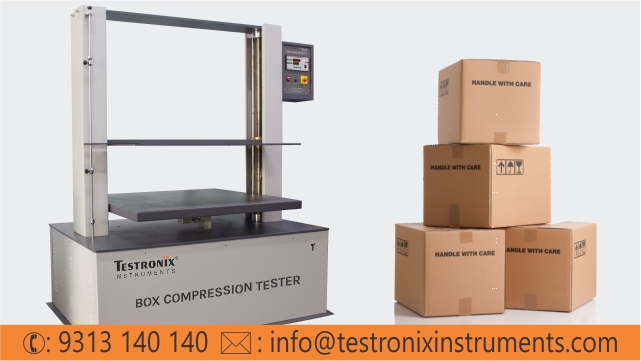
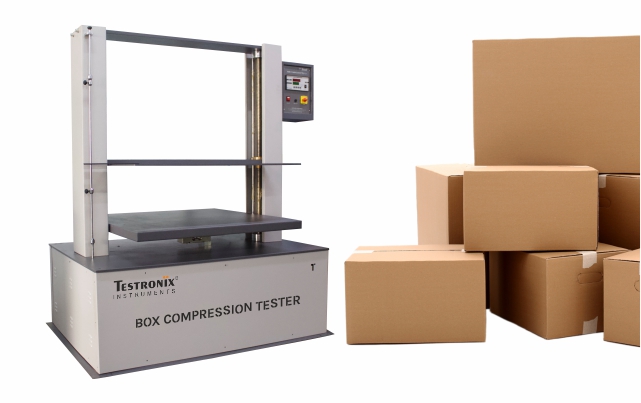
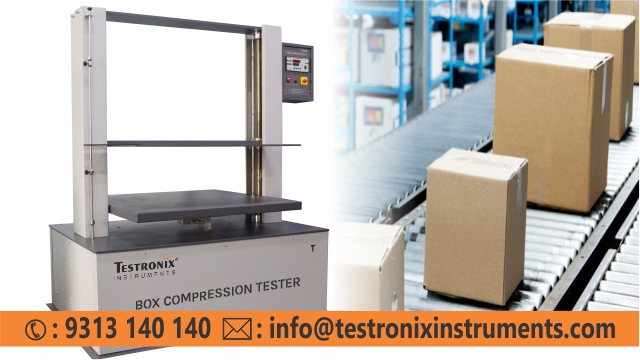
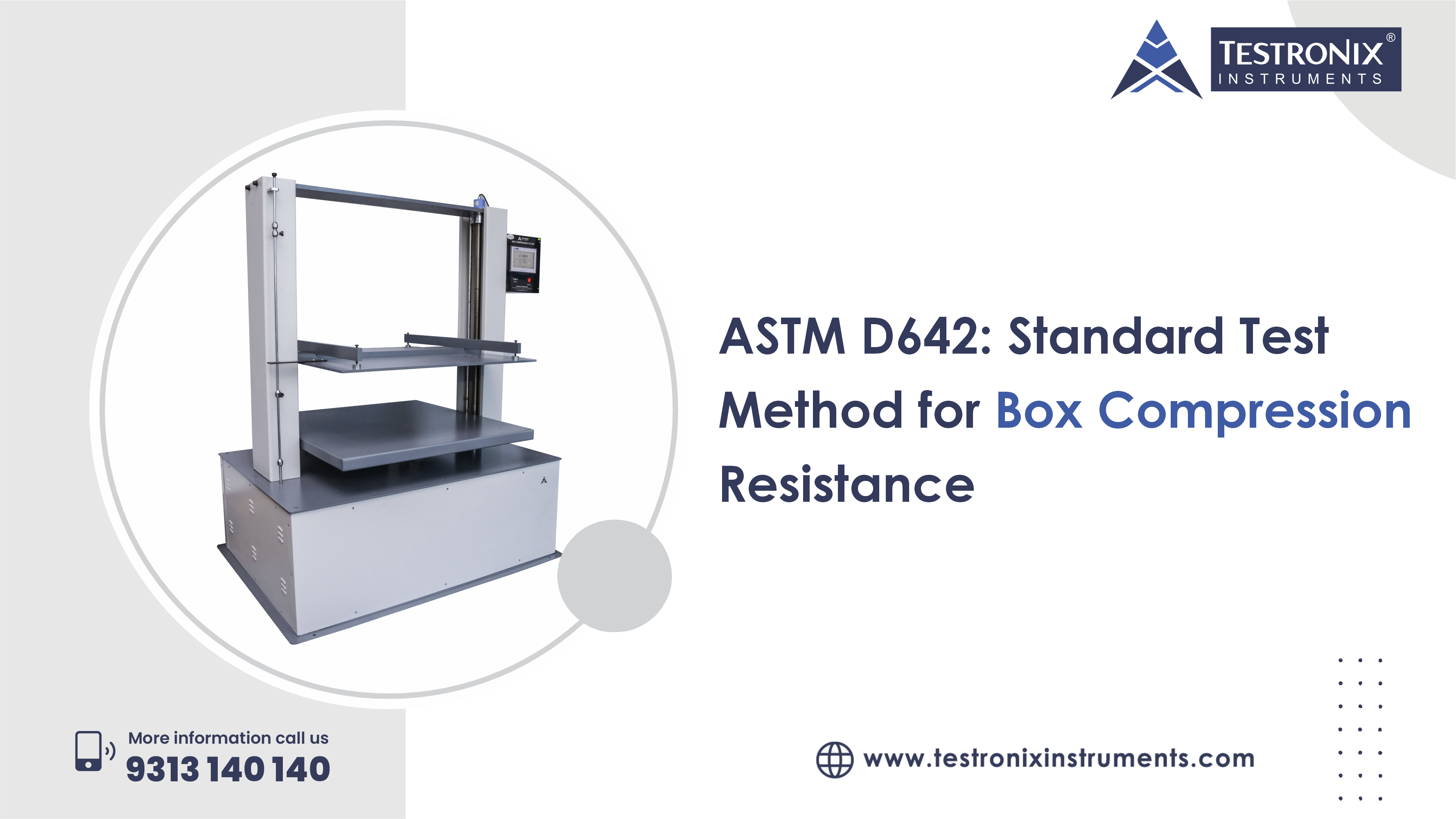
Testronix Instruments builds Box Compression Testers designed around ASTM D642 requirements, which eliminates the guesswork. Their machines use precision load cells paired with digital controls, so results stay consistent test after test instead of drifting around.
The Testronix box compression tester strikes a balance between rugged build quality and an interface that doesn't require an engineering degree to operate. The platters distribute force evenly which actually matters quite a bit when you are testing oddly shaped boxes or ones where the weight inside isn't distributed evenly. You can adjust platen speed, deformation thresholds and data logging frequency using the control software without having to delve into some clunky manual first. If any lab is performing these tests routinely, day in and day out, then that consistency is no longer a luxury but a necessity, and it's the reason these tests exist!
Testronix also backs this up with calibration support and documentation that lines up with ASTM D642 specs, which comes in handy when an auditor or client wants proof your testing process holds up. For anyone in food packaging, pharma, electronics, or logistics, having a machine that's already validated against a recognized standard cuts down a lot of back and forth during audits.
Conclusion
While box compression testing may not be the most glamorous aspect of packaging, it is a highly practical measure for preventing shipment damage and ensuring customer satisfaction. ASTM D642 gives you a dependable way to measure exactly how much stacking load a box can survive before it fails, and that number ends up saving money in ways that are easy to overlook until you're not losing it anymore.
If you are in the market for equipment that actually holds up to this standard, Testronix Instruments makes Box Compression Testers built for exactly this kind of work. Get in touch with us today to talk through your testing needs and find equipment that fits what you're actually trying to solve.