Products, whether they are a needle, paper, or a vehicle, are tested thoroughly for various characteristics. It is done to ensure they can safely survive the intended stress in the environment. Stress testing is one of the major procedures to uncover hidden flaws, find breaking points, and avoid dangerous failure.
But what is stress testing actually, and what is its purpose? This article gives you a comprehensive guide on stress tests, how to perform stress testing, and what the applications are across various industries.
What Is Stress Testing?
Stress testing is the process of applying extreme force, heat, or environmental pressure to a sample until it deforms or breaks. Stress testing is used to locate exact structural limits and identify hidden weaknesses before a product hits full market distribution.
Put simply, you load a test piece way past its normal rating. You have to find the exact point where a part permanently warps or snaps. Stress is the internal pushback a material gives against an outside force, calculated by dividing load by cross-sectional area. Strain is just the physical stretch or squish caused by that load.
Running controlled strain tests gives you critical numbers. Yield strength marks the exact moment permanent damage starts. Ultimate tensile strength tells you the absolute maximum load the part takes before thinning out and snapping. Without these exact values, design teams guess their safety margins. That leads directly to structural collapses, costly recalls, and steep warranty claims down the road.
Related: What is Yield Strength?
What is the Purpose of Stress Testing for Materials?
The main purpose of stress testing is to identify weaknesses, assess the robustness of the products, test the safety performance of the products and encourage the use of materials that are suitable to the conditions of the environment. It provides quality control teams with empirical evidence that raw materials meet design specifications. It gives quality control teams empirical evidence that raw materials meet design specifications.
Here is why manufacturing plants run these evaluations:
-
Pinpoint the exact force required to permanently bend or break a sample.
-
Prove that lower-cost resin or alloy substitutes hold up under real load.
-
Document compliance for international quality codes and customer specifications.
-
Trace exact failure mechanisms so design engineers can fix weak points.
-
Eliminate weak production batches before they leave the factory floor.
Methods of Stress Testing in Manufacturing
Depending on how the product will be used, manufacturers will adopt different methods of physical testing. Each method will measure a unique response to the physical action: tension, compression, torsion, or bending forces.
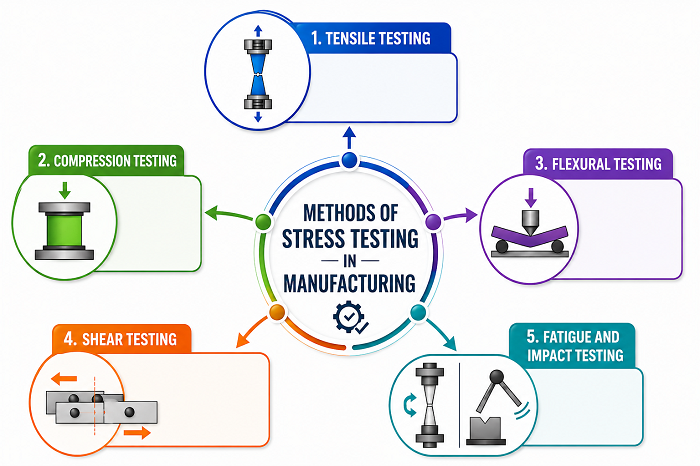 How you set up your test will depend on the application. A plastic bottle will need to undergo compression tests while a steel bolt needs testing pertaining to tension and torsion.
Tensile Testing
Tensile testing grips a specimen at both ends and pulls it straight apart until it breaks. The machine exerts a constant force on the sample. The machine measures the amount of stretch in the sample before it breaks. This test gives you ultimate tensile strength, elongation percentage, and elastic modulus. It's the standard check for steel cables, plastic films, rubber gaskets, and structural rods that take constant pulling loads in service.
Compression Testing
Compression testing places a heavy downward crushing load directly onto a sample resting between two flat platens. As the crosshead drives down, it measures how much the part squashes, buckles, or collapses under vertical weight. Engineers use these numbers to determine load ratings and stack heights in warehouses. QC teams test corrugated boxes, concrete samples, rigid containers and foam blocks for compression strength so that they will not collapse in transit.
Flexural Testing
Flexural testing is a test that determines the resistance of a material to a bending force when supported at two outer points and a central load applied from the top. The top surface is compressed, and the bottom surface is extended in tension. This setup measures the flexural strength, stiffness and the break point. It is important for testing plastic boards, composite panels, ceramic tiles and steel beams which are expected to bear heavy surface loads without sagging.
Shear Testing
Shear testing evaluates material resistance against forces that slide one layer of a structure parallel past another. It measures the exact force needed to slice a joint or sample clean through. Technicians run shear tests on structural rivets, adhesive bonds, welded seams, and joint bolts. Getting accurate shear data prevents sudden joint separation in heavy machinery, aircraft skins, and structural frames.
Fatigue and Impact Testing
Fatigue testing hits a part with thousands or millions of small load cycles to simulate years of daily wear and tear. It catches micro-cracks long before they turn into sudden structural failures. Impact testing works on the opposite principle. It strikes a notched specimen with a heavy pendulum weight to see how much energy the material absorbs when it is hit suddenly. This measure covers bump caps, vehicle bumpers and protective clothing.
Stress Testing vs Load Testing: What is the Difference?
Stress testing pushes a component beyond its design limits until it breaks; load testing ensures it operates safely within its normal operating limits. Both methods measure physical capacity, but the aims and the forces are completely different.
|
Feature |
Stress Testing |
Load Testing |
|
Primary Objective |
Find fracture limits, ultimate strength, and catastrophic failure points |
Verify safe operation and structural stability within expected working limits |
|
Force Applied |
Exceeds normal limits; pushed continuously until the material warps or snaps |
Kept strictly within or at maximum standard working capacity |
|
Result on Sample |
Destructive test; usually results in permanent deformation or physical breakdown |
Non-destructive test; sample returns to original state without damage |
|
Main Data Gathered |
Yield strength, ultimate tensile strength, elastic limit, elongation rate |
Deflection rates, stability under static weight, deformation under normal load |
|
Core Focus |
Uncovering hidden structural weaknesses and setting safety margins |
Confirming day-to-day compliance with product engineering specifications |
Applications of Stress Testing
Stress testing is used across packaging, automotive, plastics, aerospace, and construction sectors. Any product subject to weight or rough handling requires rigorous physical assessment.
-
In packaging plants, corrugated boxes are subjected to heavy stacking weight within shipping containers. Compression tests tell us exactly how many loaded cartons a bottom box can carry before buckling of the side walls occurs.
-
Automotive plants run tests on metal brackets, rubber hoses, and dashboard clips to withstand engine vibration, heat changes, and road shock. Tensile and fatigue checks keep critical parts working reliably over long mileage.
-
Plastics manufacturers run batch checks on incoming resin. Small shifts in chemical mix make lids too brittle or container walls too soft for practical use.
-
Aerospace industry uses physical load data heavily. Aircraft parts are required to be as strong as possible and as light as possible. So technicians push titanium alloys and carbon composites to their absolute limits.
Testronix UTM Machine: Best Instrument for Stress Testing
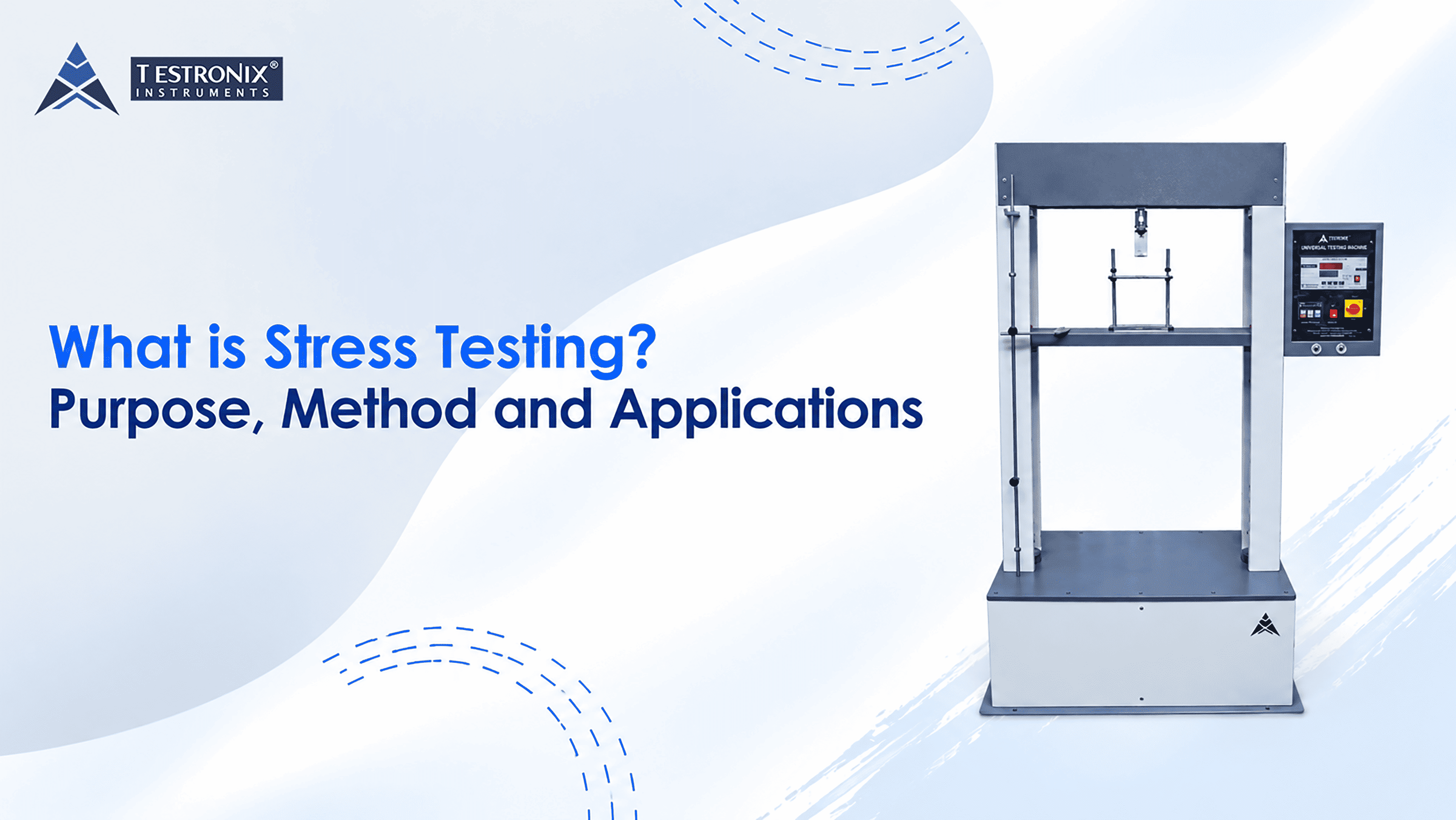
Getting reliable physical data requires an advanced universal testing machine with precise load sensors and a rigid frame setup. The Testronix UTM Machine stands out as a dependable machine for running tensile, compression, and flexural checks in modern QA labs.
The instrument is digitally controlled and uses high-precision load cells to provide real-time load vs. elongation curves. The frame holds the samples tightly without slipping. This is to prevent distorted readings. The operator sets test speed, load limits and crosshead travel distance via a simple interface.
The Testronix UTM Machine is built for rugged industrial applications and can test everything from thin, flexible films to structural metals and dense polymers. Peak load, tensile strength and percentage elongation are calculated automatically by software, eliminating manual math errors. With this level of precision in measurement, production facilities can ensure that the quality standards are the same for every single production run.
Conclusion
Knowing how a material behaves under extreme mechanical force is critical to the design of safe, long-lasting products. Stress testing gives obvious empirical data about physical limits and allows engineers to fix design flaws long before the start of mass production. Manufacturers have tight control over quality assurance with dedicated equipment like the Testronix UTM Machine that keeps defective materials off the market and protects their brand’s image.