Testing materials without a standardized baseline leads to inaccurate results and failed product designs. We are looking at ASTM standards for universal testing machines because they keep quality control consistent across manufacturers. This article breaks down the exact standards you need to know and how to apply them.
When different labs test the exact same plastic or metal piece and get completely different results, production lines stall. It is a massive headache for quality control teams. You cannot just pull a piece of plastic and stretch it until it breaks and call it a day. Without a set speed, specific temperature, and precise grip alignment, your numbers mean absolutely nothing to the rest of the industry.
Standardizing these tests is where ASTM International steps in. They establish the rules of engagement for testing physical properties. In this guide, we will list the core standards for universal testing machines, explain the three most critical ones, and see how to stay compliant.
What is UTM Testing?
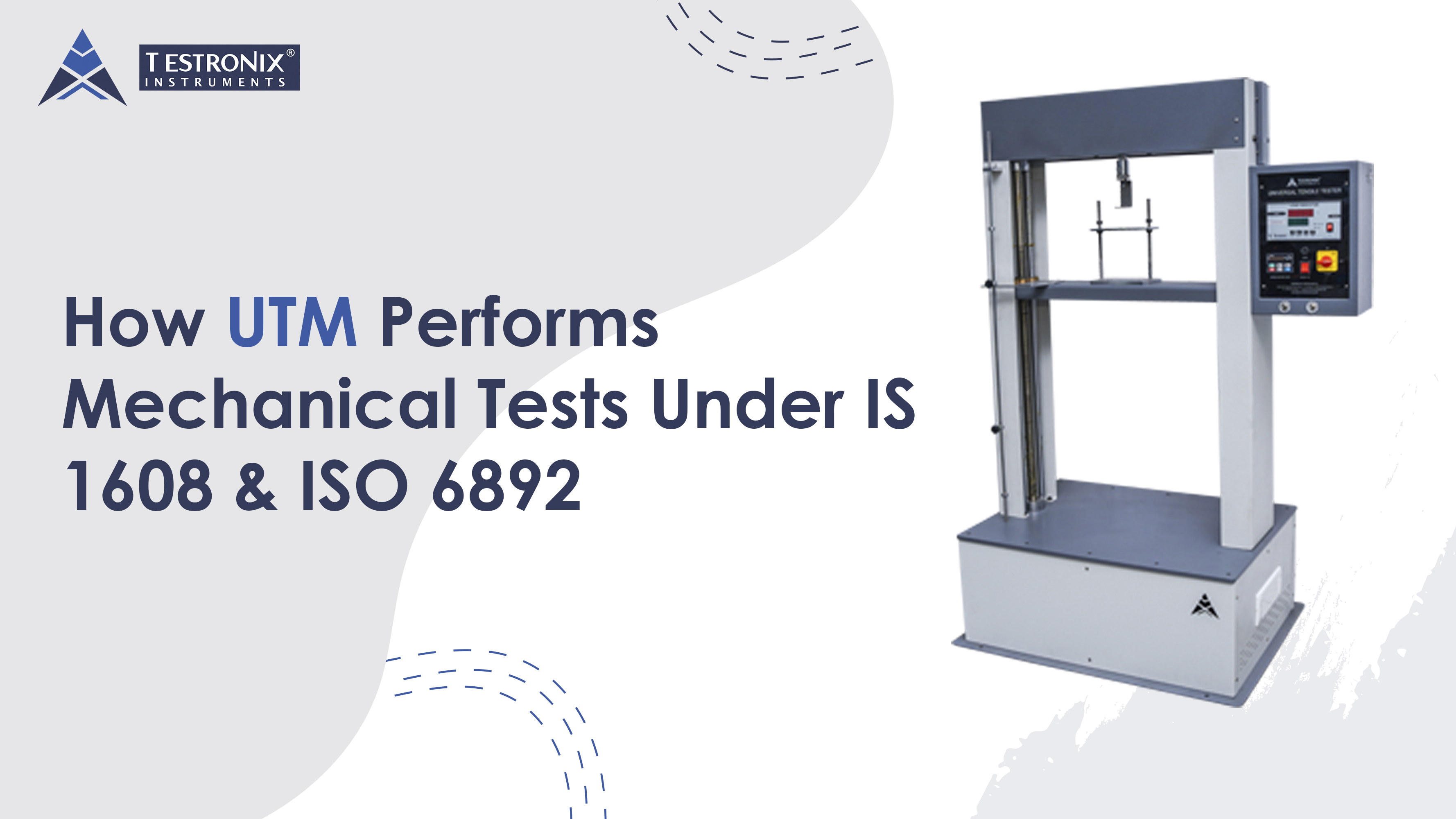
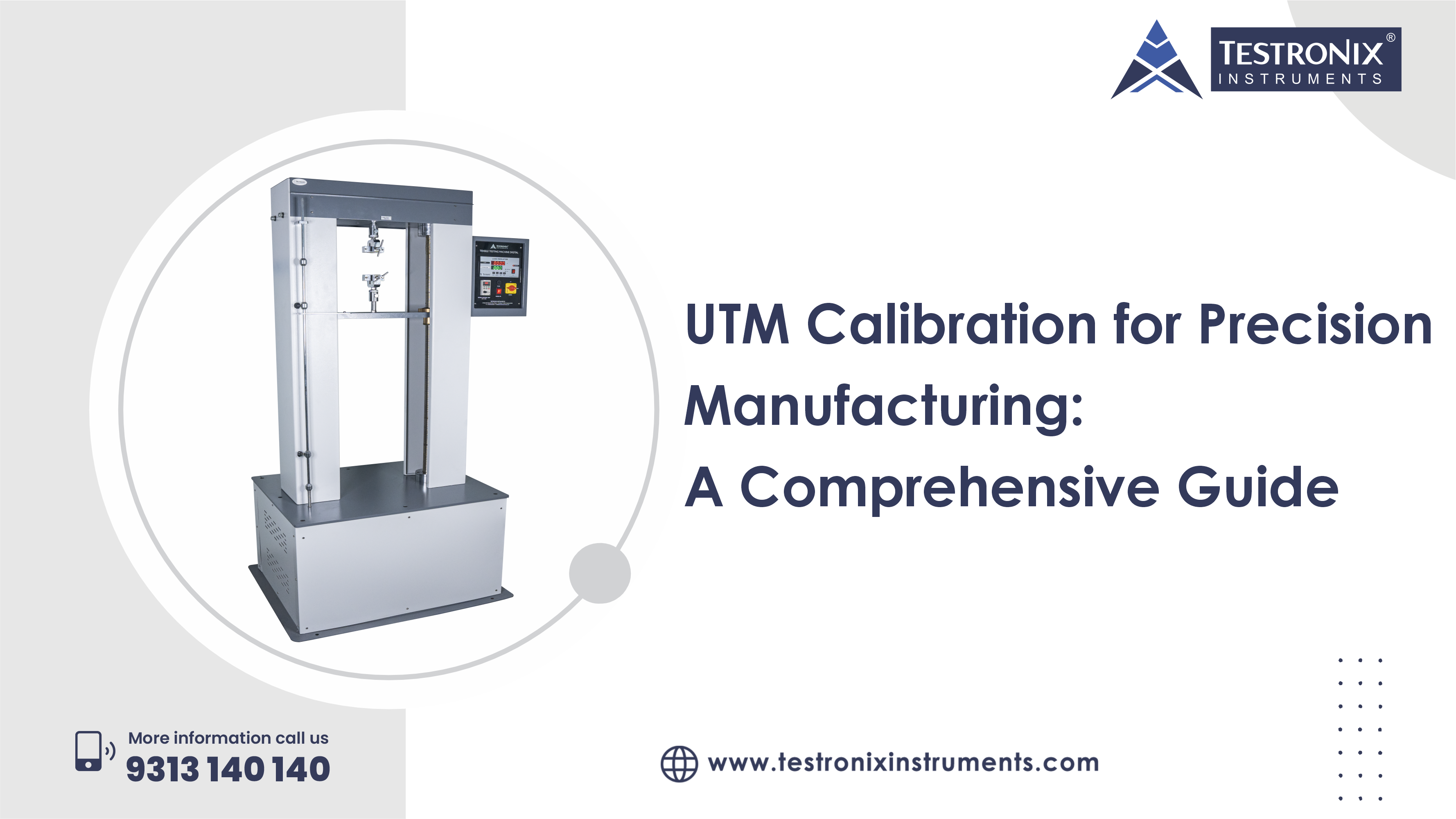
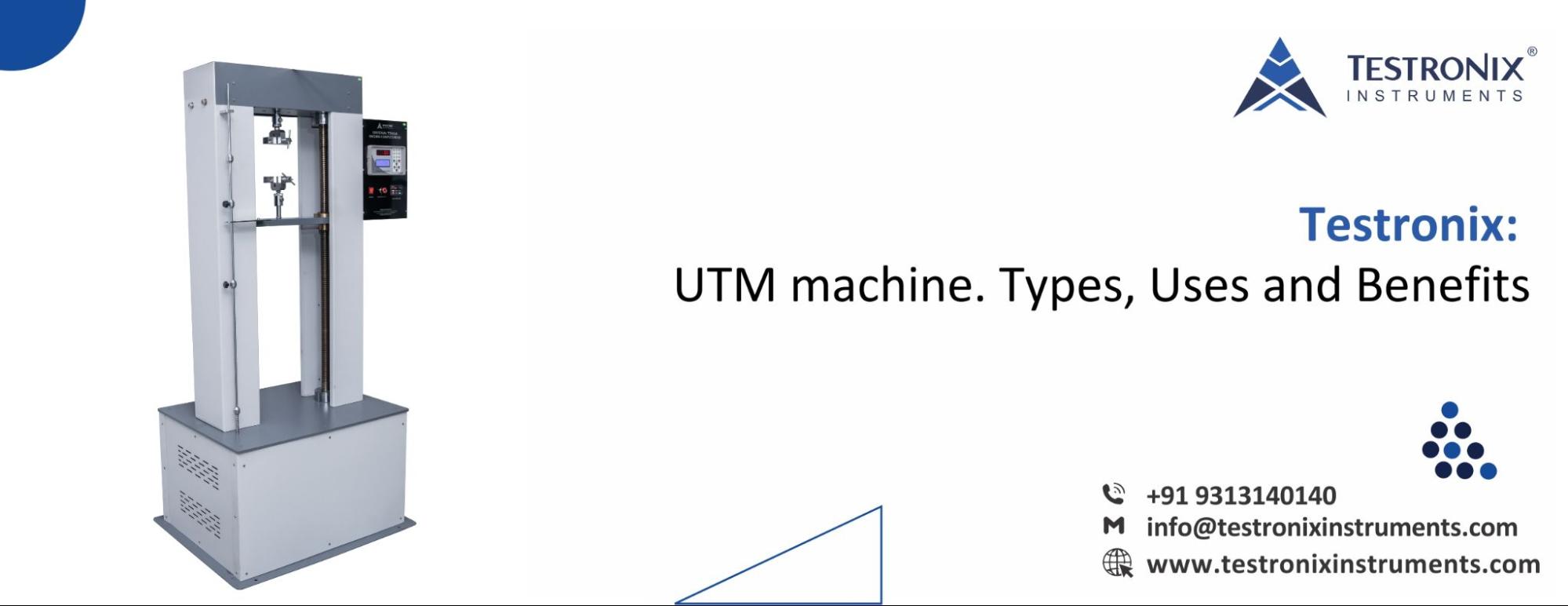
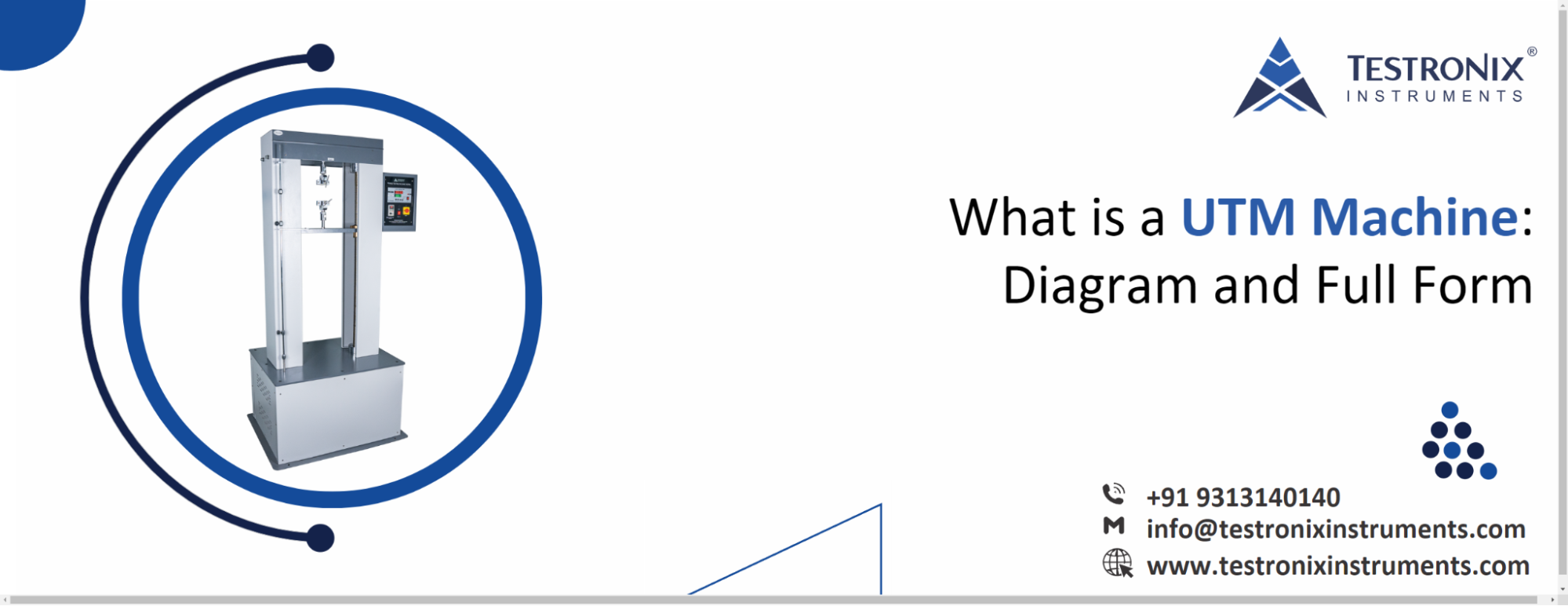
UTM testing is a method to measure tension, compression, bending, shearing, physical breaking limits and other mechanical properties of a material. It uses a single machine to perform multiple types of stress tests on plastics, metals, textiles, and rubber.
The abbreviation UTM stands for Universal Testing Machine. The word "universal" means the single machine can do different tests just by switching out the grips and accessories. One day, you are pulling a steel bar apart to check its tensile strength. The next day, you might be crushing a cardboard box to see when it collapses.
The way the machine operates is by exerting a certain pressure on an item. The forces are sensed by load cells, and the amount of stretching of the item is monitored by extensometers. By using this information, it is possible to assess the amount of weight that the product can carry before breaking down in an actual setting.
List of ASTM Standards for UTM Machine
The ASTM specifications for UTM machines provide strict guidelines for testing specific materials, such as metals, plastics, and rubbers. The set of standards guarantees that your testing rates, forms of samples, and calculations correspond to world industry norms.
Different materials behave differently under stress. Rubber stretches incredibly far before snapping while concrete fails with almost zero warning. Because of this, you cannot use the same testing speed or sample shape for everything. The ASTM library has separate guidelines for every material class.
Using the wrong standard can ruin your reputation. If you certify a product using the wrong speed, your data is useless. Let us look at the main ASTM standards used with UTM machines.
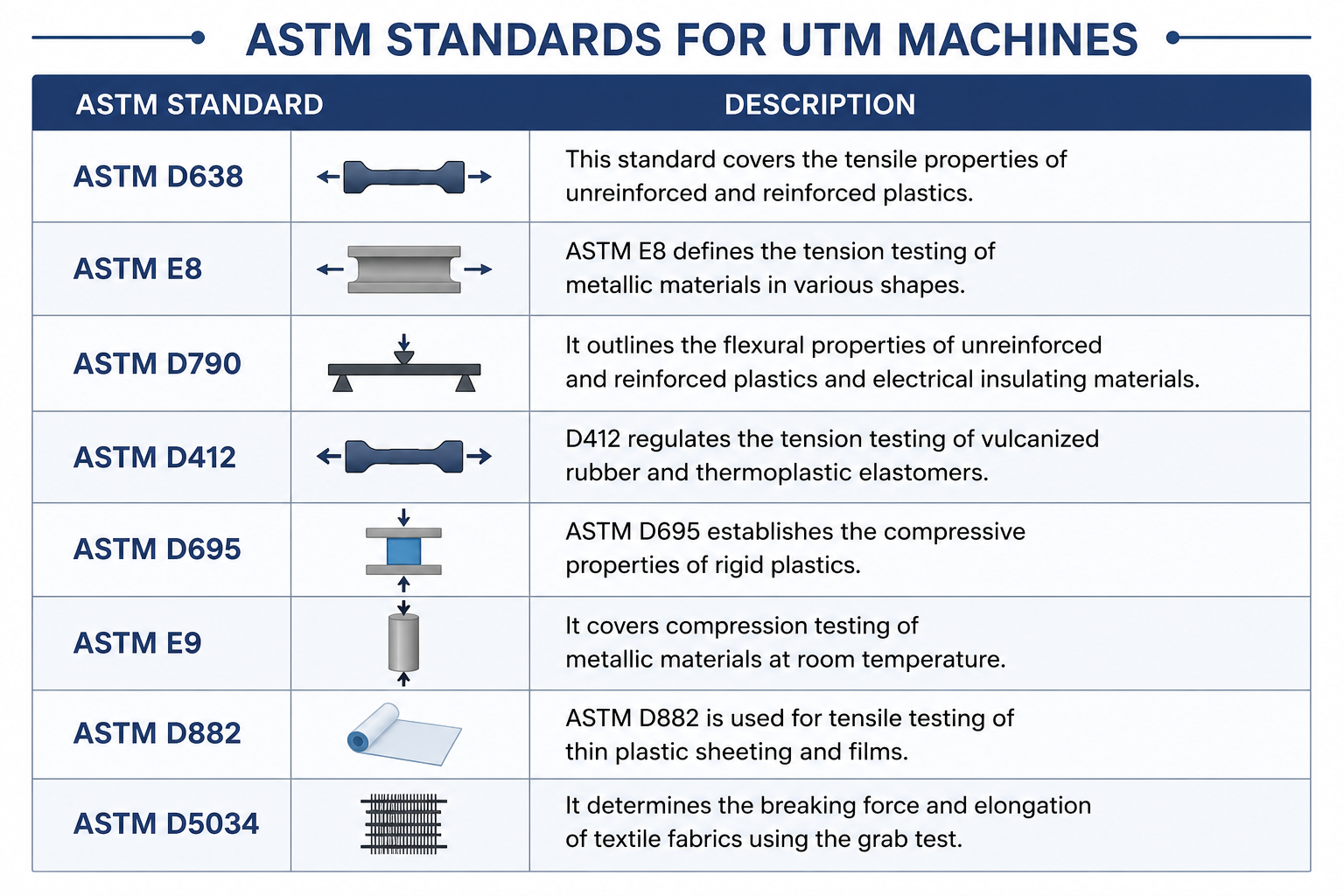
Here is the list of ASTM standards for UTM machines:
|
ASTM Standard |
Description |
|
ASTM D638 |
This standard covers the tensile properties of unreinforced and reinforced plastics. |
|
ASTM E8 |
ASTM E8 defines the tension testing of metallic materials in various shapes. |
|
ASTM D790 |
It outlines the flexural properties of unreinforced and reinforced plastics and electrical insulating materials. |
|
ASTM D412 |
D412 regulates the tension testing of vulcanized rubber and thermoplastic elastomers. |
|
ASTM D695 |
ASTM D695 establishes the compressive properties of rigid plastics. |
|
ASTM E9 |
It covers compression testing of metallic materials at room temperature. |
|
ASTM D882 |
ASTM D882 is used for tensile testing of thin plastic sheeting and films. |
|
ASTM D5034 |
It determines the breaking force and elongation of textile fabrics using the grab test. |
ASTM D638: Tensile Properties of Plastics
ASTM D638 is the go-to standard for measuring how much tension a plastic specimen can handle before it snaps. It outlines the shape of the dumbbell test bar and the specific speed at which the UTM should pull it.
If you are in the plastic and polymer industry, ASTM D638 should be followed regularly to analyze the tensile properties of plastics. It requires cutting your plastic into a specific dog-bone shape. The shape is designed to make sure the specimen breaks in the middle rather than at the grips.
This part matters because plastics are highly sensitive to speed and temperature. In case you stretch the plastic sample too quickly, it will act as a rigid material and break off too soon. Pulling it too slowly, however, might cause it to stretch infinitely. The ASTM D638 standard gives the exact rates at which the tests must run, from 5 to 500 mm per minute, depending on the type of plastic material being used.
ASTM E8: Tension Testing of Metals
The ASTM E8 standard specifies the tension tests for metals in any shape or form, be it sheets, plates, wires or pipes. It also covers the procedure of testing metals for the yield strength, tensile strength, and elongation of the given material.
Metals require massive forces to deform compared to plastics. This test determines when a metal transitions from elastic deformation, where it can spring back to its original shape, to plastic deformation, and where the damage is permanent.
Using this standard requires heavy-duty grips that will not slip under thousands of pounds of force. The alignment must be perfect. If the specimen is even slightly crooked, the UTM will apply bending forces that ruin the tensile calculations.
ASTM D790: Flexural Properties of Plastics
ASTM D790 measures the bending strength of plastics using a 3-point loading system. It tells you how much force a material can withstand when supported at two ends and loaded in the center.
Many products do not face pure pulling or pushing forces in real-world use. They bend. Think of a plastic shelf holding books or a bumper on a car. This standard uses a flat bar specimen laid across two supports. The UTM pushes down on the middle of the bar at a specified rate.
This test calculates the flexural modulus which is basically the stiffness of the material. It helps designers choose plastics that will not sag over time under a constant load.
Why choose Testronix UTM machine?
Testronix UTM ensures that your laboratory is instantly ready to perform standardized testing without tedious manual setup. Our laboratory testing machines are built to match ASTM specifications right out of the box, saving you from calibration headaches.
Buying a testing machine is a long-term investment. You do not want to spend weeks configuring software or buying extra parts just to meet basic industry rules. Testronix UTM systems come with preloaded testing profiles for ASTM D638, E8, D790, and many others.
Along with that, in these sophisticated universal testing machines, the load cells offer extremely high accuracy, and the speed control is exceptionally precise. With such accuracy, you can maintain a clear record with your customers and clients while being completely transparent about your working policy. Also, compliance with the ASTM standards helps manufacturers to get certifications and the path to becoming verified suppliers.
Conclusion
Using the right ASTM standards on a reliable UTM machine is an effective way to guarantee your materials meet safety and quality expectations. Working with a dedicated UTM manufacturer ensures your testing workflow remains accurate and compliant.
At the end of the day, testing is about building trust in your products. Whether you are manufacturing automotive parts or simple packaging films, your customers rely on your numbers.
As a leading UTM machine manufacturer, Testronix designs equipment that simplifies the entire process. We combine robust hardware with sophisticated software and an interactive display to make it easy to conduct tests and get precise results right on your display. Our expert team also provides a complete setup guide from buying a testing machine to installation and post-buying customer support.