Adhesive strength is necessary to ensure that materials and products can withstand physical forces at joints. It measures how well a material can adhere to an outside surface, especially when the materials are different. For this purpose, an adhesive strength test is performed to verify a bonded joint, coating, or tape during the development of products made up of metal, plastic, ceramic, and others.
This article will be a detailed guide on what is adhesive strength and when you actually need to perform the test on the production line. We will also discuss what different types of adhesive strength tests exist and which one is most appropriate for your industry, along with common standards to be followed.
What is an Adhesive Strength Test?
An adhesive strength test measures the force required to separate two bonded substrates. The test involves tensile, shear, or peel loading to evaluate the strength and performance of the bond. The adhesive strength test result is used to quantify bond strength and assess resistance to adhesive failure. You set up two materials joined by adhesive or tape, clamp them into a machine, and pull until something gives way.
The adhesive strength test is meant to determine whether the adhesive can withstand the forces acting on the product during regular use or will fail right away. Successful adhesive strength tests can indicate whether the adhesive failed itself or whether it detached from the surface it was applied to. From this information, manufacturers can determine whether they need to choose a stronger adhesive, change the surface preparation method, or find a cleaner surface with no contaminants such as grease or dust.
Why Adhesive Strength Test Needed?
An adhesive strength test is required to verify that bonded joints hold up under real-world physical stress. Products in automotive, packaging, electronics, and construction rely on adhesives to keep dissimilar materials securely attached during daily use.
It doesn't matter if your company produces automotive components, food packaging products, electronic items, or medical instruments. Poor quality adhesive joints will cause damage to your products, therefore generating complaints from customers and incurring costly product recalls. You run these tests to catch bad batches of adhesive or bad surface prep before goods ever leave the factory floor.
A reliable adhesive strength tester from Testronix helps you recreate the exact tugs, jerks, and continuous strains your product encounters during everyday use. When you run regular checks on your line, you pick up on small changes in temperature or adhesive thickness that ruin a batch. It saves money on raw materials, stops customer complaints before they start, and keeps your quality tight batch after batch.
Adhesive Strength Test Formula
To calculate adhesive strength, divide the maximum force applied by the total area of the bonded surface at the moment the joint breaks. This gives you a clear stress value, so you can compare different adhesives on equal terms regardless of sample size.
The formula looks like this:
Adhesive Strength (σ) = F/A
Where:
-
σ stands for the adhesive strength or stress, written in megapascals (MPa) or pounds per square inch (psi).
-
F stands for the peak force applied right when the bond snaps, measured in Newtons (N) or pounds-force (lbf).
-
A stands for the total surface area where the adhesive touches the substrate, measured in square millimeters (mm2) or square inches (in2).
Types of Adhesive Strength Test
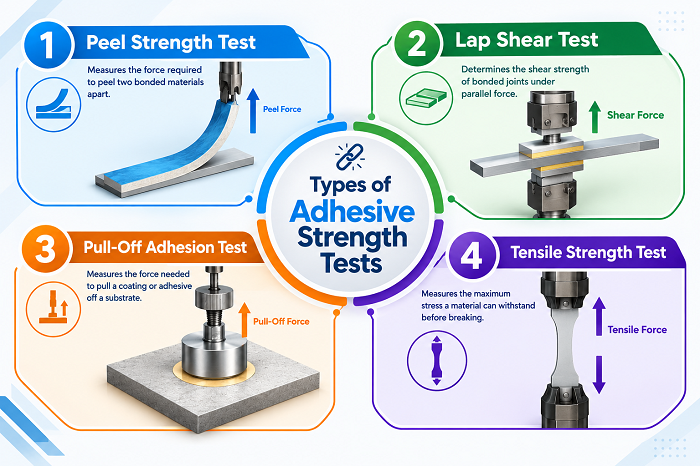
Peel Strength Test
The peel strength test measures the force required to peel a flexible material from a hard substrate or from another flexible sheet. It’s the check of choice for pressure-sensitive tapes, sticky labels, protective films and flexible food pouches. The steps to be followed for peel strength test are as follows:
-
Clamp the free end of your flexible strip into the upper grip and the rigid backing into the bottom grip.
-
Set the machine angle to pull at either 90 degrees or 180 degrees.
-
Run the crosshead at a constant rate and record the average force required to keep peeling the strip back.
Lap Shear Test
Lap shear testing is used to determine the strength of an adhesive bond when two flat surfaces are pulled in opposite directions parallel to each other. Engineers use it on metals, hard plastics and wood joints that are subject to heavy loads. The following are the steps to follow for lap shear test:
-
Overlap two stiff strips with a thin layer of adhesive right in the middle where they meet.
-
Lock the far ends of both strips into the pull jaws of the machine.
-
Pull both ends directly away from each other until the overlapping joint snaps across the adhesive line.
Pull-Off Adhesion Test
The pull-off adhesion test applies direct outward pull to see how hard it is to lift a layer of paint, varnish, or thick coating straight off a hard surface. You see this test used on painted steel beams, concrete floors, and pipeline coatings. The following are the steps to follow for pull-off adhesion test:
-
Glue a small, flat metal stud directly onto the coated surface using a fast-curing epoxy.
-
Score a clean circle through the coating around the edge of the metal stud down to the bare substrate.
-
Attach the pull-off tool to the stud and crank up the direct outward force until the coating pops off.
Tensile Strength Test
Tensile strength test measures straight-line pull strength on two rigid pieces stuck end-to-end. It gives you a clear look at how much pure tensile weight a structural adhesive can take before it breaks down the center. The following are the steps to follow for tensile strength test:
-
Apply adhesive between the flat end faces of two solid test blocks or round bars.
-
Put the assembly into self-aligning clamps so the pull stays completely straight without twisting.
-
Apply steady outward force perpendicular to the adhesive seam until the joint breaks apart.
Important Standards for Adhesion Strength Test
The adhesion strength test shall be in accordance with industry norms such as ASTM D3359, ISO 4624, ASTM D1002 and so on. Standards ensure your data is accurate, repeatable and approved by buyers and regulators across the globe.
-
ASTM D903: Standard guide to check peel or stripping strength on flexible bonded materials pulled back at a 180-degree angle.
-
ASTM D3359: The standard measures adhesion of coating films and painting to a metallic substrate using thicker films.
-
ASTM D1002: Standard procedure to evaluate shear strength on single-lap metal pieces joined with structural adhesives.
-
ISO 4624: The ISO 4624 standard is set to measure pull-off adhesion on paints, varnishes, and industrial coatings applied to solid bases.
-
ASTM D4541: Field and lab standard to check coating pull-off strength using portable testers on hard surfaces.
-
ISO 11003: Global standard specifying how to measure shear stress and strain on structural lap joints under tension.
Testronix Equipment for Adhesion Strength Tests
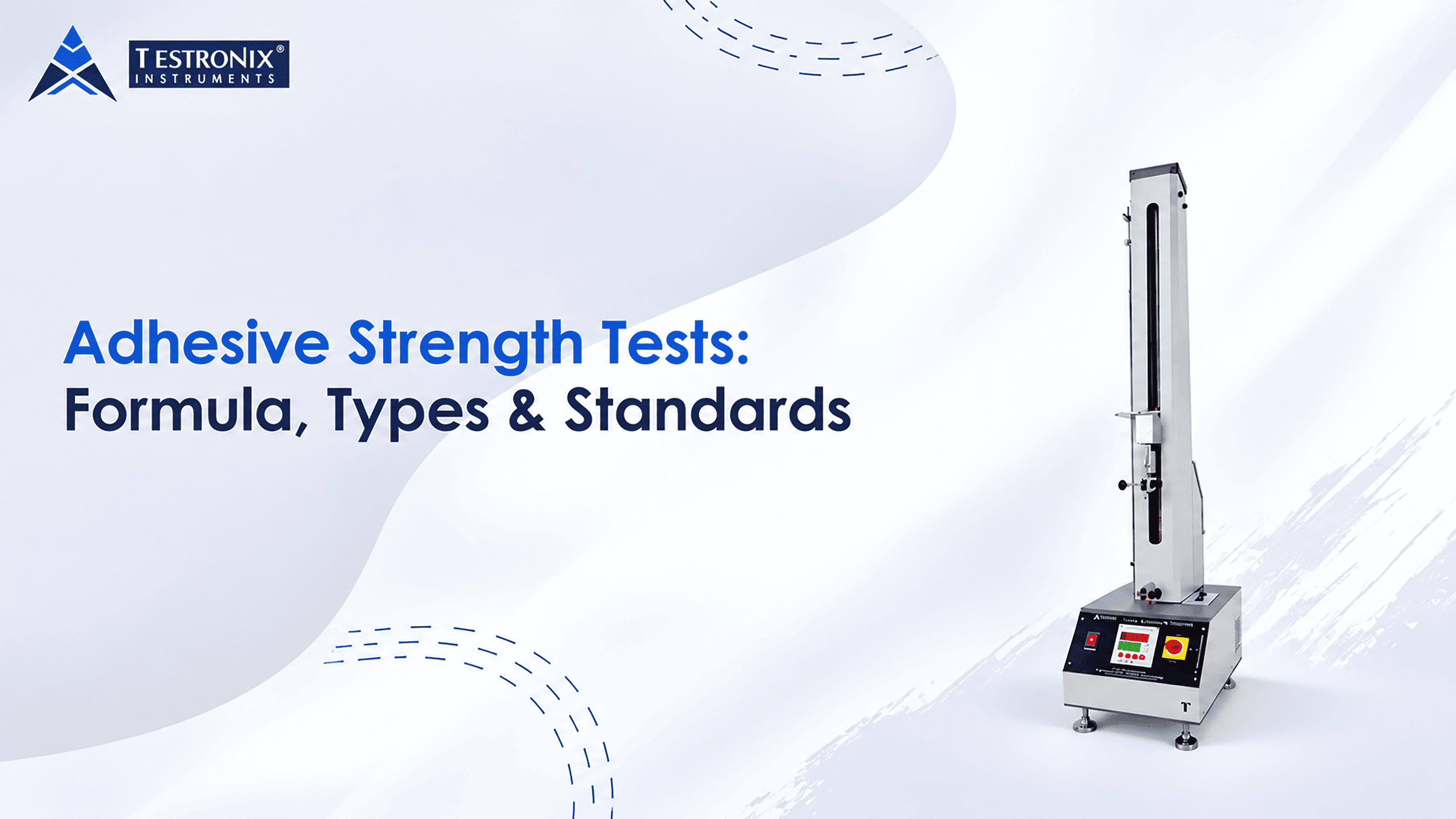
Testronix is known for manufacturing robust testing instruments for adhesion strength tests. The Testronix adhesion strength tester tells how well bonded parts hold together under real load and controlled conditions. The following are highly accurate and efficient machines to measure adhesion strength:
Testronix Universal Testing Machine
A universal testing machine, or UTM machine, is sophisticated laboratory equipment that handles a wide mix of push and pull tests across different materials. You swap out the clamps and grips to run tensile, shear, or bend tests on your adhesive assemblies at controlled speeds.
Testronix Peel Adhesion Tester
The peel adhesion tester measures the exact force needed to strip tapes, labels, and laminates off test plates. It runs smooth, steady pulls at standard 90-degree or 180-degree angles while showing live force readings on a digital display.
Testronix Tensile Testing Machine
A tensile testing machine measures the exact breaking point when you pull materials and structural joints end-to-end. It gives precise peak force numbers and shows how much the bond stretched right before it failed.
Conclusion
Testing the bond strength helps keep the production line going. Manufacturers can easily assess the peel, shear and pull-off strength of materials whether it is to prevent bad shipments, pass safety inspections, or sell products that stick together as they should. Working with an experienced instrument manufacturer like Testronix Instruments means you have the exact tools you need for quick, repeatable checks. Contact Testronix today for the right adhesive testing gear for your factory floor.