When a product is tested or an instrument is calibrated, the result needs to be dependable. A report from a laboratory is only useful when there is confidence in the laboratory’s technical capability, equipment, procedures and people. This is where NABL accreditation becomes relevant.
In this article, we will explain what NABL means, how laboratory accreditation works, how testing and calibration are carried out under an accredited system and what steps a laboratory needs to follow to obtain accreditation.
What Is NABL?
NABL accreditation is the official recognition that a laboratory is technically competent to perform specific tests, measurements, or calibrations. It shows that a third party has evaluated the laboratory against international quality standards, such as ISO/IEC 17025.
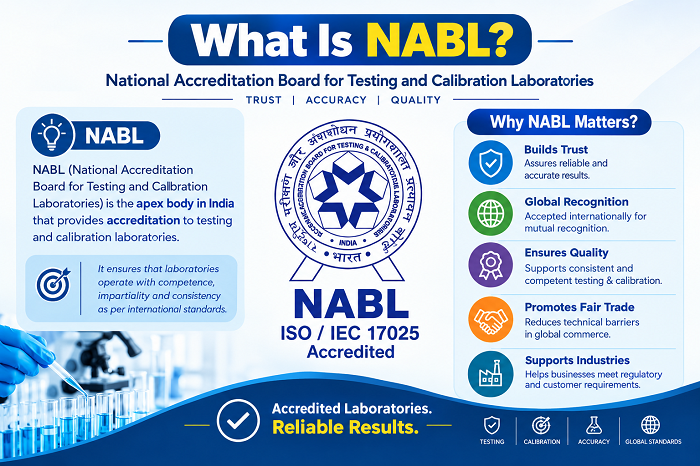 In other words, NABL operates as an accreditation body and carries out third-party assessments of laboratories against relevant international standards. NABL accreditation is not simply a certificate given to any laboratory. A laboratory has to demonstrate that it can perform specific tests or calibration activities correctly and consistently. Its facilities, equipment, staff, methods, records and quality practices are assessed as part of the accreditation process.
The accreditation is based on applicable international standards and requirements. For testing and calibration laboratories, ISO/IEC 17025 is a key standard used in the accreditation process.
When a laboratory asserts itself as being able to perform a physical property measurement or to test a material's strength or to calibrate an instrument, the accreditation process addresses the technical capability of the laboratory to do that job correctly.
Understand NABL Certification
|
Name |
Purpose |
Organization |
Uses |
|
NABL |
Accreditation of laboratories based on technical competence |
National Accreditation Board for Testing and Calibration Laboratories |
Testing, calibration and measurement activities |
|
ISO/IEC 17025 |
Requirements for testing and calibration laboratory competence |
International Organization for Standardization and IEC |
Laboratory quality and technical competence |
|
NABL Accreditation |
Formal recognition of a laboratory's competence for defined activities |
NABL under the Quality Council of India |
Reliable test reports and calibration certificates |
NABL Full Form
NABL full form is National Accreditation Board for Testing and Calibration Laboratories.
NABL operates under the Quality Council of India. The organization provides accreditation to laboratories for defined scopes of testing and calibration. This scope is important because accreditation does not automatically mean that a laboratory is approved to perform every possible test.
For example, a laboratory may have accreditation for specific tests related to paper, plastic, packaging materials, metals or other products. The exact activities depend on the laboratory's approved scope.
What is NABL Laboratory Certification?
NABL laboratory certification is commonly used to describe the recognition a laboratory receives after demonstrating compliance with the relevant accreditation requirements. Technically, NABL provides accreditation rather than a general laboratory certification.
The difference may sound small but it matters. Accreditation is a formal recognition of technical competence for specific activities. A laboratory must demonstrate that its testing or calibration work is technically valid and supported by suitable systems.
This may include the review of test methods, staff competence, equipment, environmental conditions, measurement systems and documentation for a testing laboratory. The lab must also keep adequate records for future reference and retrieval should they be needed.
A laboratory that receives accreditation gets an approved scope. The scope states the particular tests, measurements or calibration services covered by the accreditation.
This is useful for industries where test reports are used for quality control, supplier approval, product development, regulatory requirements or customer requirements.
How Testing Is Done Under NABL Accreditation
Testing under NABL accreditation follows documented methods and controlled procedures. The laboratory needs to use suitable equipment, competent personnel and appropriate test conditions so the reported result can be trusted.
The exact procedure changes depending on the product and test method. A packaging laboratory testing a corrugated box will not follow the same method as a laboratory testing a metal component. But the standard approach to working is generally this:
-
Review of test requirements: The laboratory checks the applicable standard or test method and confirms that the required testing capability is available.
-
Preparation of the sample: When necessary, conditioning, preparing and cutting of the sample is done in accordance with the relevant testing method.
-
Verification of equipment: Before being used, testing equipment is checked. The instruments are verified or calibrated at regular and appropriate intervals and maintained in good condition.
-
Conducting of the test: The trained technicians conduct the test according to the relevant documented procedure. Test conditions are controlled, as needed.
-
Recording of results: All the observations and results of the test as well as the important testing conditions are recorded either during the test itself or shortly thereafter.
-
Analysis of results: The collected data is analyzed and the results are calculated following the relevant method.
-
Report preparation: The final result is documented in a test report with relevant details about the sample and test performed.
NABL Calibration Process
NABL calibration involves checking the performance of measuring equipment against suitable measurement standards and documenting the results. The purpose is to establish confidence in the measurements produced by the instrument.
A good instrument can change its performance over time, so calibration is a routine part of the laboratory. Temperature, usage, mechanical wear and other factors may affect the measurement precision.
A typical calibration process involves the following:
-
Identify the equipment: Laboratory identifies the instrument and records the information like the model, serial number and the measurement range.
-
Choose the calibration procedure: The proper calibration procedure and reference standard are chosen for the instrument and the measurement to be performed.
-
Check on the condition of equipment: Instrument is checked prior to calibration. If there is damage or some odd occurrence visible, it might have to be fixed first.
-
Perform measurements: Equipment is tested, under controlled conditions, against appropriate reference standards.
-
Record deviations: The deviation (difference between the instrument reading and the reference value) is recorded.
-
Compare with measurement results: The results are compared with the measurement results according to the applicable calibration procedure. The uncertainty of measurements could also be considered.
-
Issue calibration documentation: The calibration results are documented in the applicable certificate or record.
-
Maintain calibration records: The laboratory keeps records so the history of the equipment can be reviewed when needed.
Calibration should not be treated as paperwork done once a year. It is part of maintaining confidence in measurement results. If an instrument gives incorrect readings, even a carefully performed test can produce an unreliable result.
How to Get NABL Certification for Your Laboratory?
To get NABL accreditation, a laboratory needs to establish the required technical and quality systems and then demonstrate its competence through the NABL assessment process. The laboratory first needs to clearly define the testing or calibration activities for which it wants accreditation. The process generally includes these steps:
Define the accreditation scope
The laboratory should identify the exact tests or calibration activities it wants to include. The scope needs to be practical and supported by available equipment, personnel and methods.
Understand the applicable requirements
The laboratory shall be familiar with ISO/IEC 17025 and relevant NABL requirements applicable to its activities. These are both technical and management system requirements.
Set up suitable laboratory facilities
The laboratory should have appropriate space, environmental conditions, equipment and supporting facilities for the proposed testing or calibration work.
Install suitable testing and measuring equipment
Equipment should be suitable for the intended measurement or test range. It should also be maintained, verified and calibrated as required.
For industrial testing laboratories, the following equipment is quite important for faster testing solutions and certification:
-
Compression Tester
-
Peel Strength Tester
-
Coefficient of Friction Tester
-
Scuff Tester
Establish documented test methods
The laboratory needs to use appropriate standard or validated test methods. Personnel should follow controlled procedures rather than relying on informal instructions.
Build staff competence
Laboratory personnel need appropriate education, training and practical competence for the work they perform. Records of training and competency evaluation are generally maintained.
Maintain calibration and equipment records
Equipment calibration, maintenance, verification and usage records should be controlled. The laboratory needs to know the status of the equipment used for testing.
Conduct internal audits
Internal audits help the laboratory identify gaps before the formal assessment. The findings need to be reviewed and corrective actions should be taken where required.
Apply to NABL
After the laboratory has established its system and prepared the required documentation, it can submit its application for accreditation along with the relevant scope and supporting information.
Undergo assessment
NABL assessors assess the laboratory as per the applicable requirements. They look at technical activities, procedures, equipment, staff competence, records and other areas.
Address nonconformities
If the assessment identifies nonconformities, the laboratory needs to investigate them and take appropriate corrective action. Evidence of the corrective actions may be reviewed as part of the accreditation process.
Receive accreditation
Once the applicable requirements are satisfactorily met, NABL accreditation is granted for the approved scope. The laboratory then needs to continue maintaining its systems and technical competence.
For manufacturers setting up or upgrading an in-house testing facility, the choice of equipment can make a real difference to the overall process. Testronix Instruments can support this requirement with world class laboratory testing solutions designed for different material and packaging applications.
Remember that the equipment alone does not provide NABL accreditation. The laboratory still needs to meet the applicable requirements and demonstrate competence. But having suitable, reliable and properly maintained testing equipment is an important part of building a capable laboratory.
Conclusion
NABL accreditation gives laboratories a structured way to demonstrate technical competence in specific testing and calibration activities. It brings attention to the complete process, from equipment and methods to trained personnel, records and measurement practices.
Companies that depend on accurate testing can rely on a well-equipped lab to help make quality decisions more consistent. It can also help to make test results more reliable when shared with customers, suppliers or other organizations.
Preparing for accreditation is more than just filling out an application. The laboratory needs adequate infrastructure, qualified staff, documented procedures, controlled equipment and a system for the maintenance of technical quality.
Testronix Instruments supports manufacturers and testing laboratories with reliable testing equipment for material, packaging and product performance evaluation. With the right test setup and good laboratory practices, organizations can build a better foundation for accurate and reliable testing under an NABL accredited system.