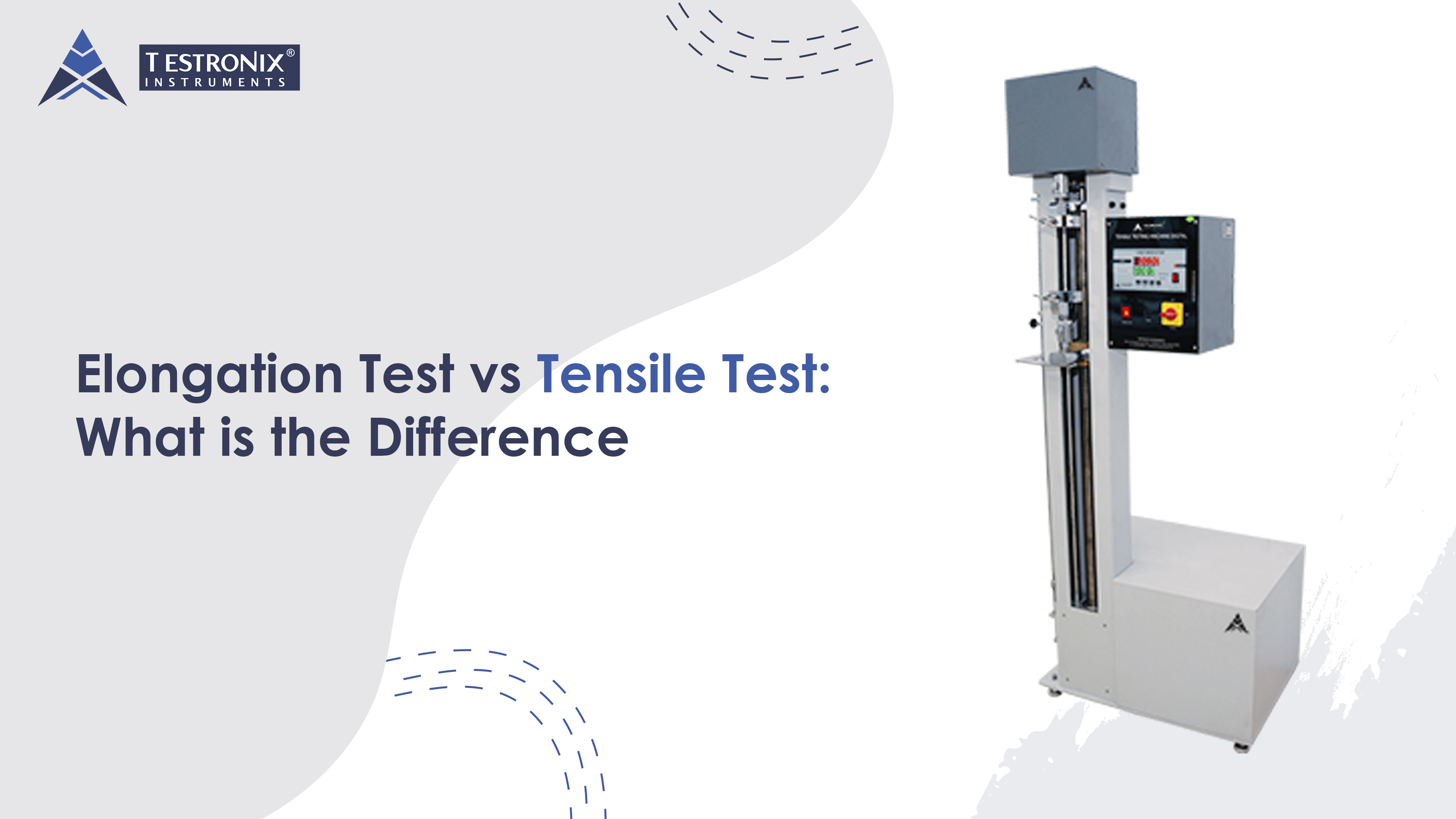
Material testing often gets confusing when terms like stretch, strength, and break start overlapping. This article breaks down the actual practical differences between an elongation test and a tensile test so you can figure out exactly which one your quality lab needs.
People on the factory floor often mix up raw load-carrying strength with how much a material can stretch. That mistake ends up causing wrong material setups or failed product batches. We will look straight at what each test measures, how you actually run them, and where they apply out in the real world.
What is Elongation Test?
An elongation test measures how much a material can stretch before it finally snaps or breaks apart completely. It focuses entirely on the ductility and flexibility of the specimen rather than the maximum force the material can withstand.
Think of it as finding the breaking point of a rubber band. When you pull a sample, it stretches permanently until it tears. This test figures out that exact stretch as a percentage of the original starting length. It shows whether your material is brittle or highly flexible. Quality teams need to know if things like plastic wraps or rubber seals can bend during real use without cracking apart.
Elongation Test Procedure
You mark a set distance on your sample and pull it until it breaks to see how much longer it is. It takes careful handling to get a true percentage.
-
First, cut your material sample to the correct length. You will usually shape it into a basic strip or a standard dogbone shape depending on whether it is plastic or metal.
-
Next, take a marker and make two small dots on the sample. The space between these dots is your initial gauge length, which is your baseline number.
-
Now, clamp the sample into the machine grips. Line it up perfectly straight because any crooked pulling throws off the whole test.
-
Start the machine so it pulls the sample at a steady pace. Keep an eye on the material as it stretches out and the dots move further apart.
Stop everything right when the sample breaks. Take the broken pieces, press them back together on a flat workbench, and measure the new distance between your two marks to find the final percentage.
What is Tensile Test?
A tensile test determines the maximum pulling force a material can handle before it deforms or breaks down structurally. It gives you a complete picture of material strength, including yield point and ultimate tensile strength.
This is the standard test for structural integrity. You take a sample and stretch it until it breaks and you find out exactly when it stops bouncing back and is permanently ruined. The test maps out a full stress-strain curve. That curve shows exactly how the material acts under heavy loads, which is vital for anyone engineering shipping boxes, car parts or building materials.
Tensile Test Procedure
This setup uses a heavy-duty machine to pull a sample apart while digital sensors log the exact force applied every second. It requires solid clamping to catch the exact moment of failure.
-
Get your sample cut to the exact standard dimensions for your material type. Having the right shape stops the material from slipping out of the clamps.
-
Secure the sample tightly into the top and bottom grips of the machine. Tighten them down hard since any slipping during a heavy pull ruins the data.
-
Testronix Instruments, for example, creates industrial testing setups that allow you to program precise speeds for a smooth, steady pull.
You press the start button and the test begins. As the machine pulls the material apart, sensors measure how much force resists and how much it stretches. Watch the monitor and note the peak force just before the fracture occurs. The system software then graphs the yield strength and ultimate tensile capacity.
Elongation Test vs Tensile Test: The Difference
The main difference is that elongation checks stretching capability while tensile testing calculates load-bearing power. They measure completely different mechanical properties even though the machines look similar.
To understand the difference between elongation test and tensile test clearly, you can see the below table for detailed analysis. Even if you use the same universal tester for both, the numbers you collect serve totally different engineering purposes.
|
Aspect |
Elongation Test |
Tensile Test |
|
Primary Metric |
Percentage of length increase |
Maximum force or stress capacity |
|
Material Property |
Ductility and flexibility |
Structural strength and rigidity |
|
Unit of Measurement |
Percentage (%) |
Newtons (N) or Pascals (Pa) |
|
Key Outcome |
Shows how much material deforms |
Shows when the material fails under load |
|
Typical Samples |
Rubber, elastomers, thin films |
Metals, hard plastics, structural components |
When to Use Elongation and Tensile Tests?
You need an elongation test if you want to know whether a product can bend or change shape without ripping during production. If you want to know if a part will take a mighty pull or carry a heavy load safely, go for a tensile test.
You make plastic packaging, stretch wrap or rubber gaskets, for example. You care about elongation here because you need the plastic to stretch out when stuffed rather than splitting open. But if you make thick plastic bottles, steel wires, or corrugated shipping boxes, tensile strength comes first. You must prove those items will not buckle or tear when stacked high in a warehouse. Many labs just look at both values together to get a complete profile of the material.
Conclusion
Knowing the boundary between stretch capacity and pure load resistance keeps your factory quality control accurate. Picking the right test method cuts down on product failures and saves a lot of wasted material costs. That’s why, today in this article, we have discussed elongation test vs tensile test and guided you on how to choose the right one.
Getting reliable data depends on using high-precision machinery that gives the same results every time. If you need a dependable partner for your lab setup, Testronix Instruments is a prominent tensile tester manufacturer and supplier in India, building tough testing machines meant for real-world factory environments. The right machine choice means your warehouse shipments comply with international quality standards each time.