In the manufacturing industry, the selection of materials is the most important matter. When manufacturers select the wrong material for a structural component, it may lead to sudden deformation under normal operational loads. This is where yield strength comes into play and ensures material should not fail under gradual loading.
This article breaks down the practical concept of yield strength, explains its mathematical calculation, details its role in factory production and reviews real-world material benchmarks.
Many people look only at the breaking point of a material but that is a major mistake because a stretched-out, bent bracket or beam is already useless long before it snaps. Knowing this exact limit helps factory teams check their raw materials and prevent terrible accidents later on.
What is Yield Strength
Yield strength is the maximum amount of stress a material can withstand before it begins to deform permanently. It marks the precise boundary line where elastic behavior ends and plastic deformation officially starts during mechanical loading.
Examples of the yield strength of materials can be seen in our daily lives. One good example of this is bending a metal paperclip. If you bend it just a little, it goes right back to its original shape. Such a behavior of materials is called elastic behavior. But if you push a little harder, the metal will eventually bend permanently. This is because the metal is now pressed beyond its yield point limit.
When manufacturers test the materials, they primarily look for yield strength and if any component goes beyond this limit, it is almost certain that it will fail in real-world conditions. Also, when a material crosses the limit, it will never return to its original shape irrespective of the force exerted.
Yield Strength Formula
The yield strength formula calculates the internal stress required to cause permanent plastic deformation by dividing the applied force at the yield point by the original cross-sectional area of the material sample.
σy= Fy/A0
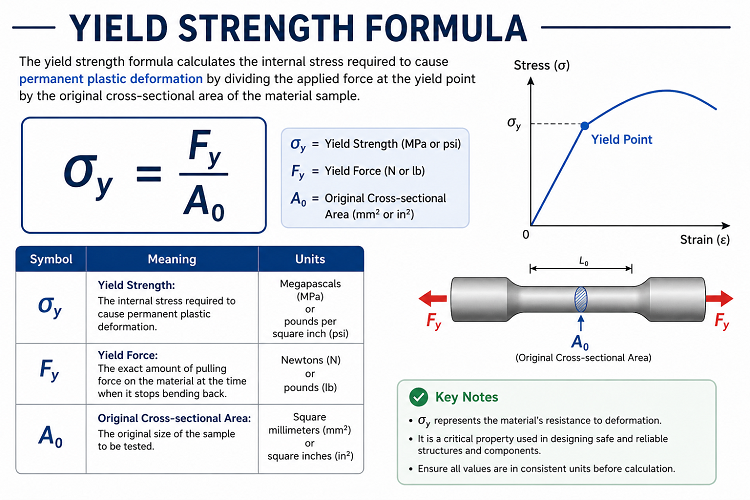
Here is what these symbols mean when you use them:
-
σy (Yield Strength): This is the final value of yield strength and it is generally measured in Megapascals (MPa) or pounds per square inch (psi) depending on which measurement unit is used.
-
Fy (Yield Force): Yield force is the exact amount of pulling force on the material at the time when it stops bending back. This value is measured in Newtons or in pounds.
-
A0 (Original Cross-sectional Area): This is the original size of the sample to be tested and measured in square millimeters or square inches. CSA is the actual value which changes over the exerted force.
For metals like soft copper or aluminum, the change from elastic stretching to permanent bending is slow and blurry rather than a sharp jump. When this happens, engineers use a standard trick called the 0.2% offset rule. They draw a straight line next to the test curve but shift it over by a tiny fraction (0.002 strain). Wherever that new line crosses the test curve, we call it the yield point, making the measurement reliable for everyone.
Why Yield Strength is Important in Manufacturing Industry
Yield strength is the measurement of the force that tells manufacturers how much force a sheet of metal can withstand before it warps or cracks in the stamping and forming processes.
On a factory floor, this number tells you how to set up your machinery. If you are stamping out car door panels, you actually want to blow right past the yield strength on purpose. So, the metal holds its new shape. But if you are making structural bolts to hold a heavy high-pressure pipe together, you need those bolts to stay way below their yield point. If those bolts stretch even a tiny bit, the seal breaks, fluid leaks everywhere, and the whole system shuts down.
It also helps shop managers save money on tooling. Buying metal with a crazy high yield strength sounds like a safe bet, but it wears down your cutting bits and stamping dies incredibly fast. It also requires massive, expensive presses to bend the parts. Knowing the exact yield numbers lets you pick a metal that handles the job without destroying your factory equipment.
Examples of Yield Strength
The yield strength for different materials can range from very soft plastics to very strong heat-treated steel alloys. Let's examine some of the common metals and see what these numbers look like. A common form of structural steel is the A36 steel with a yield strength of approximately 250MPa. This means that each millimeter square of that steel can resist 250 Newtons of force before bending. It is so predictable that it is the preferred material for warehouse construction as well as for highway bridges.
When you move to aerospace materials like titanium or spring steel, the numbers skyrocket. Some grades of titanium can achieve strengths of over 800 MPa with ease, providing a great degree of strength for aircraft without the weight of a tonne. In the meantime, Aluminum 6061-T6 which is used in bicycle frames and smaller brackets, landed around 276 MPa. It is almost as strong as regular steel, but only a third as heavy and for that reason, it's imperative to match the right yield number to the right job.
Testronix Tensile Strength Tester to Measure Yield Strength
Testronix Tensile Strength Tester provides high-precision force measurements that allow quality control teams to accurately pinpoint the exact yield strength of raw materials on the factory floor.
You cannot run a real production line on guesswork or rely on old paperwork from a supplier. The Testronix Tensile Strength Tester solves this by gripping a sample piece tightly and pulling it at a perfectly steady speed. While it pulls, highly sensitive sensors track the resistance force, and precision tools measure the exact amount of stretch. The machine plots this live data into a curve on a screen. Quality teams can see the exact moment the metal stops stretching naturally and starts to deform, letting them spot bad metal batches before they hit the assembly line.
Conclusion
Accurately determining yield strength ensures that manufactured products can survive daily operational stress without warping, bending, or failing completely over time.
As a trusted tensile strength tester manufacturer, Testronix builds the exact kind of machinery factories need to double-check these material properties. Testing your metal takes out the guesswork. When you know the true yield strength of your incoming steel or aluminum, you can set your presses perfectly, save your factory tools from breaking, and know for a fact that your products will last. Working with an experienced manufacturer like Testronix gives your operators the right tools to keep quality high and avoid costly failures out in the real world.