Paper is exposed to different kinds of stress during handling and use. Pulling strength is one that is clearly visible and discussed, but a sheet can also fail when pressure is applied over a small area.
The bursting strength test, under TAPPI T403, checks this type of failure. It measures the pressure needed to break a paper sample and gives a useful indication of how the paper will respond under pressure. TAPPI T403 provides the standard procedure used to carry out this test and measure the result.
In this article, we will discuss what TAPPI T403 is, how it relates to the bursting strength test, its scope and testing principle, and the main steps followed during testing.
What is TAPPI T403?
TAPPI T403 is a standard test method to measure the maximum bursting strength of paper. The latest version is TAPPI/ANSI T 403 om 22 and it is specifically titled “Bursting strength of paper.” TAPPI stands for the Technical Association of the Pulp and Paper Industry.
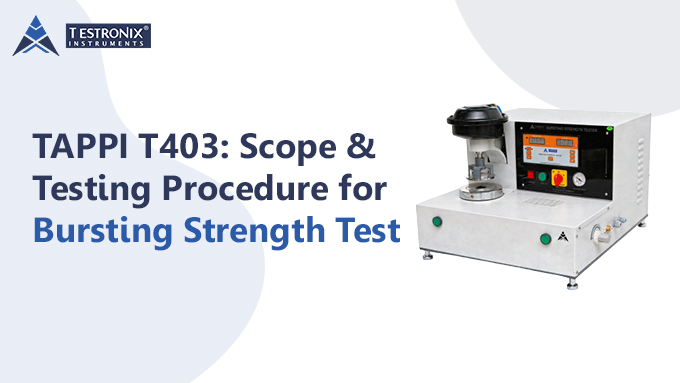
Also known as Mullen Burst Test, TAPPI T403 evaluates a material’s strength to rupture and measures how much hydrostatic pressure a paper sheet can withstand before it ruptures. When a bursting test is performed under TAPPI T403, the specimen is held firmly between two clamps and pressure is applied through a flexible rubber diaphragm. The pressure keeps increasing until the paper bursts. The highest pressure reached at the point of rupture is taken as the bursting strength.
The highest pressure reached at the time of rupture is recorded as the bursting strength. This test is commonly carried out using a Mullen-type bursting tester. The machine has a clamping system, a rubber diaphragm, a pressure system and a device for measuring the applied pressure. Each part has a job and the condition of the equipment can affect the final reading.
TAPPI T403 is mainly intended for paper in sheet form. The method covers paper with a maximum thickness of 0.6 mm and a bursting strength in the range of 50 to 1200 kPa. It can be used for different types of paper, including newsprint, printing paper, fine paper and packaging paper.
T403 is not intended for corrugated board, fiberboard, linerboard or hardboard. These materials can damage the diaphragm or behave differently during the test. Other TAPPI methods are available for such materials.
The paper sample is held around a circular test area while its center is free to move. When pressure is applied, the diaphragm pushes the center of the sheet upwards. The paper stretches and the stress increases until a rupture occurs.
That makes the bursting strength test different from a tensile strength test. The tensile test induces tension on the sample. Bursting applies pressure on a surface and causes the paper to rupture.
These outcomes could be helpful in the comparisons of different kinds of paper or in controlling the quality of the production. In the situation when a significant drop in bursting strength occurs, it can be indicative of changes in the fiber quality, paper formation, moisture or manufacturing conditions.
Another thing that can be easily overlooked is moisture. Paper reacts strongly to humidity. Testing of the paper sample in one condition may give different results from the same paper sample tested after moisture change. Proper conditioning of specimens is therefore important before testing.
The condition of the tester matters just as much. A worn diaphragm, poor clamping or problems in the hydraulic system can affect the pressure reading. So the test is not simply about placing paper in the machine and taking a number.
TAPPI T403 PDF Download
You can download TAPPI T403 PDF for detailed instructions on determining bursting strength, including the methods, specifications and calculations used in the test. The TAPPI T 403 om 22 document published in TAPPI is the latest release.
TAPPI T403 Scope & Principle
The TAPPI T403 scope is used to determine the pressure required to burst a suitable paper specimen. The test is performed on flat paper and is designed for materials within the thickness and bursting strength range covered by the method.
The principle behind the test is based on hydraulic pressure. The paper is placed between two clamping plates with a flexible rubber diaphragm underneath it. Once the sample is clamped, hydraulic pressure is applied to the diaphragm.
As the pressure rises, the diaphragm starts pushing into the paper. The paper stretches over the test area and eventually breaks. The pressure reading at that moment is the bursting strength.
The pressure has to be applied at a predetermined rate. A rapid or slow increase of the pressure may lead to changes in test conditions.
The sample must also be kept firmly held in place during the experiment. If it slips, the paper may not fail in the intended test area. Excessive clamping is not a solution either because it can damage the specimen around the clamp.
The rubber diaphragm should be checked regularly. It is the part that transfers the hydraulic pressure to the paper. If it is worn, damaged or permanently deformed, it can affect the way the sample responds during testing.
TAPPI T403 Testing Procedure
The TAPPI T403 standard entails getting the paper samples ready, verifying that the bursting tester is operational, fastening the sample in place and increasing the hydraulic pressure until the paper ruptures. The pressure value at rupture is recorded and this value corresponds to the bursting strength of the paper.
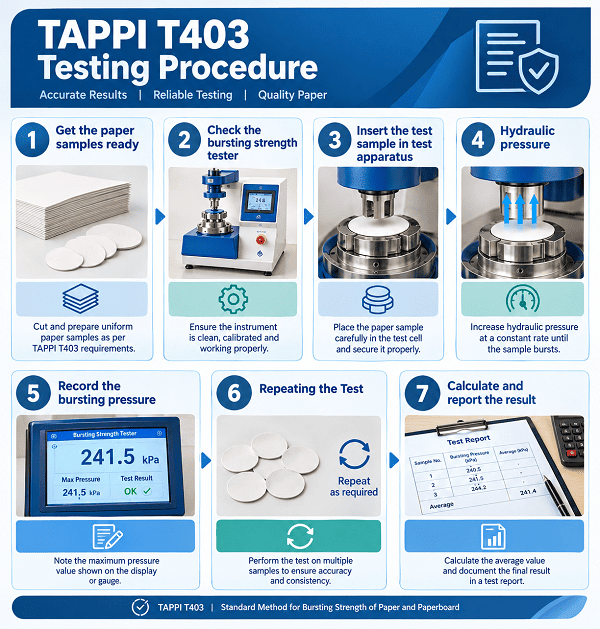 Step 1: Get the paper samples ready
Choose the most suitable portions of the paper being tested, avoiding places that are flawed or damaged. The samples must be treated according to certain conditions before testing. Conditioning of the samples is vital because moisture can greatly affect the strength of the paper.
A sample that has absorbed moisture during storage may not give the same result as a properly conditioned sample.
Step 2: Check the bursting strength tester
Inspect the tester before starting the measurements. Check the clamping surfaces, rubber diaphragm, hydraulic system and pressure measuring system. The diaphragm should be in good condition and the clamping surfaces should be clean.
The pressure system should also be free from problems that could affect the rate of pressure application. Air present in a hydraulic mechanism can hinder the motion of the diaphragm; therefore, it has to be removed before carrying out the tests.
Step 3: Insert the test sample in test apparatus
Put the paper sample in the area located between the clamping plates and make sure that the sample is aligned accurately with the diaphragm. Make sure the test sample is fixed firmly so that it does not move while the test is made, but avoid using too much pressure on the clamping apparatus. The goal is to hold the paper in place without causing any damage around the testing area.
Step 4: Hydraulic pressure
Start the tester and establish the hydraulic pressure on the diaphragm. The pressure is increased continuously at the desired rate. As soon as the diaphragm starts coming up, it will push the paper up. The paper will start to bulge in the center. Continue with the testing until rupture occurs.
Step 5: Record the bursting pressure
When the paper breaks, note the maximum pressure shown by the instrument. This reading represents the bursting strength of that specimen. Record it immediately so that individual test values do not get mixed up.
Normally, any failure should happen only in the primary testing area. If a sample unexpectedly gives a result due to an apparent testing problem, a review rather than a regular result needs to be performed.
Step 6: Repeating the Test
Repeat the test with the necessary number of samples. As per TAPPI T403, the number of tests on both sides of the paper is to be ten. The main point of conducting more than one test is that results based on only one test do not fully demonstrate the properties of the examined material.
In cases when the paper has significantly different front and back surfaces, testing on both sides can help determine whether properties of the material are affected by this factor.
Step 7: Calculate and report the result
Once the individual readings have been recorded, calculate the average bursting strength of the accepted results.
The result is generally reported in kPa or psi. Where required, the burst index can also be calculated by relating bursting strength to the grammage of the paper.
The report should contain enough information to identify the material and test conditions. Individual readings, average value and relevant variation data can be included depending on the laboratory's reporting practice.
Conclusion
The bursting strength of paper under controlled pressure conditions can be measured by the method and standard TAPPI T403. The standard outlines the procedure for quality control, material comparison and measurement of paper strength indicators with the bursting strength test.
Getting a reliable result depends on the complete testing process. Proper specimen conditioning, correct clamping, a good diaphragm and controlled pressure application all matter. Even a small problem with the tester can affect the reading.
Testronix Instruments offers bursting strength testing equipment designed for paper and packaging testing applications. If you are looking for a reliable bursting strength tester for your lab or quality control work, contact Testronix Instruments to discuss your testing requirements.