Quality problems rarely begin at the final inspection stage. In many cases, the reason is hidden earlier in the process, such as poor material selection, incorrect machine settings, inconsistent procedures, or a testing method that was not followed properly.
This is where quality assurance becomes important. It focuses on controlling how work is done to maintain the required quality from one stage to the next. In this article, we will explore the significance of quality assurance along with its principles and goals and frequently used quality assurance methods. We will also analyze the quality assurance process employed by firms and its importance in manufacturing and other fields.
What is Quality Assurance?
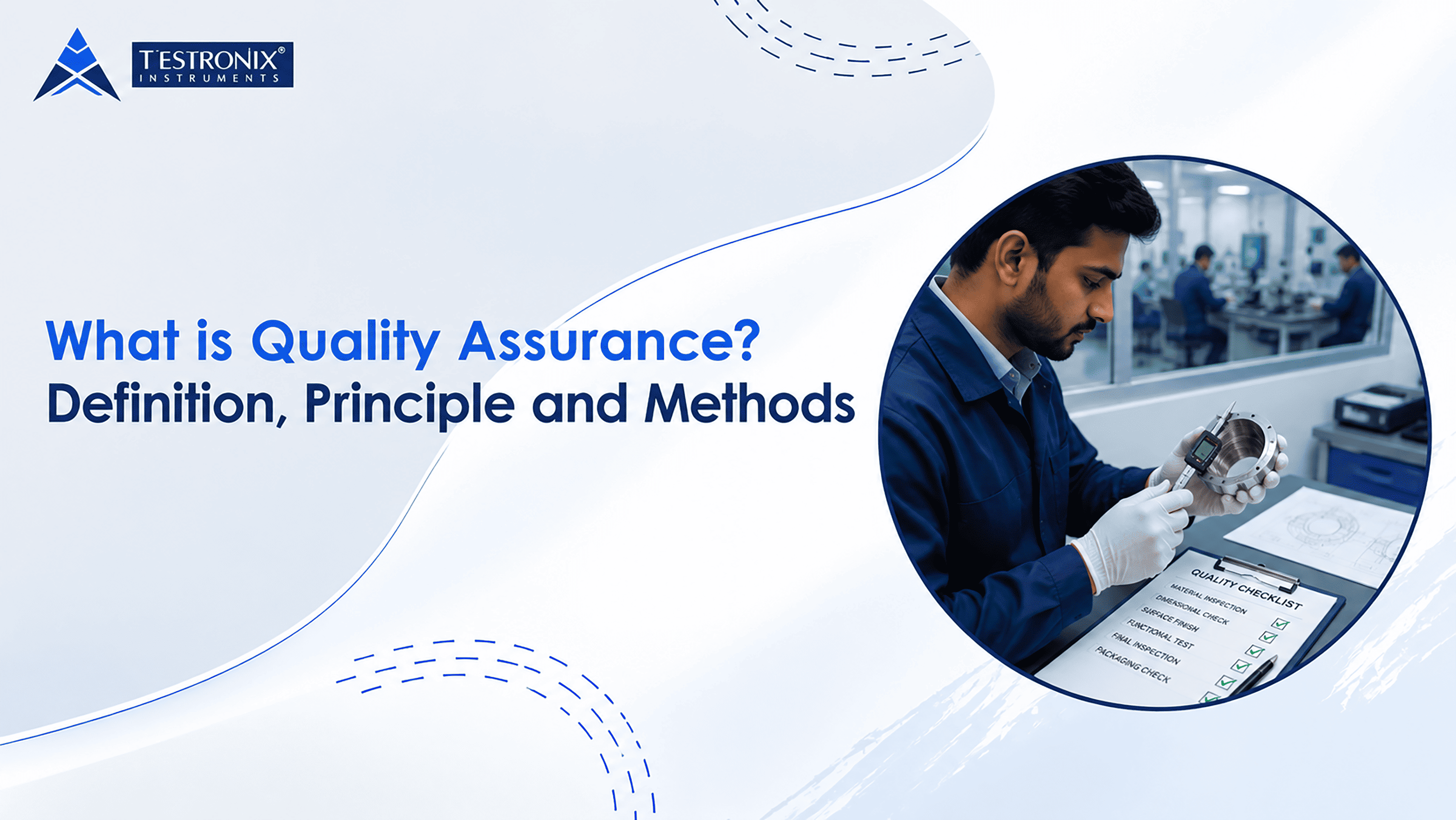
Quality assurance is a systematic approach to prevent defects and maintain the required quality of a product, service, or process. It is mainly focused on the process rather than only examining the finished product. A company sets certain procedures and quality requirements and then follows them throughout production or service delivery. Regular checks are made to see whether the process is working as expected.
Suppose a packaging manufacturer finds that the seal strength of some pouches is lower than the specified value. Testing can identify the problem. But QA goes a little deeper. The team may check sealing temperature, pressure, dwell time, material condition, machine settings, operator procedure, and calibration records to find where the process went wrong.
 Before starting the inspection process, operators must know the difference between quality assurance and quality control. Quality control is more concerned with finding defects through inspection and testing. Quality assurance looks at the system behind the work and asks whether the process is capable of producing the required result consistently.
So QA is not simply about checking more products. It is about making the overall process more dependable.
Quality Assurance Principle & Objective
The quality assurance principle is mainly based on prevention. The objective is to control the factors that can affect quality instead of dealing with the same defect again and again. A few principles form the practical foundation of this approach.
Focus on Requirements
The first step is knowing what acceptable quality actually means. Customer requirements, product specifications, safety requirements, industry standards, and regulatory conditions all need to be considered.
If the requirements are unclear at the beginning, even a well controlled production process may produce something that does not meet the actual need.
Control the Process
A finished product is affected by many steps before it reaches inspection. Materials, equipment, operators, environmental conditions, production settings, and testing methods can all have an impact.
Quality assurance therefore gives attention to these stages instead of placing all responsibility on the final inspection team.
Prevent Repeated Problems
Finding the same defect every week and simply removing the defective products is not a strong quality system.
A more effective way of approaching the issue is by coming up with the reason why it occurs repeatedly. Once the cause is known, the method can be changed. In certain situations, the solution is as straightforward as changing the settings of a machine or changing the process that is done. However, there are cases that might require maintenance of machinery, training for employees, or a change of input.
Keep Improving
A process that works today may not remain suitable forever. Production volumes change. Equipment gets replaced. Materials are updated. Customer expectations also move.
For this reason, quality systems need regular review. The objective is not to change everything constantly. It is to identify areas where a small change can prevent a bigger problem later.
Use Actual Data
There should be some evidence to support quality decisions. Information from test results, inspections, rejections, customer complaints, audits, and production measurements can all be helpful.
This is especially important in manufacturing, where a visual inspection might not show a problem in performance.
Quality assurance's overall goal is to improve the consistency of quality and the reduction of defects, waste, rework, complaints and unnecessary production losses. It also provides employees with a better idea of the steps that need to be taken and how the outcome will be verified.
Methods of Quality Assurance
There is no single QA method that works for every company. The approach depends on the product, process, industry requirements, and risks involved. Some methods are used before production starts. Others continue throughout production.
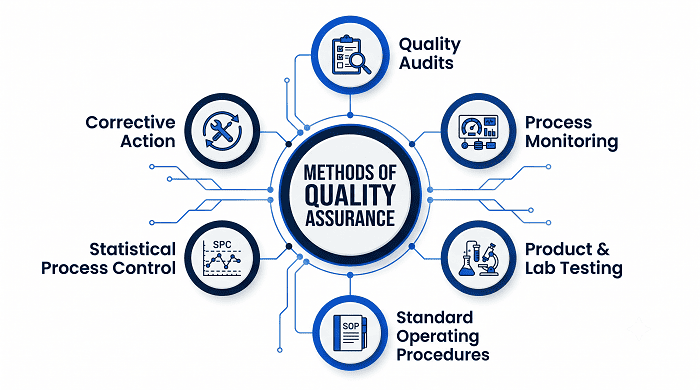 Quality Audits
A quality audit is basically a detailed review of how a process is being followed. The auditor may compare actual practices with internal procedures, quality requirements, or applicable standards. Records are also checked because paperwork can reveal problems that are not obvious during a physical inspection.
Audits can be carried out internally or by an outside organization depending on the purpose.
Process Monitoring
Production should not be checked only after everything is finished. Important process parameters can be monitored while work is taking place.
For example, a manufacturer may monitor temperature, pressure, speed, dimensions, moisture, or other conditions depending on the product. A change in one of these values may indicate that something needs attention. Catching the change early is useful because fewer products are affected.
Product and Laboratory Testing
Testing provides measurable information about the actual performance of a product or material. The test selected depends on what needs to be evaluated. Manufacturers may perform tensile strength testing, burst testing, seal strength testing, abrasion testing, leak testing, corrosion testing, compression testing, or other evaluations.
The important part is not simply having a test report. The test method needs to be suitable and the equipment needs to provide dependable results.
Standard Operating Procedures
A process becomes difficult to control when every employee follows a different method.
Standard operating procedures give workers a defined way to carry out important activities. They may cover machine operation, sampling, inspection, cleaning, testing, calibration, or handling of materials.
Good procedures should be practical. If an SOP is too complicated to follow during actual work, employees may start relying on shortcuts.
Statistical Process Control
Statistical process control, commonly called SPC, uses measurements collected during production to understand how a process is behaving.
The idea is not to calculate complicated statistics for the sake of it. Production data can show whether a process is staying within its expected range or beginning to move in an unusual direction. That early warning can give the quality team time to investigate before the problem becomes a large batch rejection.
Corrective Action
If a defect is discovered, the immediate task is not complete, but removal of the defective product must be followed by a thorough investigation. The next question is, what is causing it? Corrective action is a consideration of why the problem is occurring and a change to prevent the same problem from recurring.
If, for instance, repeated test failures can be associated with improper equipment settings, then simply discarding the failed tests is not much of a solution. The environment, process, training or equipment could be a problem.
Quality Assurance Process
The quality assurance process starts with defining what the product or service needs to achieve. Once the requirements are clear, suitable procedures, inspection points, testing methods, and responsibilities are established.
Then the process moves to ongoing monitoring. Inspections and tests provide information on actual performance. Employees follow defined procedures. The results are recorded so that they can be reviewed later.
When something does not meet the required level, the issue is investigated. The cause is identified as far as possible and a corrective action is introduced. The process is then checked again to see whether the change actually solved the problem. So, the QA process is not a single inspection at the end. It continues throughout the work.
Importance of Quality Assurance
Quality assurance matters because a defective product can cost much more than the value of the product itself. There may be rework, material loss, delayed deliveries, returns, customer complaints, or even damage to a company's reputation. A proper QA system gives businesses more control over these risks.
For manufacturers, the benefit can be seen at several stages. Raw materials can be checked before they enter production. It is possible to keep track of processes even when a manufacturing process is occurring. Once the product is completed, it is tested to check whether the product meets its specifications.
Testing becomes essential when the quality of a product cannot be determined just by examining it. A material can look normal but may be of poor strength. A package may appear as sealed successfully but can fail to pass a seal strength test. A coated surface may look acceptable while having weak resistance to corrosion.
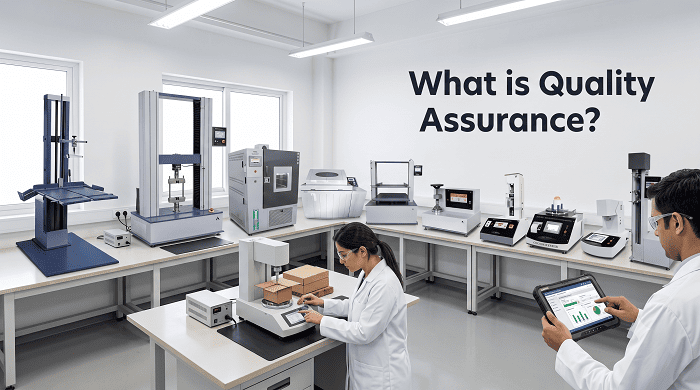
This is why laboratory testing is closely connected with quality assurance. Actual measurements give quality teams something concrete to review. Testing equipment can be effectively used to determine these properties by manufacturers and laboratories under controlled conditions. Testronix provides laboratory testing equipment suitable for different purposes. This kind of equipment is useful in performing routine tests and in maintaining quality checks of the products.
QA also becomes important when a company is working with industry standards or customer specific specifications. Documented procedures, test results, calibration records, and inspection reports can provide evidence that the required process is being followed.
There is a practical business advantage as well. When a process is stable, employees spend less time dealing with repeated failures. Production becomes easier to manage and quality problems are easier to trace.
Quality assurance does not mean that defects will never happen. That would be unrealistic. The real purpose is to reduce their occurrence and make the process better at detecting and addressing problems when they do appear.
Conclusion
Quality assurance is a process based approach to maintaining consistent quality. Instead of depending only on final inspection, it looks at the different activities that influence the final result.
For manufacturers, testing remains an important part of the system. It gives measurable information that can be compared with the product specification and the relevant standards. Good testing equipment also helps make routine quality checks more consistent and reliable.
Testronix Instruments provides testing and laboratory equipment for different material and product testing applications. Such equipment can form a useful part of a manufacturer's wider quality assurance setup.
In simple terms, quality assurance is about getting the process right instead of waiting for the final product to reveal what went wrong. When the process is controlled properly, maintaining consistent quality becomes much easier.