Many enterprises face persistent variations in product quality and ongoing customer complaints. Procedures change gradually, and nobody notices until there is a failure. Therefore, ISO 9001 was created and we should discuss it here. In this article, we will explore the standard, the meaning of the abbreviation, its underlying concepts, the version of the certification from 2015, the primary demands and requirements stated in the clauses, and some practical information at the end.
What is ISO 9001 Standard?
ISO 9001 is the international standard that outlines the requirements for a quality management system. It helps organizations run their processes that consistently meet customer and regulatory needs while aiming for continuous improvement. Manufacturers do not need to invent anything themselves, but the 9001 ISO standard gives a clear framework that works for any size of company in almost any industry.
It means that, in practice, a record of the process of working is kept, checking that the process is followed and checking that mismatches are corrected when they occur. The results of these companies are typically waste reduction, less rework and satisfied customers due to predictable results. The new version of ISO 9001: 2015 focuses on demonstrating risk-based thinking and leadership involvement instead of filling out paperwork. The procedures and records are still an important part of the system but the emphasis is being placed on the need for them to be used in practice.
The first step with many companies is to draw up an organization chart of key processes and look for areas where quality may be lost. They establish measurable goals and check in on a regular basis. The system maintains honesty through internal and external audits. When the system is functioning properly, the organization can apply for formal certification by an accredited organization. This certificate is a testament to the company's commitment to quality for its customers and partners. It's not something that you do only once, either. An annual surveillance audit is carried out and a comprehensive recertification is conducted every three years.
The standard stays process-oriented. It considers inputs, activities, outputs and feedback loops. The system should be able to detect the defect as early as possible in a process and stop the defect from recurring. Leaders need to show their commitment by putting resources behind it and by reviewing data on performance. Awareness of the employees is essential in their role of quality. All of this creates a culture of quality, rather than a special project.
ISO 9001 PDF Download
You can download the ISO 9001 PDF free from official ISO sources or authorized distributors for the detailed guidelines on the quality management system. Search for the current 2015 version on the ISO website or trusted standards portals to get the full text.
ISO 9001 Full Form
ISO 9001 stands for International Organization for Standardization 9001. The number 9001 specifically identifies the quality management system requirements standard within the broader ISO 9000 family.
ISO itself is the independent body that develops and publishes international standards. The 9000 series deals with quality management. 9001 is the one that contains the certifiable requirements. Other parts like 9000 provide vocabulary, and 9004 offers guidance on performance improvement but only 9001 is used for formal certification.
ISO 9001 Principle
The ISO 9001 principles form the foundation for building an effective quality management system. There are seven of them and they guide how the system should operate in real life.
Customer focus should be the primary perspective that determines the functioning of an organization.
The main principle of ISO 9001 is to understand customer requirements and provide them with the best quality equipment and services. Another essential principle is leadership which helps to set clear goals and directions. This perspective focuses on top management and their ability to lead by example, thus bringing the entire workforce on the same page.
The third pillar is the engagement of employees. Knowledge and experience of people involved in the process are crucial for improvement initiatives. The fourth principle is a process approach where the main emphasis is put on interconnected activities instead of individual contributions.
The fifth ISO 9001 principle is that all operations must be improved constantly which implies the constantly changing nature of the system. The decisions should be made on the basis of facts and evidence that complement the set of fundamental views. The last is to manage relationships with suppliers and other stakeholders.
Real-world Example of ISO 9001 Implementation
A manager can hire a supplier based on relevant information and not a gut feeling. It demonstrates the evidence-based principle and respect for relationships since the chosen partner will also deliver high quality.
Another example is when a team analyses process performance and then considers the results to identify areas for improvement. In this case, a combination of three views that includes process approach, continuous improvement, and decision-making based on facts leads to a positive outcome. It shows that the implementation of the standard does not imply extra paperwork but a different approach that adds value.
What is the 9001:2015 Certification?
ISO 9001:2015 certification means an independent certification body has audited the organization and confirmed that its quality management system meets all the requirements of the 2015 version of the standard. The certificate is issued after a successful audit and remains valid for three years with annual surveillance checks.
ISO 9001 was revised in 2015, which introduced several changes from earlier editions. Risk-based thinking became more explicit. Organizations must identify risks and opportunities that could affect product quality or customer satisfaction and plan actions accordingly. Leadership responsibility increased. Top management now has clearer accountability for the system’s effectiveness.
The structure follows the high-level structure used by other management system standards, which makes it easier to integrate with ISO 14001 or ISO 45001. Documentation requirements have become more flexible. You still need documented information but the exact form can match the organization’s size and complexity.
Getting certified usually starts with a gap analysis against the standard. Then the company implements the needed processes and controls. An internal audit follows to check readiness. A stage one audit looks at documentation by a certification body and a stage two audit looks at how the system works in practice. Once certified, the organization shall maintain the system, including the correction of nonconformities identified during surveillance.
ISO 9001 Certification provides a stamp of approval. A lot of customers demand that their suppliers have ISO 9001 certificates, especially in regulated or high-reliability industries. It can open up new markets and significantly minimize the number of customer-specific audits.
Clauses & Requirements of ISO 9001
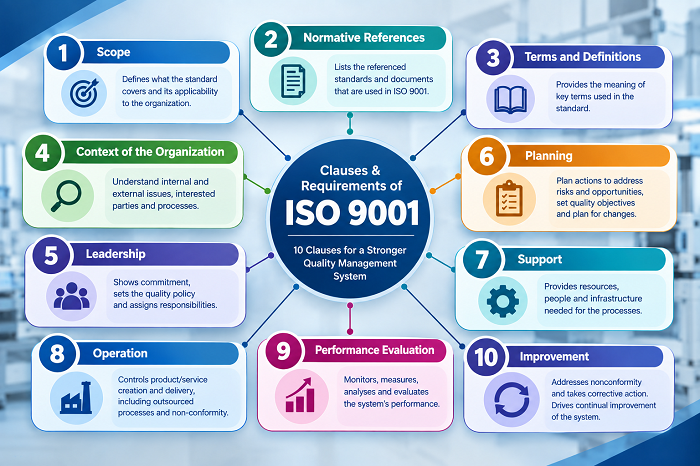
The requirements of ISO 9001 are organized into 10 clauses. Clauses 1 to 3 cover scope, normative references, and terms. The actionable requirements for the products and services start from clause 4 as mentioned below:
-
Clause 4, Context of the organization, requires the company to understand its internal and external issues, the needs of interested parties, and the scope of its quality management system. It also asks for determination of the processes needed and how they interact.
-
Clause 5 Leadership demands that top management demonstrate commitment, establish a quality policy, and assign roles and responsibilities. Leadership must ensure the system achieves intended results and promotes improvement.
-
Clause 6 Planning addresses planning of actions to address risks and opportunities, quality objectives and planning to achieve them and planning of changes. Objectives must be quantifiable and must be consistent with the quality policy.
-
Clause 7 Support addresses resources, competence, awareness, communication, and documented information. The organization must determine and provide the people, infrastructure, and environment needed for the processes. People doing work that affects quality must be competent. Relevant documented information must be controlled.
-
Clause 8, Operation, is the largest clause in this standard. The most recently updated section consists of operational planning and control, requirements for products and services, design and development when applicable, control of outsourced processes and services, production and provision of services, specification of products or services, and management of cases of non-conformity. The same section refers to the implementation of the creation and provision of products in practice under controlled conditions.
-
Clause 9, Performance evaluation, comprises monitoring, measurement, analysis and evaluation, internal audit and management review. The organization is required to monitor customer satisfaction and process performance and use the data to assess effectiveness.
-
Clause 10 covers improvement, nonconformity and corrective action, plus continual improvement. When something goes wrong, the organization investigates the cause and takes action to prevent recurrence. The system itself must continue to improve.
These clauses work together and cannot be treated in isolation. A strong leadership commitment under clause 5 supports better planning under clause 6 and more effective operations under clause 8. Regular performance evaluation under clause 9 feeds improvement under clause 10.
Conclusion
ISO 9001 provides a hands-on approach to designing and sustaining a quality management system that is effective. The principles focus on the customer and continuous improvement, while the clauses provide the structure. When done properly, it minimizes variability and increases customer trust.
For those who require accurate and consistent testing and measurement tools for quality processes, Testronix Instruments provides a variety of solutions. Talk to the Testronix team about how the right tools can make a difference in your quality management program.