A package seal may look perfectly fine but still fail when it is pulled, handled or opened. For flexible packaging manufacturers, this makes seal strength testing an important part of quality control.
ASTM F88 provides a practical method for measuring the force needed to separate a sealed specimen. In this article, we will look at what ASTM F88 means, its purpose and scope, important test parameters, the standard testing procedure and the type of equipment used for seal strength testing.
What is ASTM F88?
ASTM F88 is a standard test method used to measure the strength of seals in flexible barrier materials. The method measures the force required to separate a test strip containing a seal and also identifies how the specimen failed during testing.
In simple terms, the test answers a basic packaging question: how much force does it take to open or break the seal. The latest active version listed by ASTM International is ASTM F88/F88M 23.
The method is widely relevant to flexible barrier materials used in pouches, bags, lidding materials and other flexible packaging structures. It can also be used where a flexible material is sealed to a rigid or semi-rigid material. The seal itself may come from a laboratory preparation or from a commercially produced package.
This distinction matters because seal strength is not only about whether a package stays closed. A seal may need enough strength to maintain package integrity while still being easy enough for the intended user to open.
Purpose and Scope of ASTM F88 for Seal Strength Testing
The main purpose of ASTM F88 is to provide a consistent way to quantify seal strength. The measured force can be used during process validation, process control and evaluation of sealing capability. ASTM also notes that maximum seal force is important while average force may be useful for applications where opening behavior is being studied.
For manufacturers, this gives a useful way to compare sealing conditions and production samples. If seal temperature, pressure, dwell time or packaging material changes, the seal strength testing can show how those changes affect the finished seal.
Scope of ASTM F88 Seal Strength Test
ASTM F88 scope covers measurement of seal strength in flexible barrier materials. The test can be performed on seals between flexible materials as well as seals involving rigid or semi-rigid materials. It measures the force needed to separate a defined test strip and records the mode of specimen failure.
ASTM F88 is not the same as every packaging integrity test. It focuses on the mechanical force required to separate the seal. A package can therefore require additional tests for leakage or other forms of integrity depending on the application.
The standard also describes three approaches for controlling the specimen tails during testing: unsupported, supported at 90 degrees and supported at 180 degrees. Consistent use of the selected technique is important because the way the specimen is supported can affect the measured result.
ASTM F88 PDF Download
For detailed guidelines, specimen preparation requirements and reporting instructions, Download ASTM F88/F88M 23 PDF. The complete ASTM document is a comprehensive standard guide published by ASTM International. For production validation or compliance work, the current official ASTM F88 standard is used across multiple industries to ensure the best quality products for the consumers.
Parameters and Conditions for ASTM F88 Seal Strength
ASTM F88 gives flexibility for specimen width and testing configuration while setting important limits for consistent testing. The current version specifies specimen cutter widths of 25 mm, 15 mm or 25.4 mm with a recommended cutting tolerance of plus or minus 0.5 percent. The grip separation rate is 200 mm/min to 300 mm/min.
|
Parameter |
ASTM F88 Requirements |
|
Specimen width |
25 mm, 15 mm or 25.4 mm |
|
Cutting tolerance |
Plus or minus 0.5 percent recommended |
|
Grip separation rate |
200 mm/min to 300 mm/min |
|
Specimen orientation |
Seal line perpendicular to pulling direction |
|
Seal position |
Approximately equidistant between grips |
|
Seal support |
Unsupported, supported 90 degrees or supported 180 degrees |
|
Main reported force |
Maximum force during specimen failure |
|
Additional result |
Average seal force may be reported when relevant |
|
Conditioning |
If required, use ASTM Practice E171 or a condition suited to the test objective |
|
Failure observation |
Identify the mode of specimen failure |
The standard does not prescribe one universal conditioning period for every material. If conditioning is required, ASTM F88 refers to Practice E171. Heat seal conditioning can also be established through experimentation when enough time is needed for the seal strength to become stable.
Another point worth watching is specimen width. Seal strength is proportional to specimen width under the same test conditions. That means changing the strip width without considering the effect on the result can make comparisons misleading.
ASTM F88 Procedure and Standard Practice for Seal Strength Test
The ASTM F88 test is essentially a controlled tensile separation test. A prepared sealed strip is held in two grips and pulled apart at a controlled speed while the machine records the force.
Step 1: Prepare the specimen
Cut the sealed package or material into clean rectangular strips across the seal. The edges should be clean and perpendicular to the direction of the seal. Specimens with damaged edges can affect the result and should be handled according to the purpose of the investigation.
Step 2: Condition the samples
If conditioning is part of the test plan, condition the specimens under the selected environmental conditions before testing. Record the relevant temperature, humidity and conditioning period so the results can be reproduced.
Step 3: Calibrate the testing machine
Before testing, calibrate the tensile testing equipment according to the equipment manufacturer's recommendations. The machine should provide controlled grip movement and suitable force measurement.
Step 4: Mount the specimen
Place each tail of the specimen into the opposing grips. Keep the sealed area approximately centered between the grips. The seal line should be perpendicular to the pulling direction. Avoid putting unnecessary tension on the sample before starting the test.
Step 5: Select the support technique
Choose the appropriate specimen support method. Technique A leaves the seal unsupported. Technique B supports the seal at approximately 90 degrees by hand. Technique C uses a 180 degree supported arrangement. The same technique should be maintained when results are being compared.
Step 6: Run the test
Start the machine at a grip separation rate between 200 mm/min and 300 mm/min. Continue the test until the seal or specimen reaches failure. The machine should capture the force throughout the separation rather than relying only on a visual observation.
Step 7: Record the result
For each test cycle, ASTM F88 requires the maximum force encountered as the specimen is stressed to failure and the mode of specimen failure to be identified. Average seal force can also be useful for certain applications.
The failure mode is worth recording carefully. A specimen may separate through the seal or the material itself may tear or deform. The same force value can have a very different meaning depending on how the specimen failed.
Testronix Instruments Seal Strength Testing Equipment
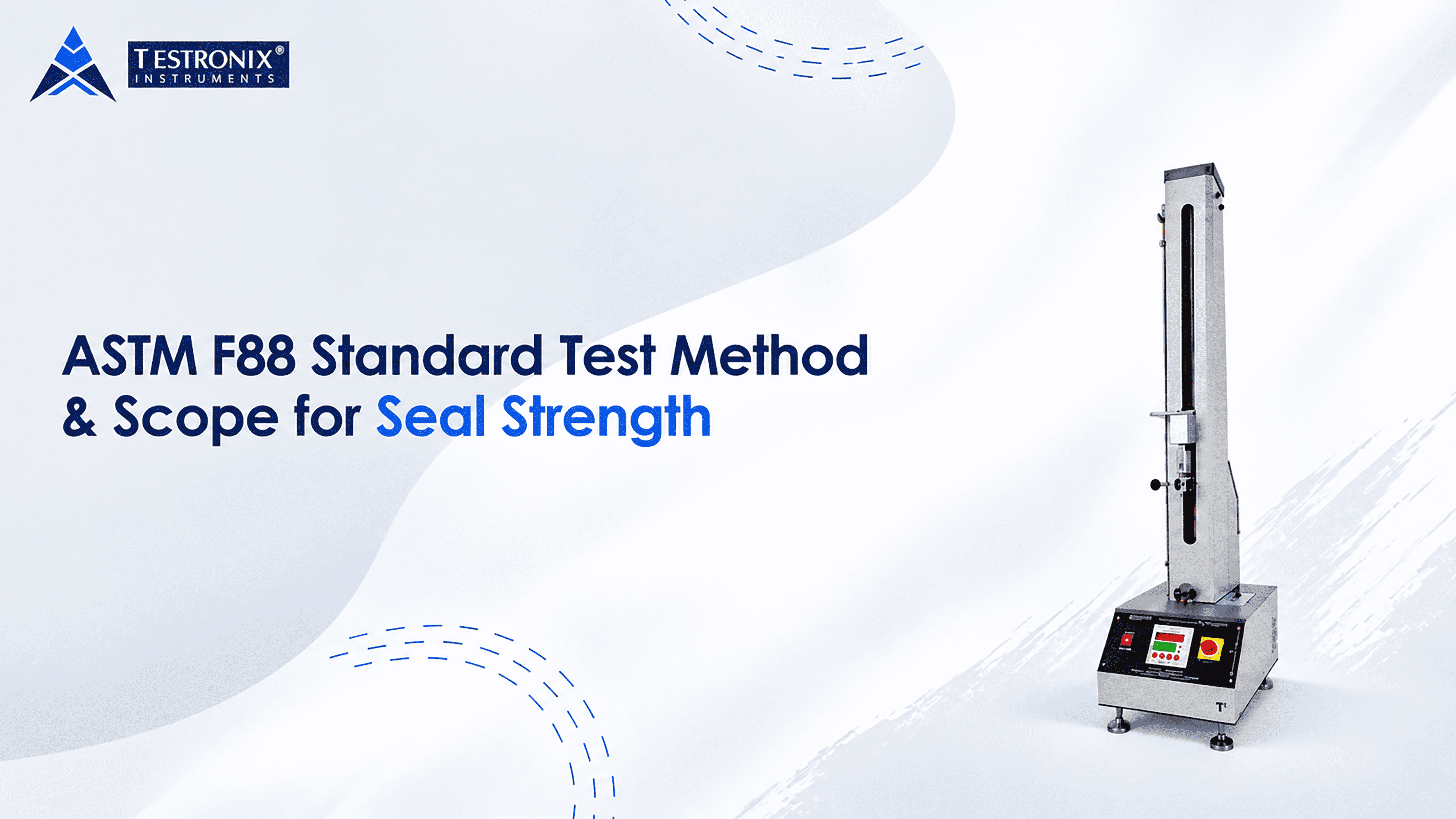
Testronix Instruments offers peel and seal strength testing equipment for packaging and adhesive applications. Our digital Peel Strength and Seal Strength Tester uses two jaws to hold the specimen and a load cell to measure the force required during separation. The measured force is shown on a digital display.
The available digital model is listed as TX PBT 200. Testronix also lists a computerized Peel Adhesion Bond Seal Strength Tester with a 20 Kgf capacity under model TX PBTC 300.
For ASTM F88 work, the important point is not simply having a seal strength tester. The machine configuration should support the required specimen width, grip movement, test speed, force measurement and selected support technique. The exact setup should be confirmed against the current ASTM method and the application being tested.
Testronix also supplies other packaging testing equipment including heat seal and seal integrity testing instruments. This makes it possible for packaging laboratories to build a broader testing setup around seal strength, sealing conditions and package performance.
Conclusion
ASTM F88 provides a practical and repeatable method for measuring seal strength in flexible barrier materials. It covers specimen preparation, controlled grip separation and identification of failure mode so manufacturers can understand not only how strong a seal is but also how it behaves during separation.
For packaging manufacturers, consistent testing can support seal process development, quality control and validation work. The test becomes much more useful when specimen width, conditioning, support technique and test speed are kept consistent.
If you are looking for equipment for seal strength or peel testing, Testronix Instruments offers digital and computerized testing solutions for packaging and adhesive applications.
Contact us today to discuss your testing requirement and select a suitable configuration for your packaging laboratory.