

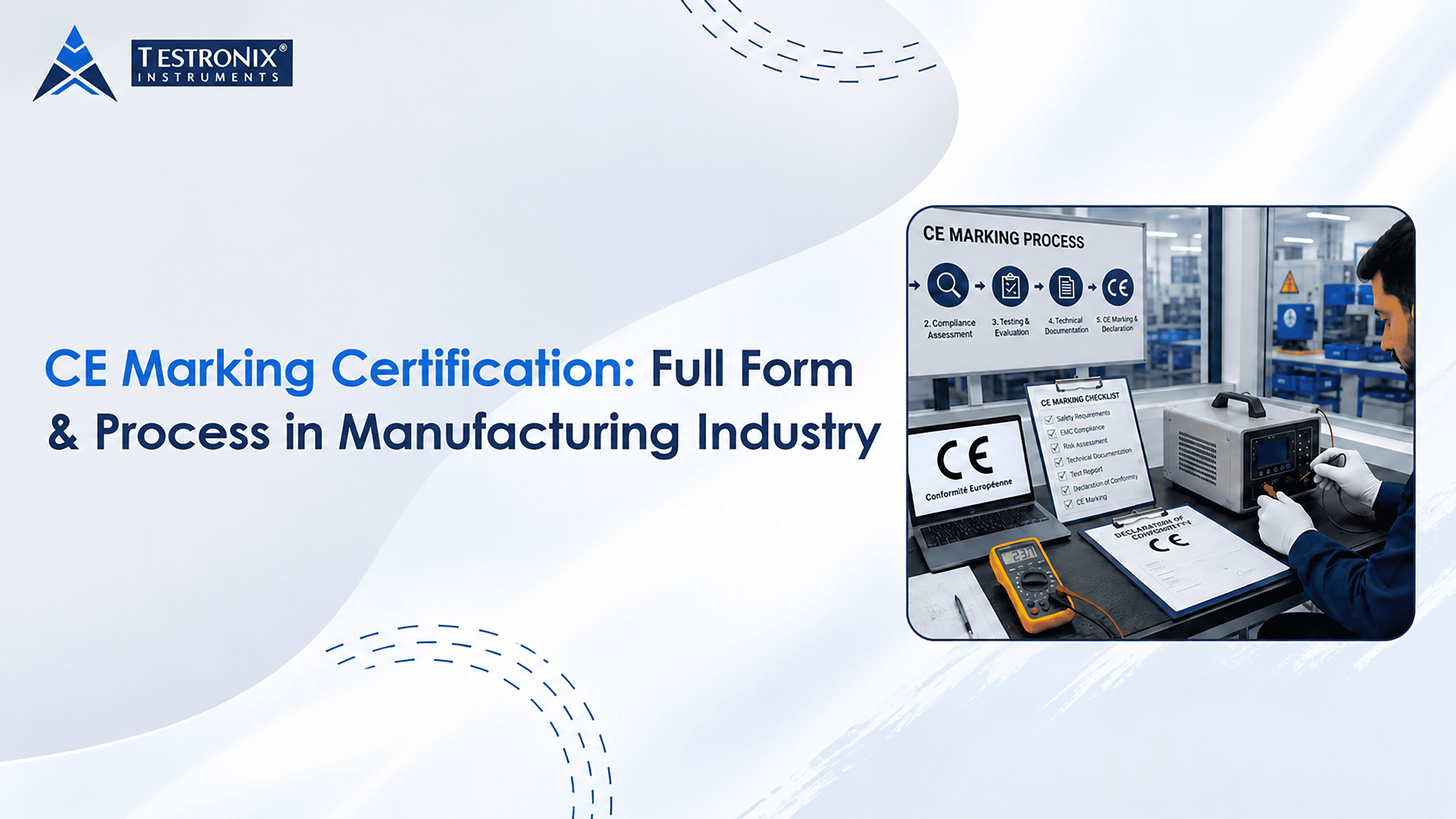
CE marking is an aspect for manufacturers who areau planning to sell their products in the European market. But before that, they need to ensure that all of their machinery, electrical devices, and other items are subject to the regulations of the European Union.
Here comes the confusion: when a buyer asks for CE certification, is it necessary for the manufacturer to have any certificate from some laboratory? Is it enough to have the testing done? What are the documents required?
The answer depends on the product. Initially, the manufacturer needs to determine the regulations that apply to the product and comply with the conformity assessment procedure according to them. To cut the clutter, in this article, we will learn what is CE marking, its meaning, and what a manufacturer needs to do before launching his product on the European market.
What is CE Marking & CE Certification?
CE marking is a conformity marking used on products applicable under European Union legislation. It indicates that the manufacturer declares the product meets the relevant EU requirements for safety, health, and environmental protection.
In simple terms, CE marking tells authorities and customers that a product has been assessed against the legal requirements that apply to it. It is commonly found on electrical equipment, machinery, toys, medical devices, and several other product categories.
CE marking is required for products covered by specific EU harmonization legislation. Not every product sold in Europe needs this marking. Products outside the scope of the relevant legislation must not carry CE marking simply to suggest they meet European standards.
CE Certification
The term CE certification is widely used in the manufacturing industry. However, there is an important difference between CE marking and a third-party certification. For many products, the manufacturer can carry out the required conformity assessment and issue an EU Declaration of Conformity without obtaining a certificate from an external organization.
Some products require the involvement of a Notified Body. These are independent organizations designated by EU member states to carry out specific conformity assessment activities. Whether such involvement is necessary depends on the product category and the applicable legislation.
Therefore, manufacturers should first identify the legal requirements for their particular product instead of assuming every product follows the same certification procedure.
CE Marking Certification Full Form
CE stands for Conformité Européenne, a French term meaning European Conformity. The marking indicates that a product meets the applicable EU legal requirements.
The symbol is commonly found on machinery, electrical appliances, and industrial equipment. Its placement and design are regulated. Manufacturers cannot modify the logo or use it simply to make a product look suitable for European markets.
Why a Manufacturing Firm Needs CE Certification
For a manufacturer, CE marking becomes relevant when the product is covered by EU legislation requiring it. This is particularly significant to Indian manufacturers who are providing industrial products to European customers.
For instance, there is a firm that produces electrical testing equipment to be exported to various nations. Before accepting the shipment, the customer may inquire about the electrical safety, related standards, and compliance documentation.
There are three main reasons manufacturers pay attention to CE marking.
-
Market access: Products covered by CE marking legislation cannot be legally placed on the EU market without completing the applicable conformity assessment. An export order does not remove this requirement.
-
Product safety: The assessment brings attention to risks that may not appear during a routine production check. Electrical overheating, exposed moving parts, and inadequate protective arrangements are examples.
-
Buyer documentation: Technical files and test reports give buyers and authorities information about the product and the assessment carried out. These records are also useful when a customer requests evidence of compliance.
CE Marking Requirements
There is no single set of tests for every product carrying the CE marking. The requirements for a machine may be quite different from those for an electrical appliance or medical device. The manufacturer needs to establish which rules apply before arranging testing.
Applicable Regulations and Standards
The first task is to identify the EU legislation covering the product. Its intended use, design, and technical features determine which requirements need to be considered. For electrical equipment, this may include electrical safety and electromagnetic compatibility. Machinery has additional requirements relating to mechanical hazards and safe operation.
Harmonized European standards provide technical methods for demonstrating conformity. The manufacturer should check the relevant standards and their current status before selecting the tests.
Product Testing and Risk Assessment
Testing checks whether the product meets the requirements identified during the assessment. The tests depend on the equipment and its intended use. For example, electrical equipment may require insulation and temperature rise tests. Machinery may need an assessment of moving parts, guarding, and emergency stop functions.
A risk assessment is also necessary under the relevant legislation. The production company indicates potential risks and determines which alterations or prevention methods should be put in place.
Technical Documentation
The technical manual encompasses the data that is to be used to prove compliance of the product. Generally, it includes diagrams of the product, specifications, risk assessments, reports on tests, and manuals.
The records should relate to the actual product being manufactured. Under general EU requirements, technical documentation is normally retained for at least 10 years after the product is placed on the market, subject to the applicable legislation.
EU Declaration of Conformity
The EU Declaration of Conformity is signed by the manufacturer or its authorized representative. It identifies the product and the applicable EU legislation. This is the document through which the manufacturer formally declares conformity and accepts responsibility for the product's compliance.
How to Get CE Certification
The procedure depends on the product and its applicable legislation. In manufacturing, the work generally follows the stages below.
Step 1: Identify the Applicable Legislation
Start with the product itself. What is it designed to do? Where will it be used? Does it have electrical components or moving parts? These details help determine which EU regulations or directives apply. Some products fall under multiple legal requirements, so checking only one regulation may not be sufficient.
Step 2: Select the Relevant Standards
Once the legislation has been identified, the next step is to check the relevant harmonized standards in Europe. The harmonized standards explain the requirements concerning technical characteristics and test methods. The manufacturer must verify the appropriate standards for the specific product and not simply take into account the instructions associated with a similar product. The chosen standards also outline the tests to be performed.
Step 3: Conduct Product Testing
The product in question goes through an evaluation based on the identified requirements. The way the evaluation takes place depends on the type of product. If we take an electrical machine as an example, one may detect an increase in temperature. Due to this reason, the manufacturer may have to change components or the cooling system of the machine and conduct tests again with the updated machine.
Step 4: Involve a Notified Body if Required
Some products can follow an internal conformity assessment procedure. Others require a Notified Body under the applicable legislation.
A manufacturer should check whether independent assessment is mandatory for its product. The selected organization must be designated for the relevant product category and assessment procedure. Its details can be checked through the EU's NANDO database.
Not every testing laboratory or certification agency has this designation.
Step 5: Prepare the Technical File
Once the necessary evaluation has been conducted, the producer compiles the technical documentation. This encompasses the pertinent testing documents, the design-related information, risk assessment, etc. The EU Declaration of Conformity is duly drawn up and signed so that the documentation describes the product being sold to the customers.
Step 6: Affix the CE Marking
Once the conformity assessment is complete and the required declaration is prepared, the manufacturer can affix the CE marking. The symbol shall conform to the prescribed design and shall be visible, legible and indelible. If applicable, the number of the Notified Body is indicated next to it.
Manufacturers also need to review compliance when product designs, components, or applicable regulations change.
Conclusion
CE marking necessitates that companies investigate not only their products but also the rules, safety issues, and documents related to product marketing in the European Union. For the exporters of their products, this should be done as part of development rather than through after-order quality checks.
Evaluation is a very significant part of this process, as it gives concrete data about the performance of the product and defines potential problems requiring adjustments to the product before the final buyer.
Testronix Instruments offers laboratory testing tools to help manufacturers and quality control labs in their work. The devices developed by this company are perfect for product evaluation and regular quality control that are part of the company’s quality assurance efforts.