Choosing a material for an industrial or structural application is not always straightforward. A material may have good strength but be too heavy. Another may be lightweight but not strong enough for the job. Corrosion, moisture, impact and maintenance can create more problems over time.
Fiber-Reinforced Polymer, commonly called FRP, is one material used to deal with some of these limitations. It combines a polymer resin with strong fibers to create a composite material with a different set of properties from the individual materials.
FRP is now found in many areas, including construction, automotive parts, electrical equipment, marine products and aerospace components. Its use is not limited to one industry or one type of product.
So, what exactly is FRP made of? What are the different types and where are they used? This article covers these points along with the main advantages of FRP over materials such as steel and other conventional options.
What Is Fiber-Reinforced Polymer (FRP)?
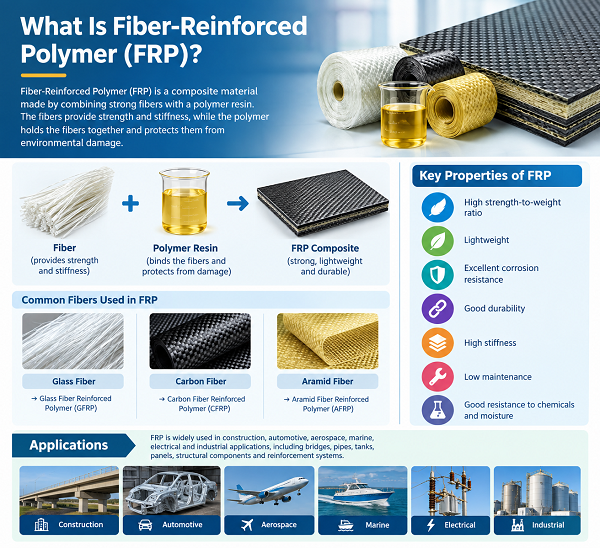
Fiber-Reinforced Polymer (FRP) is a composite material made of strong fibers embedded in a polymer matrix. It offers high strength, lightweight construction, durability, and excellent resistance to corrosion.
Although FRP may sound simple, the end product varies widely depending on the fiber and resin you choose for your project. Direction of placement is important too. A component that carries loads along one axis might be oriented so as to align its fibers appropriately.
Therefore, FRP isn't an individual substance having constant characteristics. Glass fiber composites vs carbon fiber composites may have different properties despite being referred to as FRPs by some people.
Also, an important thing to note about it is that FRP doesn't rust like steel does. One of these reasons makes them suitable for use on surfaces that are wet, chemical resistant or in humid environments.
Key Components: What Fiber-Reinforced Polymer Consists Of
FRP mainly contains two basic parts: reinforcing fibers and a polymer resin. Some products also contain fillers and other additives depending on their intended use.
Reinforcing Fibers
The fibers are responsible for much of the strength of an FRP composite. Glass fiber is commonly used because it offers a good balance between performance and cost. Carbon fiber is lighter and provides high stiffness and strength. Aramid fiber is another option and is known for its strength and resistance to impact.
Fiber selection depends on what the finished product needs to do. There is little reason to use an expensive carbon fiber composite for a job where a glass fiber material can perform adequately.
The amount and direction of the fibers matter too. Fibers can be arranged in different ways depending on the expected loading conditions.
Polymer Resin
The resin forms the surrounding matrix. It holds the fibers together and helps transfer the applied load from one fiber to another. Polyester, vinyl ester and epoxy resins are commonly used in FRP products.
Polyester is widely used where cost and general performance are important. Vinyl ester is often selected when better resistance to chemicals and harsh environments is needed. Epoxy resins can provide strong bonding and good mechanical performance.
The resin also protects the fibers from the surrounding environment. Its properties therefore have a direct effect on the service performance of the composite.
Fillers and Additives
Fillers/additives are used for some types of FRPs so as to alter certain characteristics and simplify production processes.
They might impact aspects like look, function of processing, burning properties or dimensional stability. The usage is dependent upon what you want to make from it as well as its purpose for an application.
Types of Fiber-Reinforced Polymer
The FRP can be categorized according to its fibers. Glass fibers, carbon fibers and aramid fiber reinforcement materials are some of them.
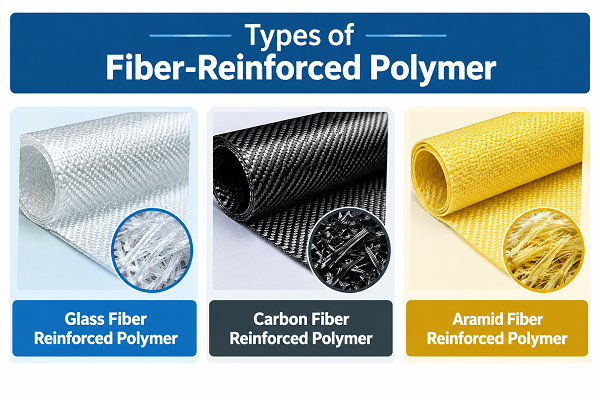
Glass Fiber Reinforced Polymer
GFRP refers to Glass Fiber Reinforced Plastic. One of them is widely used as an FRP material due to its affordability compared to other types of fibers. GFRP is used to make pipes, tanks, panels, structural components of cables and reinforcing materials. Also used for building purposes and electrical applications.
For many general-purpose applications, glass fiber provides enough performance without adding unnecessary material cost.
Carbon Fiber Reinforced Polymer
Carbon Fiber Reinforced Polymer is known as CFRP. Carbon fibers provide high strength and stiffness while keeping the overall weight low. That combination is valuable in applications where every kilogram matters.
CFRP is used in aircraft parts, racing and performance vehicles, sporting equipment and structural strengthening systems.
A disadvantage has to do with the expenses involved. Carbon fiber tends to be more expensive than fiberglass also. Hence, it is adopted when its performance demonstrates real benefits rather than simply being a stronger type of material.
Aramid Fiber Reinforced Polymer
Aramid Fiber Reinforced Polymer relies on aramid fibers as reinforcement materials. Aramid fibers possess high tensile strength and good impact strength, and yet they are relatively light. Therefore, the materials are used in applications where those properties can be useful.
Protective clothing, aerospace parts, marine products, and some specialized structural applications can take advantage of aramid-based composites.
Each type of fiber has its advantages. The correct selection should depend on actual conditions where the material is going to be used.
Applications of Fiber-Reinforced Polymer
FRP has found its way into a wide range of products. The reason is fairly practical. It can provide useful mechanical performance without the weight and corrosion issues associated with some conventional materials.
Construction and Infrastructure
FRP is used in reinforcement bars, structural profiles, panels, bridge components and strengthening systems.
FRP reinforcement can be useful in concrete structures exposed to moisture or corrosive conditions. Steel reinforcement can corrode over time if it is exposed to the right conditions. FRP does not develop rust in the same manner.
FRP sheets and plates are also used for strengthening existing structures. They can be attached to concrete or other structural surfaces without adding the same amount of weight as many traditional strengthening materials.
Automotive Industry
Vehicle manufacturers use composite materials for different body and structural components. The lower weight of FRP can be useful in vehicle design. A lighter component may contribute to better fuel economy or help manage the overall weight of an electric vehicle.
Not every vehicle component needs carbon fiber. Glass fiber composites are also used where the required performance can be achieved at a lower cost.
Aerospace
Aerospace applications place a strong focus on weight and mechanical performance. C-FRP is widely used in this area because it can provide high stiffness and strength without the mass of many metal alternatives. Aircraft structures and components can therefore benefit from composite construction.
The material still needs careful design and testing. Composite performance depends on fiber direction, manufacturing quality and the conditions under which the component will operate.
Electrical Applications
FRP is also used for electrical products such as cable trays, electrical enclosures, poles and insulating components. One reason is its electrical insulation capability. Metals are good conductors while many FRP materials can provide electrical isolation along with mechanical strength.
FRP can also be useful in outdoor electrical installations where moisture and corrosion are concerns.
Marine Applications
Water exposure can create serious corrosion problems for metals. FRP offers an alternative for many marine products. Boat components, tanks, panels, pipes and other marine structures can be manufactured from FRP. The material's resistance to moisture is particularly useful in these conditions.
The resin system still needs to be selected carefully because different chemicals, temperatures and environments can affect different composite materials in different ways.
Advantages of Fiber-Reinforced Polymer
FRP is mainly valued for the combination of properties it offers. It is not always better than steel, aluminum or other materials, but it can be a better fit for certain jobs.
High Strength With Less Weight
FRP can provide a high strength-to-weight ratio. Steel is strong but heavy. FRP can achieve useful strength with considerably less weight in many applications. This difference can be important during transportation, handling and installation. A lighter structural component can also place less load on the rest of the structure.
Resistance to Corrosion
Steel component corrosion due to exposure to water, chemicals and moisture levels is an important issue. FRP is resistant to corrosion unlike steel. It may help to solve certain issues related to corrosion and also protect against damage caused by rust applied over metal surfaces.
Not all FRPs are equally effective against chemicals. Resin and fibers should be compatible with their surroundings.
Good Durability
Properly chosen FRP materials are able to last longer than other types of metal because they do not suffer from corrosion issues like those that occur on certain metals. The real-life lifespan of this product is determined by various elements. Temperature, UV radiation levels, light intensity, humidity level and chemical composition affect these factors.
Material choice should be made according to its use case instead of just picking out an FRP due to its resistance to rusting.
Flexibility in Design
The FRP provides greater control to an engineer for designing components' characteristics. The type of fibers, resins, fiber contents and directions are also taken into account while designing them. It enables customization of this product according to various loads.
One of these differences between it and an ordinary metal like a solid steel beam is that. A composite may be engineered for specific loads instead of being based solely upon a homogeneous substance’s characteristics.
Electrical Insulation
Many FRP materials have useful insulating properties. This makes them suitable for electrical applications where mechanical strength is required but electrical conductivity is not desirable. Cable trays, poles and certain structural components are examples.
Lower Maintenance in Suitable Conditions
FRP can reduce maintenance requirements in environments where corrosion would be a major issue for steel. For example, a steel component may need regular inspection and coating work to control corrosion. A suitably designed FRP component does not require the same type of rust protection.
Still, FRP is not maintenance-free. Surface damage, cracks and other forms of deterioration should not be ignored.
Conclusion
Among the different composite materials, Fiber-Reinforced Polymer is significant because it combines a variety of features that cannot be achieved using just one type of conventional material. Some important benefits are lightweight, great strength, the ability to withstand corrosion and versatility of design.
Testing plays an important role in the work with composite materials. The performance of a particular composite material is determined not only by the type of fibers and the resin but also by the quality of the manufacturing process and the properties of the material. Thus, proper testing enables manufacturers to make sure that their products work as they are supposed to do.
Testronix Instruments provides testing solutions for different industrial and material testing requirements. For manufacturers working with FRP and other engineering materials, reliable testing equipment can be an important part of maintaining consistent product quality.