A box can look strong and still collapse under a heavy pallet load. A pouch can look perfectly sealed and still leak the first time someone handles it. You can’t judge packaging by eye, and that’s why testing exists.
Packaging tests check the physical properties, strength, and performance of materials and finished packs. Some deal with paper and corrugated board. Others look at seals on flexible packaging or at how much weight a plastic container can carry. Here are the 10 most important packaging tests used for quality control across industries.
Most Important Packaging Tests for Quality Control
1. Box Compression Test (BCT)
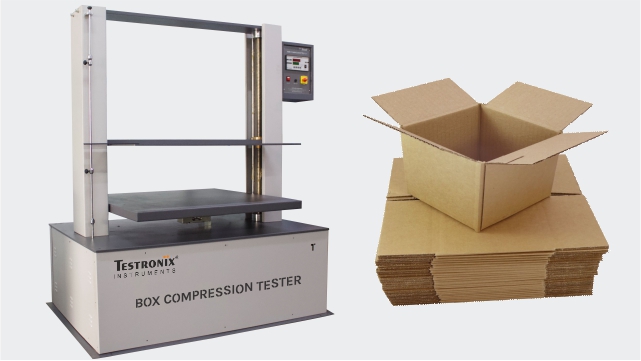
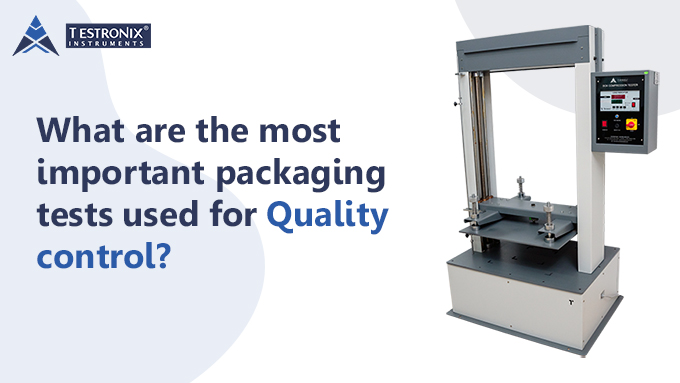
The box compression test (BCT) measures how much force a box can sustain before it breaks. In this testing process, the box is placed between two parallel plates, and the machine presses down at a controlled rate, logging the load and how the box deforms. It runs until the box fails or hits the specified endpoint. In this way, the manufacturers can analyze how strong a box or container is and how to improve its strength.
You also get a useful side benefit: a clear comparison between different box designs and board grades.
-
Equipment: Box Compression Tester
-
Standard: ASTM D642
-
Applications: Corrugated shipping boxes, cartons, stacked packaging
2. Bursting Strength Test
A bursting strength test demonstrates the maximum force a material or product can take before it collapses. During the test, a specimen is clamped over a flexible diaphragm, hydraulic or pneumatic pressure is pushed against it, and it waits for it to rupture. The peak pressure at that moment when specimen breaks, is the bursting strength. It’s a quick way to compare materials and confirm that paper or board meets the spec though the exact method depends on what you’re testing.
-
Equipment: Bursting Strength Tester
-
Standard: TAPPI T 810 for corrugated board, or another applicable method based on material type
-
Applications: Kraft paper, paperboard, corrugated packaging
3. Edge Crush Test (ECT)
Corrugated board behaves differently when it’s squeezed along its edge than when it’s pushed on its face, and ECT targets exactly that. A narrow strip is prepared with the flutes upright, placed between compression platens, and loaded until it buckles. The maximum force is reported relative to specimen width.
Bursting strength tells you about surface pressure. ECT tells you about edgewise compression, which makes it handy for comparing board grades and deciding whether a board is right for box production.
-
Equipment: Edge Crush Tester
-
Standard: TAPPI T 811 or ASTM D5639/D5639M, depending on the test method
-
Applications: Corrugated board, shipping cartons, packaging material evaluation
4. Drop Test
In the drop test, a package gets dropped from a certain height to test the durability and structural strength of the packaging. Drop testing shows what happens when they do. Load the package with the real product or a suitable test load, release it from a set height onto a rigid surface in a defined orientation, and repeat on faces, edges, and corners as the procedure requires.
Then inspect, and don’t stop at the carton. A clean outer box doesn’t mean the product inside is fine. The results usually expose weak points in the structure or the cushioning.
-
Equipment: Drop Tester
-
Standard: ASTM D5276
-
Applications: Shipping cartons, e-commerce packages, protective packaging
5. Cobb Test
Water absorption is the question here. Weigh the specimen, expose a defined area to water using a Cobb apparatus, and after the contact period, remove the excess water by the standard procedure. Weigh it again. The mass difference gives absorption per unit area, normally in grams per square meter.
Higher numbers mean more water taken up under the test conditions. If moisture could affect how your packaging performs, this is the test to look at.
-
Equipment: Cobb Sizing Tester and weighing balance
-
Standard: ISO 535 or TAPPI T 441
-
Applications: Craft paper, paperboard, corrugated packaging materials
6. Grammage (GSM) Test
When performing GSM (grams/square meter) test, one must first prepare a sample of known size, weigh it on a precise scale, and indicate the result in grams per square meter. This is the GSM where two similar-looking sheets can have different grammages (weights). Thus, having regular checks is a good means to confirm specifications & find variations between batches.
One caution: grammage doesn’t determine strength by itself. Read it alongside other tests.
-
Equipment: GSM Sample Cutter and Precision Balance
-
Standard: ISO 536
-
Applications: Paper, paperboard, kraft paper, corrugated board
7. Moisture Content Test
Paper that’s too wet or too dry causes trouble in converting, printing, and box making. Stiffness, dimensions, and compression performance can all shift with moisture level.
With the oven drying technique, the specimen needs to be weighed, after which it's dried for an agreed amount of time before weighing it again. The lost mass gives the moisture content. Oven drying is needed when one wants to know the exact moisture content. For routine assessments, moisture meters are fine when appropriate for the method and the material.
-
Equipment: Laboratory Drying Oven and Precision Balance, or a suitable Paper Moisture Meter
-
Standard: ISO 287 for moisture determination of paper and board by oven drying
-
Applications: Paper rolls, kraft paper, paperboard, corrugated board
8. Peel and Seal Strength Test
The peel and seal strength test analyzes the question: Does the seal work and how difficult is it to open? In the test, a sample can be taken from the closed package at a predetermined size, with both ends placed into a tensile testing machine, and the two parts pulled at a constant speed. The device logs the force used to open the seal.
The way specimens are prepared and the methods used are of great importance since seal strengths differ for different sealing temperatures, pressures, times, and materials. And remember that a strong seal doesn’t prove a package is leakproof.
-
Equipment: Peel, Seal, Bond, Adhesion Strength Tester
-
Standard: ASTM F88/F88M for flexible barrier material seals
-
Applications: Flexible pouches, laminated films, heat-sealed packaging
9. Coefficient of Friction (COF) Test
Film that slides too much or too little causes problems on a packaging line. COF testing quantifies it. A film specimen lies on a flat surface with a weighted sled on top, and the sled is pulled at a controlled speed while the instrument measures the force needed to start or sustain movement.
Static COF is the resistance before sliding begins. Kinetic COF is the resistance while it’s moving. Both matter when you need smooth feeding and consistent handling.
-
Equipment: Coefficient of Friction Tester
-
Standard: ASTM D1894
-
Applications: Plastic films, flexible packaging, laminated materials
10. Top Load Test
A top load test measures the maximum axial force that a container or package can withstand before it collapses or ruptures. Piling up containers causes the bottom layers to bear the load of the containers placed above. In the case of the top load test, a bottle or a container should be tested for vertical pressure. The testing process will involve standing a bottle upright under the compression plate and applying pressure at a constant rate and recording the maximum load based on the expected deformations.
Shape, wall thickness, material, & design all affect the result, so the setup should reflect the actual container & its application.
-
Equipment: Top Load Tester
-
Standard: Choose a method suited to the container type and test objective. ASTM D2659 covers column crush properties of blown thermoplastic containers and should only be cited when applicable.
-
Applications: PET bottles, plastic containers, packaging jars
Choose the Right Tests for Products
In the case of corrugated boxes, they usually need to be checked for compression, edge crush resistance and burst strength testing. For paper and board, grammage and moisture tests are usually done. In addition, flexible packaging has to undergo checking for seal strength and friction testing as well. Bottles and rigid containers have to go through top load testing.
There is no one test that tells the complete story. Use a combination of materials tests and finished-product tests to get a complete picture, and allow your product requirements, standards and actual distribution conditions to determine your choice.
Conclusion
Good packaging QC is about finding weaknesses early, before they become damaged goods, complaints, or extra costs. Each test measures one property, so the combination you pick is what counts. Consistent testing also gives you reliable data for comparing materials and monitoring production.
Testronix Instruments offers a range of testing equipment for packaging and material evaluation. The right instruments and methods can help laboratories and manufacturers build a more consistent quality control process.