Friction is one of those things people deal with every day without paying much attention. When you walk on a floor, press the brakes in a car, drag a chair, etc, the friction is quietly involved in all of these scenarios. But we hardly notice these until the friction becomes a problem. The problems are like the machine gets stuck, a surface becomes too slippery or a conveyor stops running smoothly. That is usually when people start talking about friction.
In industries, friction matters a lot more than it seems from the outside. Packaging films can jam because of high friction. Printed sheets can slip during handling because friction is too low. To understand this concept practically, in this article, we will discuss everything related to friction, its types and real-life examples.
What Is Friction
Friction is simply the force that resists movement between two surfaces touching each other. One surface tries to move, the other resists a little, and that resistance is called friction.
A very simple example of friction is the movement of cardboard when you push it. When you start pushing, the box does not move immediately, as it needs a specific initial force to start movement. You apply more force, then it slowly starts moving but the point is that the floor always resists the movement which we know as friction.
People often assume smooth surfaces have no friction at all. Real surfaces are never perfectly smooth though. Even polished materials have tiny rough portions when viewed closely. These small irregularities interact with each other during contact. Because of this, movement becomes difficult to some extent.
Meanwhile, friction isn't necessarily bad. This can be understood with an example: Imagine trying to walk on a freshly polished wet floor wearing smooth shoes. In such an instance, the coefficient of friction is too low to walk over and the walker will feel unstable for a certain amount of time.
What Is the Principle Behind Friction
The principle behind friction is based on contact between surfaces. When two surfaces touch and one tries to move over the other, resistance develops naturally because of surface roughness and pressure.
In simple terms, surfaces lock slightly against each other. The greater the pressure between them, the stronger the resistance usually becomes.
Surface condition also changes the friction behavior. Dry rubber shoes grip the road better than smooth, worn-out soles. You may have noticed that oil and relevant fluids are frequently used in machines. It is because the fluid creates a thin layer between moving parts of the machine that reduces direct contact or very smooth contact.
This is why friction becomes an important part of manufacturing industries and is monitored carefully. Too much friction can damage products and machine parts. Too little friction can create slipping and handling issues.
Different Types of Friction
Friction behaves differently depending on how surfaces interact. Sometimes surfaces are stationary. Sometimes they slide. Sometimes objects roll instead of scrape. Because of these differences, friction is divided into separate types.
Understanding these types makes it easier to solve practical problems in machines, vehicles, packaging systems, and industrial production.
Static Friction
Static friction acts before movement begins. It is a force that holds an object in place until the force is great enough to move it. This is a type of friction that occurs due to unevenness on the surface of the object which fails to release the starting movement.
Examples of Static Friction
Consider pushing a heavy sofa in a living room. Initially, there is no movement, despite an applied force. You press harder, and voila, the sofa moves. That initial resistance before movement starts is static friction.
Another easy example is walking. Your shoe grips the ground while taking a step. If that grip disappears, your foot slips backward instead of helping you move forward. So every normal step depends on static friction.
Sliding Friction
Sliding friction comes into action when one surface slides directly over another surface. Unlike static friction, this type works during movement. Continuous rubbing between surfaces creates resistance, and sometimes heat as well.
Examples of Sliding Friction
Vehicle brakes are the biggest example of how sliding friction works in real life. The brake pads / brake shoes press against the rotating disk and create resistance which slows down the tires and stops the vehicle gradually. Now let us consider a situation that there is no sliding friction between the tires and road, then a moving vehicle can not be stopped.
Rolling Friction
Rolling friction occurs when an object rolls over a surface instead of sliding on it. It is much smaller compared to sliding friction. Since rolling creates less direct rubbing, movement becomes smoother and requires less effort.
Rolling Friction Examples
The best example of rolling friction is a shopping trolley which moves smoothly due to rolling friction in its bottom. In general, the trolley and bags scrap on the floor but a trolley doesn't. If there are no wheels, there will be no friction as well which would otherwise require extra force to move.
Bicycles and cars are no different. Why does a car have tires? To roll more smoothly on roads, making it more efficient.
Fluid Friction
Fluid friction occurs when an object travels through water or air. The object moving through the fluid pushes on the fluid and the fluid pushes back on the object. The motion is generally the more rapid, the greater the resistance of the fluid.
Examples of Fluid Friction
Swimming is probably the easiest example to understand. Water resists body movement constantly while swimming. This is why swimming becomes tiring after a while. Swimmers attempt to straighten their bodies as much as they can to reduce water resistance and swim faster.
Airplanes have problems with fluid friction when they fly, too. The plane moves and the air presses against the body. Engineers spend years improving aircraft design so air flows more smoothly around the surface and resistance stays lower.
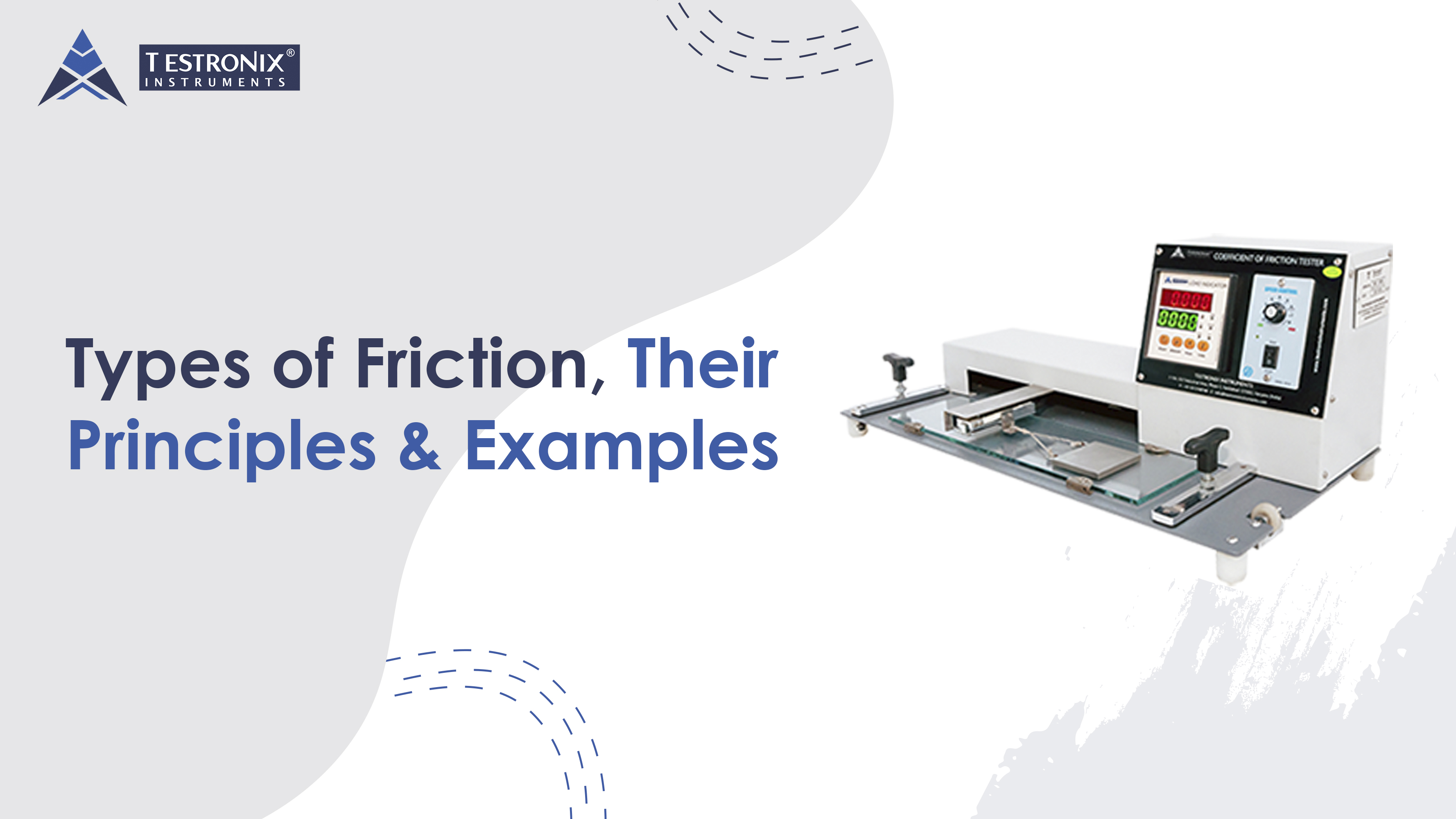
Testronix Coefficient of Friction Tester For Friction Measurement
In manufacturing industries, friction cannot be judged just by touch or guesswork. Small friction changes can affect packaging quality, machine performance, and material handling. That is why friction testing becomes necessary.
The Testronix Coefficient of Friction Tester is used to measure static and kinetic friction between surfaces. It is commonly used for packaging films, plastic sheets, laminates, paper, and similar materials.
This highly efficient coefficient of friction tester by Testronix becomes a must have equipment in packaging operations. Suppose a plastic film becomes too slippery. Stacked packets may slide during transport or storage. If friction becomes too high, the same material may create feeding problems inside automatic machines. Both situations affect production efficiency.
Testronix provides friction testing equipment designed for accurate and repeatable measurements. Many manufacturers use these testers during quality control because stable friction values improve machine handling and reduce material-related problems during production.
Conclusion
The working of friction highly depends on the type of friction a specific situation is facing. For example, static friction keeps things as they are, sliding friction keeps any object moving; rolling friction ensures smooth movement. All these are looks a textbook example but all the activities including the products we use in our everyday life, entirely depend on the friction.
Industries rely on proper friction testing because even small variations can create production issues and handling problems. Testronix is a trusted friction tester manufacturer offering reliable Coefficient of Friction Testers for accurate friction measurement and quality control applications. Businesses looking to improve material performance and production consistency can explore Testronix testing solutions for dependable results.