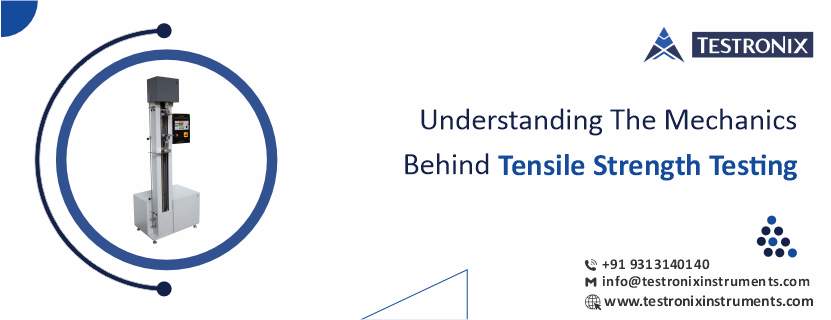
Material or product failures don’t happen overnight. If you have observed, they are triggered by gradual changes like stretching or permanent deformation. To ensure reliability and to avert catastrophic failure in real-world applications, manufacturers depend on controlled testing methods like the tensile test to quantify a material’s strength and performance limits in full.
Because of that, manufacturers do not take risks with material strength and its performance. They test it properly before shipment or delivery to the end customer. One common way to do this is through a tensile test. It’s not a complicated idea but it gives very useful information. In this article, we will discuss what a tensile test is, how people usually carry it out, the standards involved, and where it actually gets used in day-to-day industrial work.
What is Tensile Test
A tensile test determines a material's behavior under axial tensile load by applying a steadily increasing force to a sample until fracture occurs. The test will gather important information in this process including the yield point, ultimate tensile strength and ductility. This will provide you with the values needed to determine if a material is suitable for the engineering application.
What makes this test useful is not just the breaking point. It’s everything that happens before that. The amount of stretch, the point where it stops returning and the maximum force it can handle. All of this gets recorded during the test.
So instead of guessing whether a material is strong enough, you get actual values after performing a tensile test. Those values help in deciding if the material is suitable for a specific job or not.
Tensile Test Procedure: Step Wise Explanation
The tensile test procedure is basically a controlled way of pulling a sample and observing how it reacts when load increases. Here is the step-by-step process:
Step 1.
Tensile testing starts with preparing the sample. This part matters more than people think. If the sample size is off or the shape is uneven, the result can be misleading. So standard dimensions are followed.
Step 2.
Once the sample is ready, it is placed in the machine. Both ends are held firmly using grips. If the grip is too loose, the sample may slip during the test which makes the overall test and the data unreliable.
Step 3.
After that, the machine settings are adjusted. The pulling speed is fixed. This is important because different speeds can give different results.
Step 4.
Now the actual tensile test begins. The machine starts pulling slowly. First the material stretches and still has the ability to return to its original form. After some time, that changes. The material starts to deform permanently.
Step 5.
The force keeps on increasing until the material reaches a maximum. That is the maximum strength. Beyond that, it cannot hold the load and breaks.
Throughout this process, the machine keeps recording both the force and the extension. Later, this data is used to study the material behavior in detail.
Common Standards for Tensile Test
Tensile testing is not done randomly but it follows set standards so that the results make the test efficient and ensure the high-quality product.
Some commonly used standards for tensile tests include ASTM E8 for metals and ASTM D638 for plastics. ISO 527 is also used for polymer materials. These are widely accepted, so results based on them are easier to trust.
In addition to the standards, the machine used for testing also plays a role. If the testing equipment is not properly calibrated or accurate, even a well-followed method won’t help much. Testronix Instruments builds tensile testing machines that match these standards. This helps in getting consistent readings without much variation.
So, it’s not just about doing the test; it’s about doing it in the right way with the correct setup. These standards explain how to prepare the sample, how quickly to run the test and how to record the results.
Uses of Tensile Test
Tensile tests have a very wide range of applications in industries like manufacturing, packaging, pharmaceuticals, electronics, and others. This ensures that products manufactured across these industries should be efficient, reliable and durable in the long term.
-
In manufacturing, it helps in selecting materials before production begins. Instead of assuming that a material will perform well, companies test it first.
-
In construction, materials like steel are checked to see how much load they can handle. This is important for safety.
-
Tensile testing is part of packaging testing where the amount of force a plastic film can withstand before tearing. It is used to determine increased product durability.
-
Tensile testing is also used in automotive and aerospace applications. In these industries, components are subject to stress, so they must be tested for strength.
-
Tensile test is also widely used in product development. The new materials are tested to know the behavior and the existing materials are improved according to the results of the tests.
Conclusion
Tensile testing gives a practical understanding of how materials behave when force is applied. It is not just about finding the breaking point. It helps in seeing the full behavior of the material under stress. This makes it easier to avoid failures and improve product quality.
Testronix Instruments offers tensile testing machines that follow standard methods and provide dependable results. If you want better control over material quality and performance, using proper testing equipment is something worth considering.