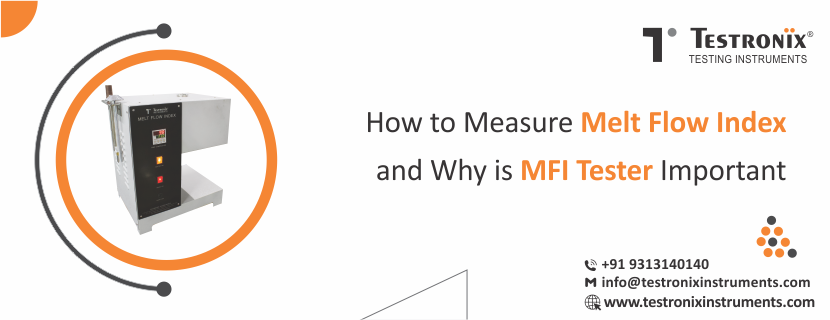
Anyone working with plastic manufacturing knows one thing very clearly: Even a small change in raw material behavior can create big production issues. Sometimes the material does not fill the mold properly and other times, the surface finish comes out rough. In other cases, the product becomes weaker than expected even though the machine settings look fine.
A lot of these problems connect back to material flow and that is exactly why MFI testing is important in the plastics industry. It gives manufacturers a quick idea of how a polymer will behave once it melts inside the processing machine.
People often hear the term MFI during injection molding, extrusion, and quality testing but many are still not fully clear about what it actually means or why industries depend on it so much. So in this article, we will break it down in a simple way. We will discuss the meaning of MFI, its full form, formula, practical example, advantages, and also the limitations people usually ignore.
What Is MFI
MFI, or Melt Flow Index, is a measure of how easily a thermoplastic material flows when it is melted under a specific temperature and load. The result tells manufacturers whether the material is flowing too fast, too slow, or somewhere in between.
In simple terms, it is like checking the thickness of melted plastic during processing. Some polymers become very fluid once heated. Others stay comparatively thick and move slowly through the machine barrel. MFI gives a measurable value for this behavior so manufacturers can compare materials properly before starting production.
The test is mainly performed on thermoplastic materials. During the procedure, the plastic sample is heated inside a metal barrel. A standard load is placed on top, and the molten material is pushed through a small die opening. The quantity of material coming out within 10 minutes is measured and recorded as the MFI value.
This small test actually saves manufacturers from a lot of confusion later on. A material with very high flow may process quickly but might not provide the strength needed for some products. On the other hand, low flow material may become difficult to process in thin wall applications. So the balance matters quite a bit in real factory conditions.
MFI Full Form
MFI full form is Melt Flow Index. It is often known as Melt Flow Rate or Melt Index in factories and testing labs. Most professionals use these terms almost interchangeably. All of them refer to measuring the flow behavior of molten plastic material.
Related: What is Melt Flow Rate?
MFI Formula
MFI formula is used for calculating the Melt Flow Index. It measures the amount of molten polymer flowing through the die over a fixed period and calculates it in g/10 minutes.
MFI = W × 600 / t
Here:
W = Weight of molten material collected in grams
t = Time taken in seconds
600 = Conversion factor for 10 minutes
The formula converts the collected sample into grams per 10 minutes. That standard timing is important because every manufacturer needs comparable results under the same conditions.
Understand MFI Testing With An Example:
Suppose a lab technician collects 4 grams of molten plastic in 24 seconds during the test.
Then the formula becomes:
MFI = 4×600/24
MFI = 2400/24 = 100
The final result will be:
MFI = 100 g/10 min
This means the material has a relatively high melt flow property. Such materials usually move more easily during molding operations.
In actual manufacturing, these numbers help operators decide whether a material batch is suitable for the production line or not. Sometimes even a slight variation in MFI creates visible differences in the final product quality. Experienced production teams pay close attention to this test for that reason.
Benefits of Melt Flow Index in Manufacturing Industry
Quick Results
The biggest benefit of MFI in the plastics industry is that it gives quick results without making the process overly complicated. Factories need practical testing methods. MFI fits that requirement pretty well.
Easy Identification
Plastic manufacturers often receive material from different batches. Even when the grade name stays the same, processing behavior may change slightly. MFI testing helps identify those changes before production begins.
Easy to Set Up
Melt flow index is not only an educational term but it also offers a smoother machine setup. Even a beginner operator can adjust temperature and processing parameters easily as they already understand material flow characteristics with the help of MFI. It reduces trial runs and unnecessary wastage on the shop floor.
Great Choice for Recycled Materials
The test is also useful for comparing virgin and recycled plastic materials. Recycled polymers usually behave differently after repeated heating cycles. MFI values help manufacturers understand whether the recycled material can still perform properly for a particular application.
Quality Control
Quality control departments rely heavily on this test as well. If a batch suddenly shows abnormal MFI values, it often indicates contamination, degradation, or formulation issues. Catching such problems early prevents larger production losses later.
Material Selection
Another practical benefit is material selection. Different applications require different flow properties. Thin molded products usually need better flow. Structural applications may require lower-flow material with higher strength characteristics. MFI values make this selection process much easier.
With so many packaging and polymer companies taking the preference of automated testing systems, manual variations can affect the readings. Testronix is one of the most popular brands that are preferred by the Indian manufacturers for the melt flow testing equipment because of its consistent performance and ease of operation in the industrial environment.
Limitations of Melt Flow Index
Even though MFI testing is widely used, it does not provide a complete picture of polymer performance. A lot of people make the mistake of depending only on this value while selecting materials.
-
One limitation is that the test works under fixed laboratory conditions. Real production environments are much more dynamic. Pressure, temperature, shear rate, and machine speed keep changing during actual processing.
-
MFI also does not directly measure product strength or durability. Two materials can show very similar MFI values but behave completely differently in real applications. Molecular structure and additives still play a huge role.
-
Filled materials sometimes create another challenge. Plastics containing fibers or fillers may not give perfectly reliable flow readings during testing. In such situations, additional rheological analysis becomes necessary.
-
Operator handling can also affect results. Improper cleaning, temperature fluctuation, or sample preparation mistakes may produce inaccurate readings. This part gets overlooked more often than people think.
That is why experienced manufacturers never depend on MFI alone. They usually combine it with tensile testing, impact testing and other quality checks before approving a material for production use.
Conclusion
You have seen many reasons why MFI testing is a standard practice for plastic quality control purposes. It provides manufacturers with a quick, convenient method to learn about polymer melt flow during processing. The MFI test plays a very important role in various industries, from material selection and batch verification to ensuring better production decisions as we discussed in this article.
However, MFI should form part of a larger quality assessment. It gives valuable information but it does not account for all the properties of a polymer in isolation.
If you are involved in any plastic-related business and are looking for reliable equipment to conduct accurate tests, you should schedule a consultation with Testronix, known as one of the leading Melt Flow Index Tester manufacturers in India. Our testing instruments including the MFI tester, are widely used in packaging, polymer, and industrial testing applications.
To get the right MFI tester for your business, contact us to get a quote. You will get a fully customized MFI index tester based on your requirements and designed for your business only to improve consistency and process control.