The tensile strength of a yarn is one of the important factors of a textile product that determines if the product will keep serving its purpose or will fail. Even a well-structured yarn may fail to perform as expected under forces if the appropriate tensile characteristics were not assessed during its production. The differences in appearance and performance testing are then critical.
Tensile strength testing and adherence to Indian Standard 1670:1991 are always ensured by textile manufacturers, quality control organizations, and consumers. Without an established procedure for testing, manufacturers cannot be confident in the results that different testing facilities obtain from the same lot of yarn. Such a situation could lead to disagreements among departments and produce data that cannot be trusted as accurate.
This article covers what IS 1670:1991 is, what it covers, how the tensile strength measurement procedure works, and what equipment is needed to run compliant tests.
What is IS 1670:1991?
IS 1670:1991 is published by the Bureau of Indian Standards and specifies the method for determining the tensile strength and elongation of yarn. It applies to single yarns tested on a tensile testing machine under defined conditions.
The standard was established to bring consistency to yarn strength testing across the Indian textile industry. Before standardized methods, manufacturers and labs used varying gauge lengths, testing speeds, and conditioning requirements. Results were not comparable. IS 1670:1991 eliminated this problem by specifically defining what constitutes each parameter.
In addition, any lab that follows the testing method will produce results that can be compared to specifications or supplier claims in an accurate manner. The standard is still used as a reference when assessing yarn in regard to purchasing, quality assurance or for the resolution of disputes in the textile industry.
Purpose and Scope of IS 1670:1991 for Yarn Strength Testing
The purpose of IS 1670:1991 is to provide the textile industry with a single, reproducible method for measuring how much load a yarn can bear before it breaks and how much it stretches in the process.
The scope of IS 1670:1991 covers spun yarns and continuous filament yarns tested individually. It defines the gauge length at which specimens are tested, the rate of extension during the test, the number of specimens required for a valid result and how the final values should be calculated and reported. Conditioning is also addressed. Yarn absorbs or releases moisture depending on ambient humidity, and moisture content directly affects tensile properties.
According to the standard, samples must first be conditioned using a standard atmosphere of 27 degrees Celsius (80) at 65 percent relative humidity before the actual testing takes place. If this step is skipped, you will receive test results that cannot be compared to other test environments or seasons.
This standard provides information on how to properly handle yarn packages during preparation and how to avoid introducing twisting changes through extraction as well as the definition of what is considered an outlier test so that outliers can be excluded from the final calculation. These specifications are often overlooked but have a significant impact on how reliable the test data will be.
IS 1670:1991 PDF Download
For accurate tensile testing results, manufacturers must have a complete understanding of IS 1670:1991 with all test parameters, calculation methods, and reporting guidelines. Download the full PDF below for detailed IS 1670:1991 specifications to set up and verify your yarn tensile testing procedures.
[Download IS 1670: 1991 PDF]
IS 1670:1991 Tensile Strength Measurement Procedure
The procedure is not complicated but each step has a reason behind it. Skipping or approximating any part affects the validity of the result.
Specimen Conditioning
Before any testing begins, yarn specimens must be conditioned at 65% relative humidity and 27°C for a minimum period as specified in the standard. This is the step most often skipped in informal testing setups. The effect of moisture on yarn strength is real and significant. Cotton yarn tested at 40% RH will give different breaking strength values than the same yarn tested at 65% RH. Conditioning removes that variable.
Specimen Preparation
Yarn is threaded from the package carefully to avoid adding or removing twist. The test specimen is set at the gauge length specified in the standard, typically 500 mm for most yarn types. The ends are clamped into the tensile tester grips without slippage. Grip slippage is a common source of error. If the yarn slips rather than breaks, that result is discarded.
Running the Test
The tensile tester applies a continuous extension at the defined rate of traverse until the yarn breaks. The machine records the breaking load and the extension at break. IS 1670: 1991 specifies the rate of extension in terms of time to break, not traverse speed, so the tester needs to be set accordingly based on the expected elongation of the yarn being tested.
Result Calculation
A minimum number of specimens is tested per lot as defined in the standard. Results from specimens that broke at the clamps or showed grip slippage are excluded. Breaking load is recorded in Newtons or grams-force depending on the reporting requirement. Elongation at break is expressed as a percentage of the original gauge length. The mean and coefficient of variation are calculated from valid results to give both the average performance and the consistency of the lot.
Testronix Tensile Tester: IS 1670 Compatible Tensile Testing Equipment
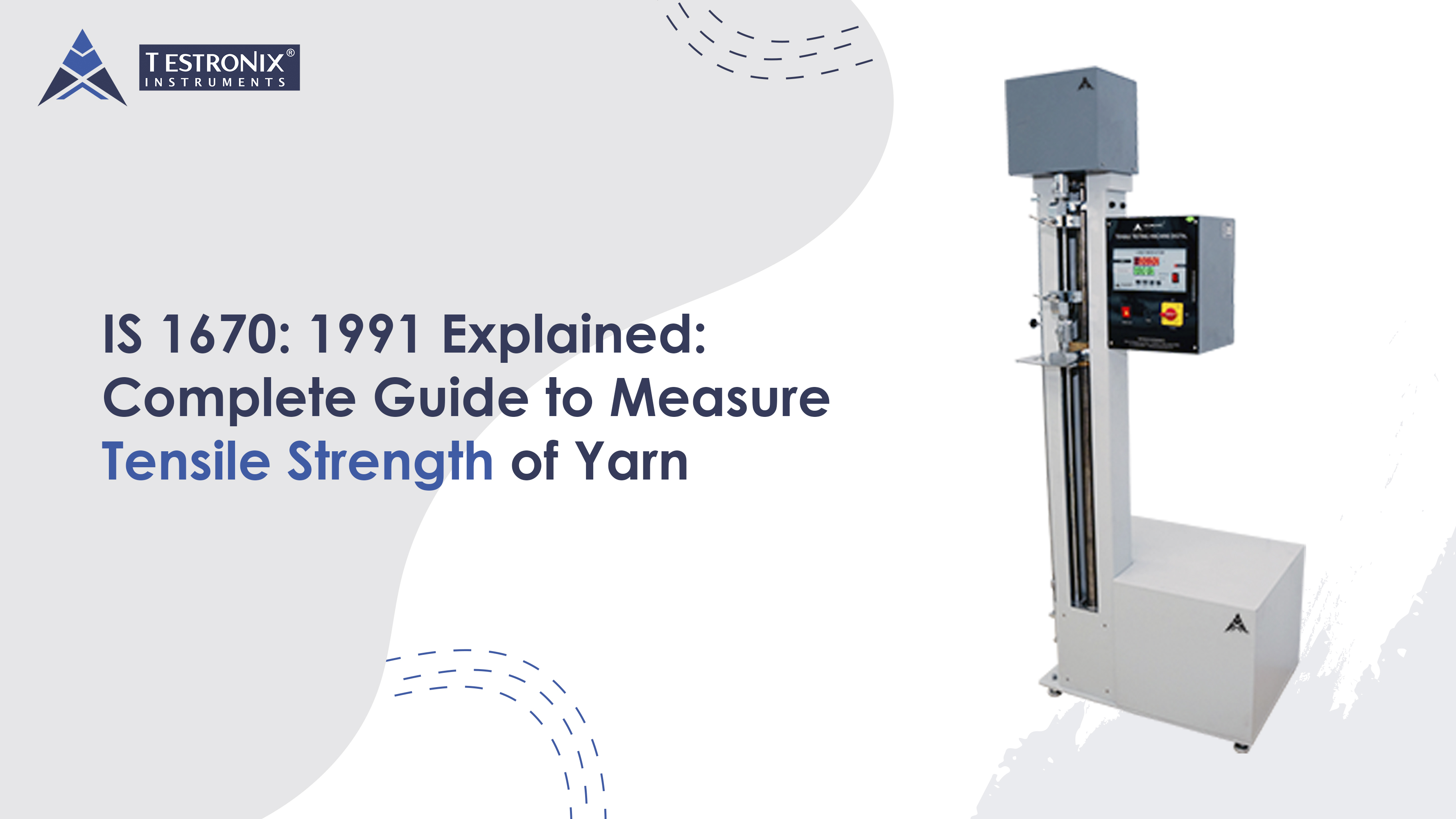
Running IS 1670:1991 compliant tests requires a tensile tester that can handle yarn-scale specimens with the accuracy and control the standard demands. Testronix Instruments manufactures tensile testing machines built for textile applications including IS 1670 yarn testing.
Our tensile testers support programmable traverse speeds and rate of extension settings. So, the tester can be configured to meet the time-to-break requirement specified in the standard for different yarn types. The load cell range in our tensile testing machine covers the breaking loads typical of both fine and coarse yarns without resolution loss at the lower end.
Data logging captures breaking load and elongation for each specimen automatically. The software calculates mean values and coefficients of variation across the test series and generates test reports that work directly with quality documentation and audit requirements. For labs running regular incoming yarn inspection or process quality checks, this kind of structured output matters more than the individual test result.
Conclusion
Tensile strength testing of yarn is only as reliable as the method behind it. IS 1670: 1991 provides that method, and following it correctly requires the right conditioning setup, proper specimen handling, and a tensile tester that can be configured to the standard's requirements.
Testronix Instruments offers IS 1670:1991 compatible tensile testers with the yarn-specific fixtures and software needed for compliant, repeatable testing. Contact us to get a quote or to discuss specifications, get a product demonstration, or get a technical consultation based on your yarn testing requirements.