A pH meter is a scientific instrument used to measure the acidity (acidic nature) or alkalinity (basic nature) of a liquid solution. It determines the hydrogen ion (H+) activity in the solution and displays the result as a pH value on a scale ranging from 0 to 14. Compared with pH paper or indicator solutions, a digital pH meter provides more accurate and consistent measurements, making it a preferred choice for laboratories and industrial applications.
pH meters are widely used in chemistry laboratories, biology and microbiology research, environmental testing, water and wastewater treatment, food and beverage processing, pharmaceutical manufacturing, agriculture, and quality control laboratories. Accurate pH measurement helps maintain product quality, supports reliable experimental results, ensures regulatory compliance, and provides optimal conditions for chemical and biological processes.
In this article, you will learn what a pH meter is, its full form, pH scale, diagram, basic components, and how it measures the pH of a solution.
What is a pH Meter?
A pH meter is a laboratory instrument designed to measure the pH value of a solution by detecting the activity of hydrogen ions (H+). It consists of an electronic meter connected to a pH electrode (probe), which generates an electrical signal based on the hydrogen ion concentration in the sample. The meter converts this signal into a pH value displayed on the screen.
The pH of a solution is measured on a scale from 0 to 14, where:
- pH 0–6.9: Acidic solution (higher hydrogen ion concentration)
- pH 7: Neutral solution (pure water at standard conditions)
- pH 7.1–14: Alkaline or basic solution (lower hydrogen ion concentration)
Because of its accuracy and ease of use, a pH meter is commonly used for chemical analysis, laboratory research, water quality testing, food processing, pharmaceutical production, environmental monitoring, agriculture, and industrial quality control.
pH Meter Full Form
The full form of pH is commonly written as "Potential of Hydrogen." It is also sometimes referred to as "Power of Hydrogen." The term represents the concentration or activity of hydrogen ions (H+) present in a solution and indicates whether the solution is acidic, neutral, or alkaline.
A pH meter measures the hydrogen ion activity and calculates the corresponding pH value.
- Higher H+ concentration → Lower pH value → More acidic solution
- Lower H+ concentration → Higher pH value → More alkaline (basic) solution
- Neutral solutions have a pH value of approximately 7.
Understanding hydrogen ion concentration is essential for maintaining the desired pH in laboratory experiments, industrial manufacturing, water treatment, and biological processes.
pH Meter Diagram
The pH meter diagram below shows the major components of a typical laboratory pH meter and their functions. Understanding these parts helps users operate the instrument correctly and interpret pH measurements accurately.
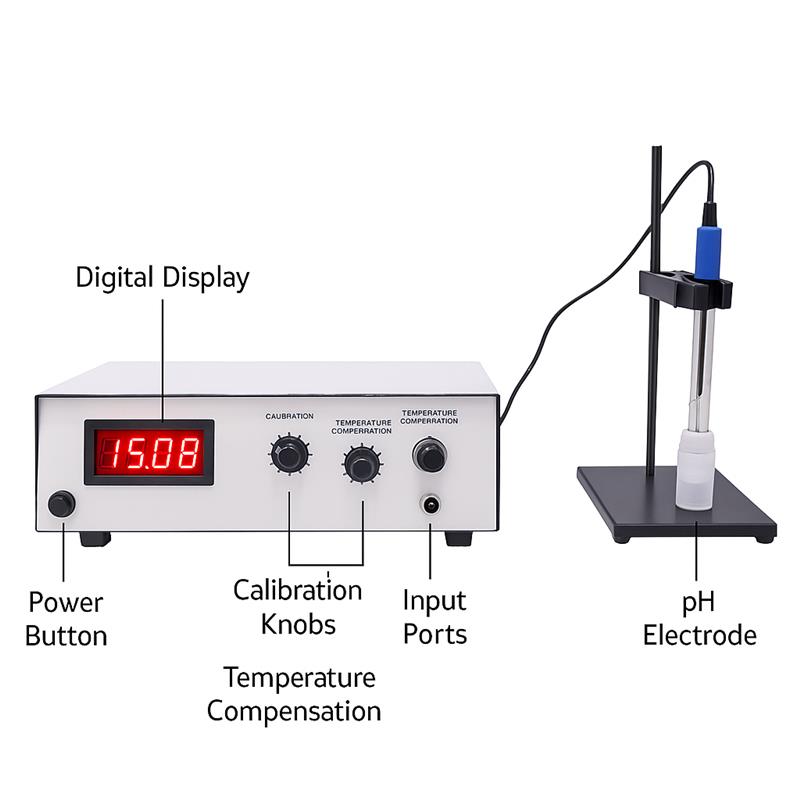
The main components of a pH meter include:
- Digital Display: Displays the measured pH value.
- pH Electrode (Glass Probe): Detects the hydrogen ion (H?) activity in the sample solution.
- Calibration Knobs/Controls: Used to calibrate the meter with standard buffer solutions for accurate measurements.
- Temperature Compensation: Corrects measurement variations caused by changes in sample temperature.
- Input Ports: Connect the pH electrode and temperature probe to the meter.
- Power Button: Turns the instrument on or off.
When the pH electrode is immersed in a solution, it generates a small electrical potential based on the hydrogen ion activity. The meter converts this electrical signal into a pH value, which is displayed on the digital screen. Proper calibration and temperature compensation help improve measurement accuracy.
How Does a pH Meter Work?
A pH meter measures the acidity or alkalinity of a solution by detecting the activity of hydrogen ions (H?) using a glass electrode. When the pH electrode is immersed in a sample, it develops a small electrical potential that varies according to the hydrogen ion concentration. This electrical signal is compared with the stable voltage produced by the reference electrode.
The pH meter processes the voltage difference between the two electrodes and converts it into a pH value displayed on the digital screen. The measured value indicates whether the solution is:
- Acidic: pH below 7
- Neutral: pH equal to 7
- Alkaline (Basic): pH above 7
To ensure reliable results, the instrument should be calibrated regularly using standard buffer solutions. Many modern digital pH meters also include automatic temperature compensation (ATC) to minimize measurement errors caused by temperature variations.
Working Principle of a pH Meter
The working principle of a pH meter is based on measuring the electrical potential (voltage) difference generated between a glass measuring electrode and a reference electrode when they are immersed in a solution.
The glass electrode is sensitive to hydrogen ions (H?), while the reference electrode provides a stable electrical potential. The difference in voltage between these two electrodes changes according to the hydrogen ion activity in the solution. The pH meter measures this voltage and converts it into a pH value using the Nernst equation, which describes the relationship between electrode potential and ion concentration.
The Nernst equation is expressed as:

Where:
- E = Measured electrode potential
- E0 = Standard electrode potential
- R = Universal gas constant (8.314 J/mol·K)
- T = Temperature in Kelvin
- n = Charge number of the ion (for H+, n = 1)
- F = Faraday’s constant (96,485 C/mol)
- H+ = Hydrogen ion concentration
- Q = Reaction quotient
Because electrode voltage changes with temperature, many modern pH meters include automatic temperature compensation (ATC) to improve measurement accuracy.
What is the pH Scale?
The pH scale is a logarithmic scale used to measure the acidity or alkalinity of a solution based on its hydrogen ion (H+) concentration. The scale ranges from 0 to 14, where lower values indicate higher acidity and higher values indicate greater alkalinity.
The pH scale is divided into three categories:
- Acidic (pH below 7): The solution contains a higher concentration of hydrogen ions (H+) than hydroxide ions (OH-).
- Neutral (pH 7): The concentrations of hydrogen ions (H+) and hydroxide ions (OH-) are equal. Pure water at standard conditions has a pH close to 7.
- Alkaline or Basic (pH above 7): The solution contains a higher concentration of hydroxide ions (OH-) than hydrogen ions (H+).
Because the pH scale is logarithmic, a change of one pH unit represents a tenfold change in hydrogen ion concentration. For example, a solution with a pH of 4 is ten times more acidic than a solution with a pH of 5.
Components of a pH Meter
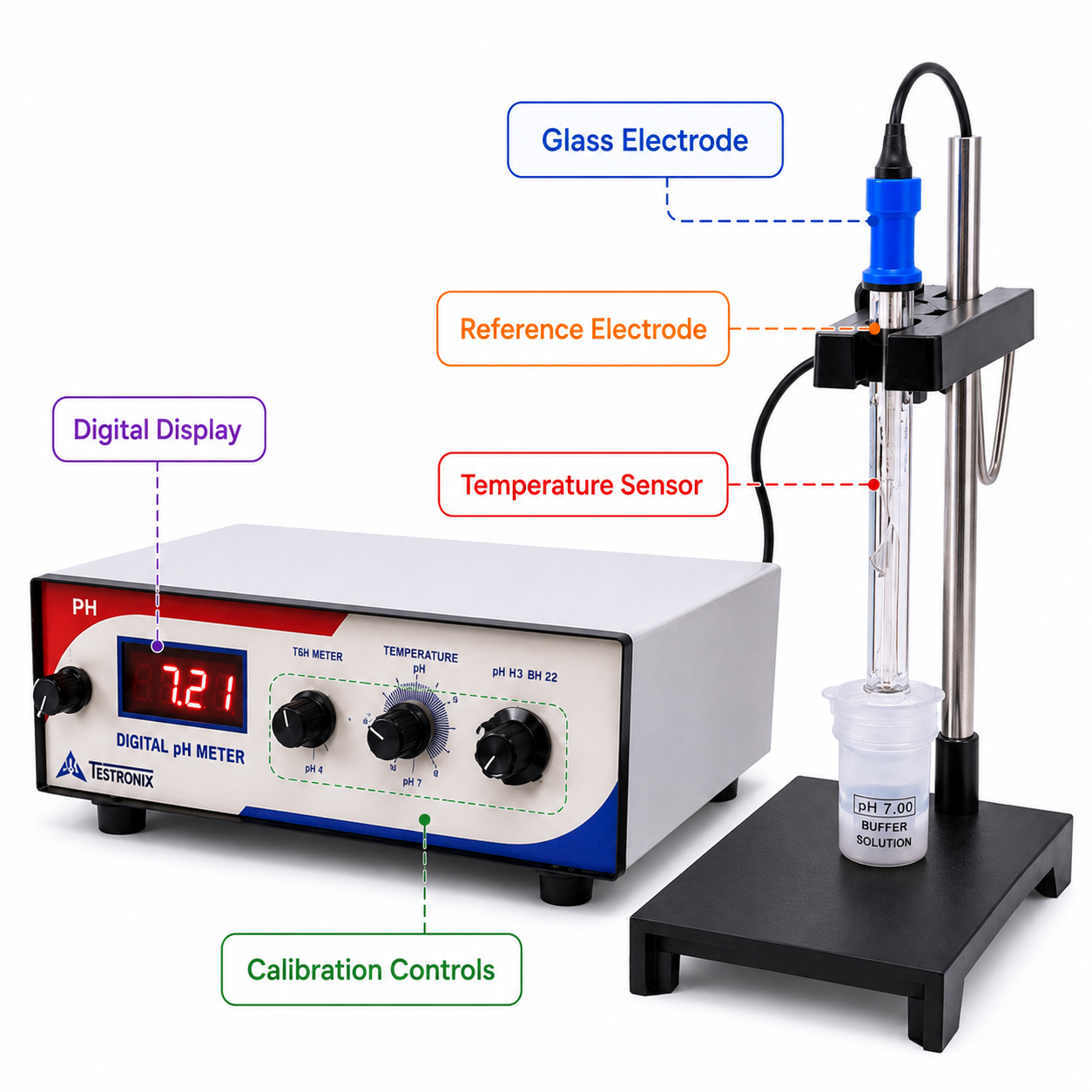
A pH meter consists of several components that work together to measure the pH of a solution accurately. Each component performs a specific function to ensure precise and reliable measurements.
Glass Electrode
The glass electrode is the primary sensing element of a pH meter. Its thin glass membrane is sensitive to hydrogen ions (H?) present in the sample solution. When the electrode comes into contact with the solution, it generates a small electrical potential that changes according to the hydrogen ion activity. This signal is used to determine the pH value.
Reference Electrode
The reference electrode provides a stable and constant electrical potential against which the measuring electrode is compared. It typically contains a silver/silver chloride (Ag/AgCl) or calomel reference system with a potassium chloride (KCl) electrolyte solution. The stable reference voltage enables the pH meter to accurately measure changes caused only by hydrogen ion activity.
Temperature Sensor
The temperature sensor measures the sample temperature and compensates for temperature-related changes in electrode response. Since pH measurements vary with temperature, many digital pH meters use Automatic Temperature Compensation (ATC) to improve measurement accuracy and consistency.
Digital Display
The digital display shows the measured pH value clearly and accurately. Modern pH meters typically use LCD or LED displays that can also show temperature, calibration status, battery level, and other measurement parameters, making operation easier and reducing reading errors.
Calibration Controls
Calibration controls allow users to calibrate the pH meter using standard buffer solutions before taking measurements. Common buffer solutions have pH values of 4.00, 7.00, and 10.00. Proper calibration ensures that the instrument provides accurate and repeatable results. Most modern pH meters support automatic one-point, two-point, or three-point calibration.
Types of pH Meters
Different types of pH meters are available to suit laboratory, industrial, and field-testing requirements. They differ in size, accuracy, portability, and intended application. Choosing the right pH meter depends on the testing environment, measurement accuracy required, and sample type.
|
Type of pH Meter |
Description |
Common Applications |
|
Analog pH Meter |
A traditional pH meter with a needle-based analog display. It requires manual interpretation and regular calibration for accurate measurements. |
Educational laboratories and basic pH testing. |
|
Digital pH Meter |
An electronic pH meter with a digital display that provides fast, accurate, and easy-to-read measurements. |
Chemical laboratories, pharmaceutical manufacturing, food processing, research laboratories, and industrial quality control. |
|
Pen-Type pH Meter |
A compact and lightweight portable pH meter designed for quick spot measurements. |
Food production, aquariums, hydroponics, swimming pools, and field testing. |
|
Handheld pH Meter |
A portable meter with replaceable electrodes, offering higher accuracy than pen-type models. |
Water treatment plants, agriculture, environmental monitoring, wastewater analysis, and field research. |
|
Benchtop pH Meter |
A high-precision laboratory instrument with advanced calibration and measurement features. |
Research laboratories, pharmaceutical laboratories, food and beverage testing, environmental analysis, and quality control laboratories. |
How to Use a pH Meter in a Laboratory?
Using a pH meter correctly is essential for obtaining accurate and repeatable measurements. Proper calibration, sample handling, and electrode maintenance help ensure reliable results.
Step 1: Calibrate the pH Meter
Before measuring any sample, calibrate the pH meter using standard buffer solutions with known pH values, typically 4.00, 7.00, and 10.00.
- Rinse the electrode with distilled water.
- Gently blot the electrode dry using a lint-free tissue.
- Immerse the electrode in the pH 7.00 buffer solution and allow the reading to stabilize.
- Repeat the process with pH 4.00 and pH 10.00 buffer solutions if multi-point calibration is required.
Step 2: Measure the Sample
After calibration:
- Rinse the electrode with distilled water to prevent cross-contamination.
- Immerse the electrode completely in the sample solution.
- Avoid allowing the electrode to touch the sides or bottom of the container.
- Wait until the displayed reading becomes stable.
- Record the pH value shown on the display.
Step 3: Clean and Store the Electrode
After completing the measurement:
- Rinse the electrode thoroughly with distilled water.
- Clean it with an appropriate electrode-cleaning solution if deposits are present.
- Store the electrode in the recommended storage solution to prevent the glass membrane from drying out.
Proper storage and routine maintenance extend the life of the electrode and help maintain measurement accuracy.
Applications of pH Meters in Laboratories
A pH meter is widely used in laboratories and industrial facilities to measure the acidity or alkalinity of solutions. Accurate pH measurement is essential for scientific research, product quality, regulatory compliance, and process control.
Chemical Research
In chemistry laboratories, pH meters are used to monitor acidic and alkaline reactions, prepare buffer solutions, and control reaction conditions. Maintaining the correct pH helps improve experimental accuracy, reproducibility, and laboratory safety.
Medical and Pharmaceutical Industry
The pharmaceutical industry uses pH meters during drug formulation, quality control, and clinical laboratory testing. Maintaining the correct pH is essential for ensuring the stability, effectiveness, and safety of medicines, vaccines, and other pharmaceutical products.
Food and Beverage Industry
Food manufacturers use pH meters to monitor the acidity of dairy products, beverages, processed foods, meat products, fermented foods, and packaged foods. Proper pH control improves product quality, enhances shelf life, and supports food safety standards.
Environmental Science
Environmental laboratories use pH meters to assess the quality of drinking water, groundwater, rivers, lakes, industrial wastewater, and treated effluents. Measuring pH helps identify pollution, evaluate treatment efficiency, and ensure compliance with environmental regulations.
Agriculture
In agriculture, pH meters are used to measure the pH of soil and irrigation water. Soil pH directly affects nutrient availability, fertilizer efficiency, and crop productivity. Regular pH testing helps farmers select suitable crops and optimize soil management practices.
Biotechnology and Microbiology
Biotechnology and microbiology laboratories use pH meters to maintain the optimum pH required for cell culture, microbial growth, fermentation, and enzyme activity. Accurate pH control ensures reliable experimental results and consistent production processes.
Water and Wastewater Treatment
Water treatment facilities continuously monitor pH during drinking water purification, wastewater treatment, and industrial process water management. Maintaining the correct pH helps optimize chemical treatment, reduce corrosion, and ensure compliance with water quality standards.
Benefits and Limitations of a pH Meter
A pH meter is widely used in laboratories and industries because it provides fast, accurate, and reliable measurements of the acidity or alkalinity of solutions. Like any scientific instrument, it offers several advantages but also has certain limitations that users should understand before selecting or operating the device.
Benefits of a pH Meter
Accurate and Fast Measurements
A pH meter provides highly accurate and repeatable pH measurements within seconds. Unlike pH paper or chemical indicators, which rely on color comparison, a digital pH meter displays precise numerical readings, reducing human error and improving measurement reliability.
Easy to Use and Portable
Modern digital pH meters are designed for convenient operation and are available in pen-type, handheld, and benchtop models. Many instruments feature automatic calibration, digital displays, and automatic temperature compensation (ATC), making them suitable for both laboratory and field applications.
Suitable for a Wide Range of Applications
pH meters are used in chemical laboratories, pharmaceutical manufacturing, food and beverage processing, agriculture, environmental monitoring, biotechnology, water treatment, and academic research. Their versatility makes them an essential instrument for quality control, scientific analysis, and process monitoring.
High Measurement Precision
Laboratory-grade pH meters provide greater precision than indicator strips, making them suitable for applications where even small changes in pH can affect product quality, chemical reactions, or biological processes.
Limitations of a pH Meter
Although pH meters provide accurate measurements, proper operation and maintenance are essential for obtaining reliable results.
Requires Regular Calibration
A pH meter must be calibrated periodically using standard buffer solutions (typically pH 4.00, 7.00, and 10.00). Failure to calibrate the instrument can result in inaccurate or inconsistent measurements.
Glass Electrode Requires Careful Handling
The glass electrode is the most sensitive component of a pH meter. It can be damaged by physical impact, improper cleaning, or incorrect storage. Careful handling and regular maintenance are necessary to maintain measurement accuracy.
Measurements Are Influenced by External Factors
Several factors can affect pH measurements, including temperature variations, sample contamination, electrode aging, and improper calibration. Many modern pH meters include Automatic Temperature Compensation (ATC) to reduce temperature-related measurement errors.
Periodic Electrode Replacement
Over time, the performance of the pH electrode gradually decreases due to normal wear and chemical exposure. Replacing the electrode at the manufacturer's recommended interval helps maintain consistent measurement accuracy.
How to Maintain and Calibrate a pH Meter
Proper maintenance and calibration are essential for ensuring accurate, reliable, and repeatable pH measurements. Regular care also extends the service life of the electrode and reduces the likelihood of measurement errors.
1. Calibrate the Meter Regularly
Calibrate the pH meter using certified buffer solutions with pH values of 4.00, 7.00, and 10.00 before use or according to the manufacturer's recommendations. Routine calibration compensates for normal electrode aging and ensures accurate measurements.
2. Store the Electrode Correctly
Always store the pH electrode in the recommended electrode storage solution when it is not in use. Never store the glass electrode in distilled or deionized water, as prolonged exposure can damage the reference system and reduce measurement performance.
3. Clean the Electrode After Every Measurement
Rinse the electrode thoroughly with distilled water after each measurement to remove any sample residue. If deposits or contamination remain, clean the electrode using a suitable electrode-cleaning solution recommended by the manufacturer. Gently blot the electrode dry with a lint-free tissue instead of rubbing the glass membrane.
4. Inspect the Electrode Regularly
Check the electrode for cracks, scratches, air bubbles, salt deposits, or contamination. If calibration becomes difficult or readings are slow, unstable, or inconsistent, the electrode may require cleaning or replacement.
5. Follow the Manufacturer's Maintenance Schedule
Routine maintenance, proper calibration, and timely electrode replacement help maximize the accuracy, reliability, and service life of the pH meter. Following the manufacturer's instructions ensures consistent performance in laboratory and industrial applications.
pH Meter Troubleshooting – Common Problems and Solutions
During routine laboratory or industrial use, a pH meter may produce inaccurate, unstable, or inconsistent readings due to electrode condition, calibration issues, contamination, or improper handling. The following troubleshooting guide helps identify common problems, their possible causes, and recommended solutions.
The table below summarizes the most common pH meter problems encountered during laboratory and industrial use, along with their possible causes and recommended corrective actions.
|
Problem |
Possible Cause |
Recommended Solution |
|
Reading is unstable or fluctuates |
Dirty electrode, air bubbles trapped in the reference junction, or depleted potassium chloride (KCl) electrolyte |
Clean the electrode thoroughly, gently tap it to remove trapped air bubbles, and refill the KCl solution if using a refillable electrode. |
|
Reading drifts slowly |
Electrode has become dehydrated due to improper storage |
Soak the electrode in 3 M KCl storage solution or pH 4.00 buffer solution for 30–60 minutes before use. |
|
Cannot complete calibration (reading remains more than ±5 mV from the buffer value) |
Glass electrode is aged, contaminated, or damaged |
Clean the electrode first. If calibration still fails, replace the electrode. |
|
Reading is consistently too high or too low |
Incorrect calibration, expired buffer solution, or contaminated buffer |
Recalibrate the pH meter using fresh, certified buffer solutions at the appropriate temperature. |
|
Meter displays an error during calibration |
Contaminated buffer solution, incorrect calibration sequence, or incompatible buffer settings |
Use fresh buffer solutions and calibrate in the correct order (typically pH 7.00, followed by pH 4.00 or pH 10.00). |
|
Electrode tip is cracked, chipped, or cloudy |
Physical damage or chemical attack on the glass membrane |
Replace the electrode immediately. A damaged glass membrane cannot produce accurate pH measurements. |
|
Slow response time (more than 60 seconds) |
Protein deposits, contaminated membrane, or electrode nearing the end of its service life |
Clean the electrode using a suitable electrode-cleaning solution such as a pepsin-HCl cleaner. Replace the electrode if performance does not improve. |
|
Display shows "OL" or out-of-range |
Electrode is not fully immersed or the sample is outside the instrument's measurement range |
Ensure the sensing tip is immersed by at least 1 cm and confirm that the sample pH falls within the meter's specified measurement range. |
Frequently Asked Questions (FAQs) About pH Meters
What does a pH meter measure?
A pH meter measures the hydrogen ion (H+) activity in a liquid solution to determine whether the solution is acidic, neutral, or alkaline. The instrument converts the electrical potential generated by the pH electrode into a pH value on a scale from 0 to 14, providing more accurate and reliable measurements than pH paper or indicator solutions.
How do you calibrate a digital pH meter?
To calibrate a digital pH meter, rinse the electrode with distilled water and immerse it in a pH 7.00 buffer solution. Allow the reading to stabilize and calibrate the meter according to the manufacturer's instructions. Repeat the process with pH 4.00 and pH 10.00 buffer solutions if two-point or three-point calibration is required. Always use fresh, certified buffer solutions for accurate calibration.
What is the purpose of a pH meter in a laboratory?
A pH meter is used in laboratories to measure the acidity or alkalinity of liquids accurately. It is commonly used in chemical analysis, pharmaceutical manufacturing, food quality testing, environmental monitoring, biotechnology, microbiology, and water analysis. Accurate pH measurement helps maintain product quality, support research, and ensure compliance with laboratory standards.
How does a pH meter work?
A pH meter works by measuring the electrical potential difference between a glass measuring electrode and a reference electrode immersed in a solution. The voltage generated by the hydrogen ion activity is converted into a pH value using the Nernst equation, and the result is displayed on the instrument's digital screen.
What are the common types of pH meters?
The most common types of pH meters include analog pH meters, digital pH meters, pen-type pH meters, handheld pH meters, and benchtop pH meters. Portable models are suitable for field testing, while benchtop instruments provide higher accuracy for laboratory research, quality control, and industrial applications.
How can I maintain a pH meter for long-term use?
To maintain a pH meter for long-term use, calibrate it regularly using certified buffer solutions, rinse the electrode with distilled water after each measurement, store the electrode in the recommended storage solution, and inspect it periodically for damage or contamination. Proper maintenance improves measurement accuracy and extends the service life of the electrode.
How often should a pH meter be calibrated?
The calibration frequency depends on how often the instrument is used and the accuracy required. In most laboratories, a pH meter is calibrated before each day's use or before critical measurements using standard buffer solutions. Frequent calibration compensates for normal electrode aging and helps ensure accurate and repeatable results.
Temperature affects the electrical response of the pH electrode and can influence the measured pH value. Many modern pH meters include Automatic Temperature Compensation (ATC), which adjusts the measurement based on the sample temperature. Using ATC helps improve accuracy, especially when measuring samples at temperatures different from room temperature.
Conclusion
A pH meter is an essential laboratory instrument used to accurately measure the acidity or alkalinity (pH) of a solution by determining its hydrogen ion (H+) activity. It plays a critical role in chemical analysis, pharmaceutical manufacturing, food and beverage testing, environmental monitoring, agriculture, biotechnology, and water quality assessment, where precise pH measurement is essential for reliable results and quality control.
Understanding the working principle, components, types, and applications of a pH meter helps users select the right instrument and use it correctly. Regular calibration, proper electrode maintenance, correct storage, and routine troubleshooting ensure accurate, consistent, and long-lasting performance. Whether used in a research laboratory, industrial facility, or field application, a well-maintained pH meter provides dependable measurements that support scientific research, regulatory compliance, and efficient process control.