Corrosion is one of those problems that doesn't appear suddenly or reveal itself. It penetrates quietly, weakens structures and coatings and may cost a lot to manufacturers if not handled correctly. That's why testing for it matters so much before a product ever reaches the field.
The IS 11864:1986 standard gives manufacturers a clear method to evaluate if the materials and coatings can hold up against salt-induced corrosion. Getting this test right is critical for industries as it creates the difference between a product that lasts years and one that fails within months, subjected to the conditions.
This blog breaks down what IS 11864:1986 actually covers, why it is still relevant today and what a reliable salt spray test procedure looks like in practice.
What is IS 11864:1986?
IS 11864:1986 is an Indian standard published by the Bureau of Indian Standards (BIS). It specifies the design, construction and operating requirements for a salt spray apparatus used in corrosion testing.
In simple terms, the IS11864:1986 specification describes the design, operation and test conditions of salt spray testing machines. The purpose of this standard is to create consistency in performing salt spray testing by different laboratories or industries throughout India.
Its core principles around chamber construction, spray nozzles, temperature controls and solution concentration remain very much applicable today.
It covers everything from what the chamber is built out of, to how you angle the specimens inside, to what temperature the whole thing should be running at. It is an elaborate document and when you are establishing a testing lab or need to check compliance requirements, it is easy to read through directly.
Download IS 11864:1986 Standard (PDF)
You can access the full IS 11864:1986 standard document here. It covers all construction specifications, operating conditions and technical requirements in detail. Recommended reading for anyone doing serious corrosion testing work.
Why IS 11864:1986 Important for Salt Spray Testing
Salt spray tests are common in the automotive, marine, aerospace, electronics and construction sectors. Any product that has a metal surface or protective coating usually undergoes some sort of this test. The findings dictate shelf life, durability assertions and in certain instances, compliance with customer or regulatory stipulations.
IS 11864:1986 is basically the rulebook for this kind of testing — it makes sure that whoever runs the test gets results that can actually be compared against each other. It lays out exactly what conditions need to be kept inside the chamber, how to mix the salt solution, and which way the specimens should be sitting. This consistency is what makes the test data meaningful rather than just a rough estimate.
This part matters especially for export-oriented manufacturers. When your products need to meet specific corrosion resistance claims, a salt spray test conducted as per an accepted standard carries weight. It's documentation that actually holds up.
Standard Procedure for IS 11864 (Salt Spray Test for Corrosion): Step by Step
Step 1: Prepare the Salt Solution
Take distilled water and dissolve sodium chloride in it — you are going for a 5% solution. Collect it at 25°C and check the pH, which should sit between 6.5 and 7.2. This one really matters, so go slow and be careful — mess this up and the rest of the process goes with it.
Step 2: Clean and Prepare the Test Specimens
Wipe the specimens down and get rid of any oil, dust or muck on them. Don't go too hard at it though — the coating needs to stay intact.
Step 3: Set Chamber Conditions
The temperature of chamber is the critical step in the operation that should be maintained at 35°C with a tolerance of two degrees according to IS 11864:1986. Before putting the specimens in, make sure the salt solution reservoir and atomizer have reached the right temperature and that the chamber has fully settled — don't rush this part.
Step 4: Position the Specimens Correctly
Angle the specimens between 15° and 30° from vertical, test side facing up. Make sure they're not touching each other or the walls of the chamber. Drip from one specimen should not fall onto another. This positioning rule is one of the more commonly skipped details in practice.
Step 5: Start the Test and Monitor
Keep the salt spray running the whole time without switching it off midway. Now and then, just pop in and check how much is being collected — anywhere between 1.0 and 2.0 ml per 80 cm² per hour is where you want to be. Those funnel-shaped collectors sitting inside the chamber are what you use to get that number.
Step 6: Remove and Evaluate
When the test wraps up, carefully take the specimens out and rinse them off with clean water — nothing too harsh, just a gentle rinse. Leave them to dry and then go over them properly. Look for rust, any bubbling or blistering, peeling, that sort of thing — basically anything that looks like the surface has taken a hit.
Tips for Accurate IS 11864:1986 Testing
A few practical things that make a real difference in getting reliable results.
Use high-purity sodium chloride
Low-grade salt introduces variables that affect both the pH and the corrosion mechanism. Always use lab-grade or analytical-grade sodium chloride. Tap water is also a problem. Even small traces of chlorine or minerals can throw off the solution chemistry.
Calibrate the chamber regularly
Temperature drift is more common than most labs expect. A chamber that reads 35°C on the display might have uneven heat distribution internally. Calibrate with a certified thermometer at multiple points inside the chamber especially with older machines.
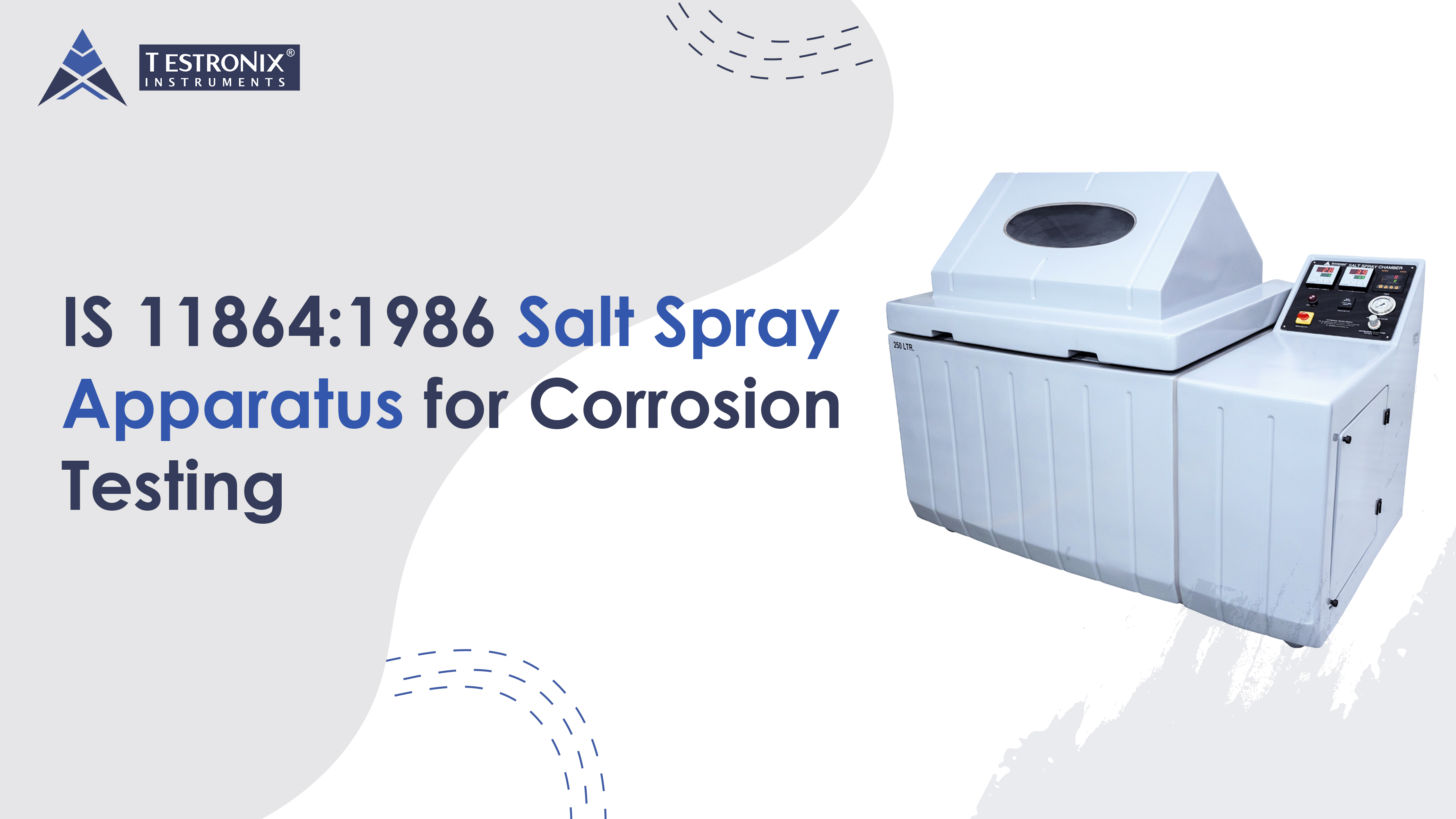
For labs doing high-volume corrosion testing, the machine itself matters a lot. Testronix Instruments manufactures salt spray testing chambers built with tight temperature uniformity and consistent spray output. Our equipment is designed to meet IS 11864:1986 along with other international standards which is useful when a lab needs to validate results across multiple specifications. It's a practical choice for facilities that can't afford inconsistent readings.
Don't ignore the nozzle condition
A blocked nozzle is pretty common and before you know it, your results are all over the place. Just clean it out regularly and take a look at how the spray is coming out — it should be nice and even. Even if it's only partially blocked, the mist won't distribute properly and that alone can compromise the whole test.
Document everything
Record chamber temperature, solution pH, spray rate, and specimen orientation for every test. If a result looks off, this documentation is how you trace the issue back to a specific cause rather than guessing.
Conclusion
IS 11864:1986 gives structure to something that's easy to do inconsistently. Salt spray testing isn't complicated in principle but the details in the standard exist because small deviations in temperature and specimen placement can produce misleading data.
If you are setting up a corrosion testing lab or reviewing your existing process, going through the IS 11864:1986 document is time well spent. You can download IS 11864:1986 PDF to check all relevant standards and SOPs before conducting a test.
Looking for a Reliable Salt Spray Tester?
Testronix Instruments is one of India's leading manufacturers of salt spray testing chambers, trusted by manufacturers across the automotive, coatings, aerospace and electronics industries. Our machines are built to comply with IS 11864:1986 and relevant international standards, with features like precise temperature control, uniform mist distribution and easy-to-operate interfaces. If you are evaluating equipment for your testing setup, Testronix is worth a serious look.