Adhesion is present all around us but is very rarely noticed. The adhesion between tape and boxes, between paint and walls and between bandage material and skin are just a few examples of adhesion working behind the scenes to hold two items together.
While adhesion may sound like a complex technical topic, it is actually quite practical once you understand the fundamentals. This guide will provide you with a definition of adhesion, the mechanics of how it works, the main forms of adhesion and examples of real world applications of adhesion.
What is Adhesion?
Adhesion is the attractive force that develops between two different surfaces when they come into contact. It's what causes unlike materials to stick to each other at their shared boundary.
Cohesion is when molecules of the same material attract each other. Adhesion is specifically between two different materials. Sounds like a small difference but it actually matters quite a bit once you run into real bonding problems.
How Adhesion Works and Its Principles
Adhesion works through intermolecular forces that build up at the contact zone between two surfaces. The strength of the bond depends on how well those forces develop and how much surface area they act across.
The main one is surface energy. Materials with high surface energy such as glass or steel, allow other things to spread on their surface. So they can make more contact. It is important to note that low surface energy materials like polyethylene repel liquids and so have similar characteristics. That's why water beads up on a car just after it has been waxed.
Surface texture matters too. A slightly rough surface gives an adhesive more area to grip. Bonds are tough to make on completely smooth surfaces because the adhesive has nothing to hold onto. However, if you use a surface with too much texture, it creates pockets of air between the surfaces that will cause the bond to weaken from the inside.
Types of Adhesion
Mechanical Adhesion
Mechanical adhesion is purely physical not chemical. A glue seeps into the microscopic holes and cracks on the surface of an object, solidifies and grips it like roots in a rock.
That's why you can stick to a wall with rough sandpaper but not to a smooth surface. Mortar gripping brick works this way. So does paint soak into a textured wall. No chemical reaction is needed — just good physical contact and a material that can harden in place. It's straightforward, reliable and widely used in construction.
Chemical Adhesion
Chemical adhesion forms real molecular bonds between the adhesive and the surface. It is not just about two things touching anymore. The connection happens at a deeper level and that is what makes it noticeably stronger than most other types.
Epoxy bonding metal parts is a common example. The reaction that happens at the interface creates bonds that hold under heat, stress, and vibration. Products like Loctite are engineered specifically around this — designed to create durable chemical bonds in demanding environments like automotive assemblies, aerospace components, and electronics.
Surface preparation and primers matter a lot here because a contaminated surface blocks chemical bonding from forming properly.
Dispersive Adhesion
Van der Waals forces produce dispersive adhesion due to being weak attractive forces that exist between two molecules, regardless of whether or not there has been a chemical bond or physical entanglement created.
Individually these forces are tiny. Collectively they are surprisingly powerful. The gecko is the go-to example here — it sticks to smooth vertical surfaces using millions of microscopic hair-like structures that maximize dispersive contact with whatever it's climbing on. In engineering, this type comes into play when bonding very smooth, non-porous surfaces where mechanical or chemical adhesion has limited options.
Electrostatic Adhesion
Static adhesion is caused by a build-up of opposite charges on two surfaces which attracts them to each other. For example, when you rub a balloon on your hair, it produces static electricity enabling the balloon to stick to the ceiling when you release it.
In manufacturing, this gets put to practical use in powder coating. The paint is sprayed on to the metal surface, which is grounded and the paint particles are attracted electrostatically until the part is heated in an oven. This results in an even coat that's difficult to apply otherwise.
Diffusive Adhesion
Diffusive adhesion is when molecules from one surface actually move into the other which creates a zone where the two materials are partially mixed rather than just sitting against each other.
This works best between materials that are chemically similar. Solvent welding PVC pipes is a real-world example most people have seen. The solvent softens both pipe ends, the molecules merge at the interface and then the solvent evaporates and leaves behind a joint that's chemically continuous. It's not really a bond in the traditional sense — it's closer to the two pieces becoming one.
Uses of Adhesion
Construction and Building Materials
Adhesion holds buildings together, sometimes more literally than people realize. Tiles stick to walls, coatings bond to concrete, glass panels attach to facades — all through controlled adhesion.
Modern construction increasingly uses structural adhesives instead of mechanical fasteners especially for prefabricated systems and curtain wall setups. The bond needs to be reliable for decades so getting surface prep and product selection right is not optional.
Medical and Biological Applications
At the biological level, adhesion is what allows cells to attach to each other and form tissues. When that process breaks down, it contributes to serious conditions including tumor spread and tissue degeneration.
On the applied side, medical adhesives close wounds, attach wearable sensors and secure prosthetics to skin. Some surgical procedures now use tissue adhesives instead of sutures because they are faster to apply and carry lower infection risk in certain wound types.
Electronics Manufacturing
Chips get bonded to substrates. Protective coatings adhere to circuit boards. Display screens are laminated with optical adhesives that have to be completely transparent and free of bubbles. Every layer in an electronic device depends on adhesion performing consistently under heat cycles and mechanical stress.
Automotive and Aerospace
Both industries bond dissimilar materials regularly — metal to composites, glass to structural frames, panels to body assemblies. The adhesives used here have to survive vibration, wide temperature swings and years of service. Failure isn't just a product defect in these fields. It's a safety issue.
Everyday Consumer Products
Labels, packaging seals, bandages, sticky notes, tape — the consumer world runs on adhesion working reliably without anyone thinking about it. When it fails, people notice immediately. When it works, nobody gives it a second thought.
Conclusion
Adhesion is one of those foundational ideas that quietly connects biology, chemistry, engineering, and everyday life. In manufacturing, it shows up at almost every stage, from surface coating and assembly to quality control and final finishing. Once the basics click, a lot of things start making more sense. Why some materials bond easily and why surface prep gets skipped and then regretted,
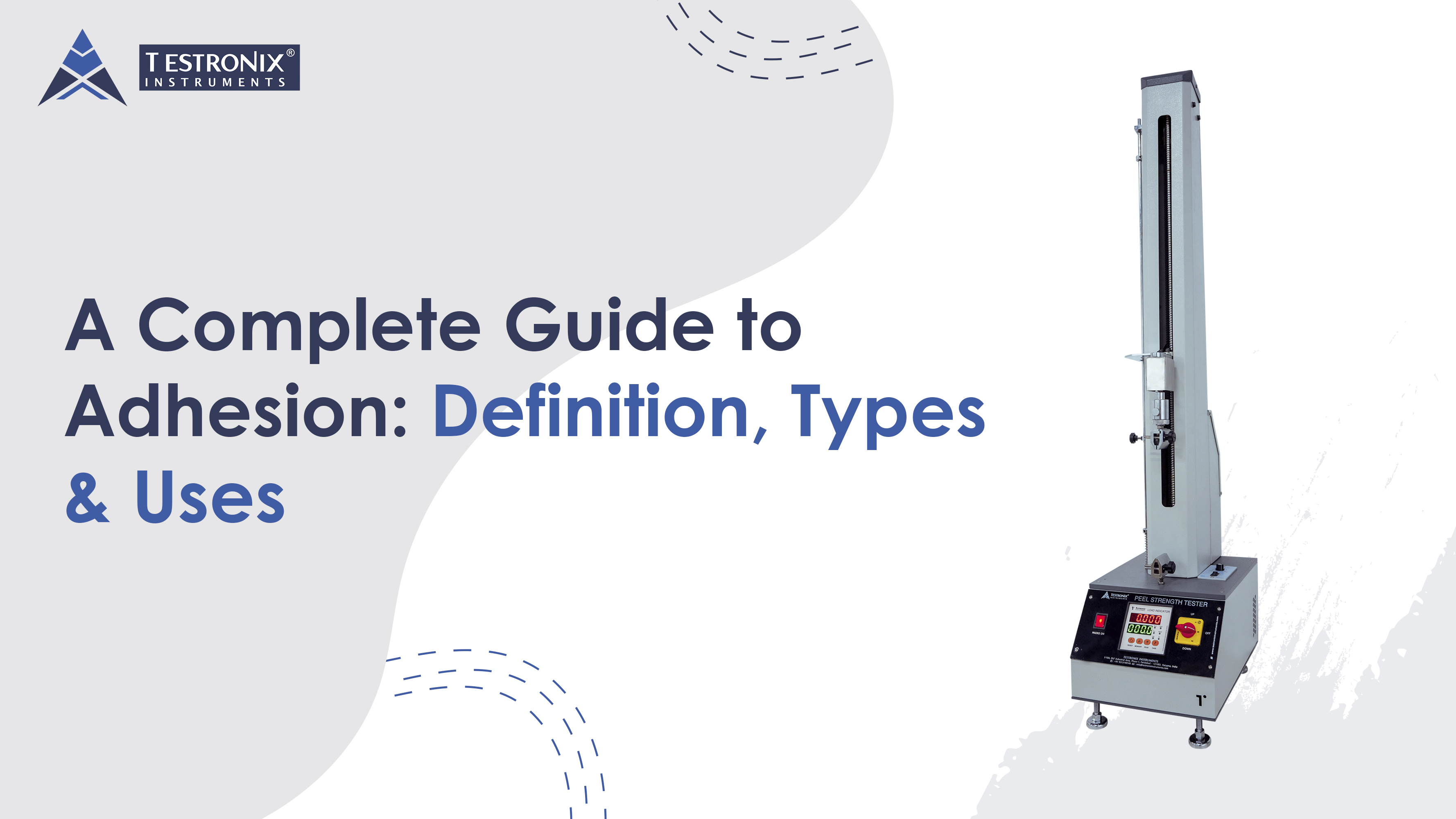
if you actually need to test adhesion in your work, Testronix Instruments has pull-off adhesion testers worth looking at. Our adhesive testers are built for real testing conditions, not just lab settings, and give you solid bond strength readings across coatings, paints, and industrial surfaces.