A PCB (Printed Circuit Board) can get accepted at one manufacturing unit and rejected at another during testing. Same board, same design, different results. The reason behind different results is common and frequently known in industries: Not following industry standards and one such standard is IPC.
IPC standards were published to avoid such anomalies in the same kind of products in different firms. They are the reference point buyers, builders, and inspectors all agree on. Still, a lot of people in the industry mix up the standard with the certification, or assume one automatically covers the other. It doesn’t.
In this article, we’ll look at what an IPC is standard, what is IPC full form, the main types you will actually run into, how certification works step by step, and how testing equipment from Testronix helps you in getting IPC certification.
What Is IPC Standard?
An IPC standard is a published industry document that defines how electronic products, mainly printed circuit boards and assemblies, should be designed, built, inspected, and accepted. It gives everyone in the supply chain the same rulebook.
Essentially, it eliminates conflicts. When an engineer claims that the solder joint has appeared to be okay, another engineer will later claim the opposite. All they have to do is open a document and take a look at the same criteria. These standards have come from committees of professionals working in the industry and feature real manufacturing problems instead of mere theoretical issues.
Most IPC documents cover things like materials, workmanship, test methods, and acceptance limits. Some are for designers. Some are for the shop floor. A few are for the lab. You do not need to learn all of them, only the ones that match your work.
IPC Standard Full Form
IPC stands for Association Connecting Electronics Industries. That is the current name, anyway.
The history is a bit messy, and this part confuses people. The group started in 1957 as the Institute of Printed Circuits. Later it became the Institute for Interconnecting and Packaging Electronic Circuits. In 2000 it simply went by the letters IPC, and the longer name was updated again to match what the organization had become. So if you see older documents using the earlier expansions, they are not wrong. They are just old.
Types of IPC Standards
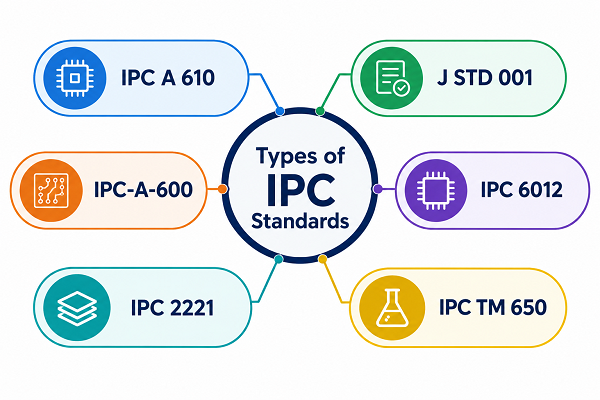
IPC publishes hundreds of standards and related documents however, a few are frequently used in the industry to test products. Some of the important IPC standards are listed below:
IPC A 610
IPC-A-610 is the go-to inspection standard for assembled boards. It shows what an acceptable solder joint or component placement looks like, with photos for each case.
It sorts products into three classes. Class 1 is general consumer stuff, Class 2 is for products that need steady performance, and Class 3 is for high-reliability work like medical or aerospace. A joint that passes under Class 2 can fail under Class 3. So before anything else, find out which class your customer expects. Inspectors open this document almost every day.
J STD 001
J STD 001 covers how soldering should be done. It is about the process, while A 610 is about the result. Plenty of shops use the two together. One guides the operators; the other guides the inspectors. It’s co-developed with another industry body, hence the J at the start.
IPC-A-600
IPC-A-600 is the acceptance guide for bare printed boards before any component is placed. It covers plating voids, hole wall quality, laminate defects, and surface problems. Fabricators lean on it when deciding if a panel ships or gets scrapped. The cross section images are very useful on the line because you can compare what you see against what the book shows.
IPC 6012
IPC 6012 regulates the qualifications of rigid boards' performance. The requirements and parameters that need to be checked can include proper plating thickness, based on copper integrity and electrical performance, good reliability of the product, etc. Hence, it is likely that the customer is considering IPC 6012 as a basis for demanding certain performance characteristics from the boards. It uses the same three class system, which keeps things consistent across the other standards.
IPC 2221
IPC 2221 is the base design standard for PCBs. It deals with conductor spacing, trace width, hole sizes, and thermal limits. Designers use it early. A spacing mistake caught on screen costs almost nothing, while the same mistake found after a full production run costs a lot.
IPC TM 650
IPC TM 650 is the test methods manual. It isn’t a pass or fail document. It explains how to run tests such as peel strength, solderability, ionic contamination, and thermal stress. Lab teams care about this one most. When another standard says a board must hit a certain number, TM 650 usually tells you how to measure that number the right way. Skip the method and your result may not be accepted.
There are some other standards including IPC-A-620 that cover cable and wire harness work. IPC 7711 and 7721 are for rework and repair. IPC 4101 is about base laminate materials, and IPC CC 830 deals with conformal coatings. Whether you need any of them depends on the product you make.
How to Get IPC Certification
IPC certification is a training- and exam-based credential showing that a person understands a specific IPC standard. It applies to people, not to boards or factories.
When someone says “IPC certified product,” they usually mean the product was built or inspected by certified staff. The most common credentials are CIS, for operators and inspectors, and CIT, for those who train others. The process looks roughly like this.
-
Decide which standard fits your role. Inspectors usually start with A 610, solder technicians with J STD 001, and harness teams with A 620.
-
Look for an authorized IPC training center. Only licensed centers can run official courses and issue certificates, so check this before paying anyone.
-
Sign up and attend the course. You get theory, visual examples, and sometimes hands on practice, depending on the program.
-
Take the exam. It’s written, and the pass mark is generally around 70 percent. Ask your center for the current number because rules get updated.
-
Collect your certificate. It usually stays valid for two years. After that you renew with a refresher and another test.
-
Keep your paperwork safe. Customers and auditors ask for it more often than you’d think.
One practical tip. Don’t train for a higher class than your customers need. Preparing everyone for Class 3 when you only build Class 2 products burns time and money without much payoff.
How Testronix Helps To Get IPC Certification
Testronix supplies the laboratory instruments that generate product level test data and helps in getting IPC certification. The IPC certificate itself is only for people, so it comes from an authorized training center. Boards and factories don’t get “certified” this way; they get proven with test results.
IPC TM 650, the Test Methods Manual, is where most of those procedures operate. It covers physical, environmental, and mechanical testing, and many IPC specifications point back to it when they set a limit. Testronix builds laboratory testing equipment that supports these kinds of tests. Exact method compatibility depends on the instrument, so check each one against the TM 650 method for your customer names.
Testronix Products for Testing Purposes:
-
Environmental and reliability testing: Salt spray chambers for corrosion resistance and hot air ovens for conditioning, baking, and temperature exposure.
-
Coating and surface analysis: Thickness gauges for plating and coatings, plus paint and surface testing equipment.
-
Mechanical integrity: Drop testers and other mechanical testing instruments to see how products and packaging handle physical stress.
Conclusion
Standards from the IPC provide a singular system of communication to all in the electronics manufacturing industry. The standards A 610, J STD 001, A 600, 6012, 2221, and TM 650 address nearly all concerns that a PCB manufacturer or assembler may have. The full name of IPC, Association Connecting Electronics Industries, shows how far the organization has grown since it was first established with respect to printed circuit boards.
Certification is about people. Choose the right standard, find an authorized center, pass the exam, and renew when it expires. Then back it up with good testing, because a certificate on the wall means little if the lab data disagrees with it.
That’s where Testronix Instruments comes in. With dependable testing instruments, identifying, logging, and verifying production quality becomes more effective and convincing for the customers and authorities. So, if you are considering launching a new laboratory or enhancing an existing one, connect with the Testronix team regarding your testing requirements and get personalized solutions.