All manufacturing industries require reliable quality control measures for all manufactured goods. Before products can be sold to consumers, they need to pass certain requirements for strength and durability and be able to demonstrate expected performance during use.
Even if there is a minor defect in the material strength of a manufactured good, there is a significant potential for product failure, posing risks to consumer safety and imposing financial losses on the manufacturer. As a result, manufacturers spend a lot of money purchasing quality control machinery and equipment.
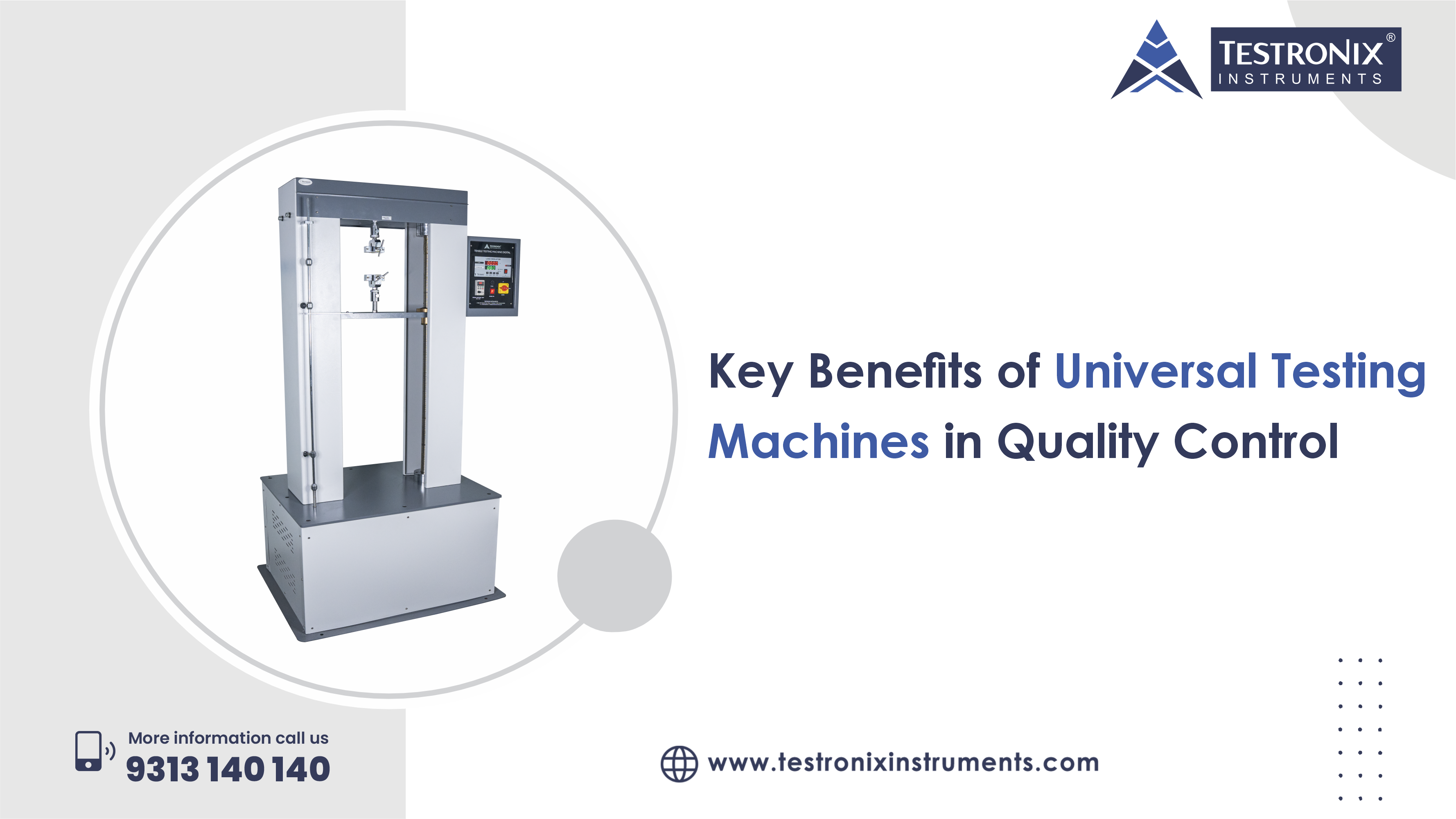
To tackle these problems during materials testing in a laboratory, a Universal Testing Machine (UTM) is used. UTM machine allows a manufacturer to determine the mechanical strength of various materials such as metals, plastics, rubber, textiles and composite materials. For this purpose, a variety of tests like tensile testing, compressive testing, flexural testing, and shear testing are employed with UTM. By using a reliable Universal Testing Machine, manufacturers can ensure that their materials conform to all the necessary standards for quality.
What is Quality Control in the Manufacturing Industry?
Quality Control (QC) refers to all processes employed in manufacturing to monitor, test and verify manufactured goods to ensure all products produced adhere to predetermined specifications and standards. QC also aims to discover any defects in manufactured goods as early as possible and guarantee that every batch produced meets the same quality requirements.
To facilitate the checking of quality, QC employs various method (s) of testing, including:
1. Material strength testing
2. Durability/performance testing
3. Inspection of dimensional accuracy
4. Environmental/stress testing
The primary purpose of QC is to achieve:
1. Reliability of a product
2. Consistency in manufacturing
3. Minimal quantity of defective products
4. Compliance with industry regulations/certifications
Without adequate QC systems, manufacturers run the risk of product failures, customer complaints, high costs associated with product recalls, etc. Advanced, sophisticated EQ testing equipment (e.g., Universal Testing machines) has become an important component of maintaining QC standards.
How Universal Testing Machines Help
A UTM is a device used to assess the mechanical properties of various materials by exerting controlled forces on them. A UTM exerts tension (pulls), compresses (pushes), and bends (flexes) material samples until they break. Due to this property of being able to exert various types of force on material samples, engineers are able to determine how strong and capable a material is and how it will serve as a construction component.
A Universal Testing Machine is used to help manufacturers in:
1. Determining the tensile strength of a raw material
2. Determining the compression capabilities of a raw material
3. Determining the flexibility (bending strength) of a raw material
4. Determining how a raw material will behave from the time it is deformed until it is completely broken
Some of the main functions of a UTM are:
1. Testing raw materials before fabrication
2. Verifying the quality/integrity of the fabricated product
3. Validating that the material being tested meets or exceeds certain industry requirements
Testing allows manufacturers to catch material weaknesses before the product even hits the market. This process is crucial because it ensures the final products are both safe and exactly what customers expect.
Top 7 Advantages of Universal Testing Machines in Quality Control
A Universal Testing Machine is an incredibly helpful tool for companies relying on product quality and reliability.
1) Accurate Measurement of Material Strength
Universal testing machines provide careful measurement of material strength, which includes:
4) Elongation Properties
Having accurate data means that manufacturers can be sure that they have the proper strength of materials to meet the minimum performance standards.
2) Improved Product Reliability
Manufacturers can verify their products' ability to withstand real-world working stress by using a Universal Testing Machine.
Some examples of this include:
1) Less product failure
2) Better product durability
3) Increased customer satisfaction
Reliable testing allows for the safe use of products during the actual operation.
3) Detection of Material
Universal Testing Machines help identify defective raw materials prior to production.
A few examples:
1) Structural Weakness
2) Material Variability
3) Poor Bonding or manufacturing defects
By identifying defective materials early, they can be eliminated before reaching the marketplace.
4) Compliance with Industry Standards
Manufacturers use Universal Testing Machines to comply with internationally recognized testing standards such as ASTM E8 for tensile testing of metals, ASTM D638 for plastics, ISO 6892 for metallic materials, and IS 1608 for tensile testing according to Indian Standards. These standards ensure that materials are tested using uniform procedures and deliver reliable, comparable results across industries.
Some of the industries heavily reliant on UTM testing are used in:
1) Automotive Manufacturing
2) Aerospace Engineering
3) Building Materials
4) Packaging
The testing conducted using Universal Testing Machines ensures that products meet the standards established at both
5) Testing Flexibility
Universal Testing Machines are a versatile type of testing equipment. An example of this is that a single machine can typically perform more than one type of test.
The most common types of tests are:
1. Tensile Tests
2. Compression Tests
3. Bend Tests
4. Shear Tests
5. Peel and Tear Tests
Due to their flexibility, U.T.M. (Universal Testing Machine) machines can be used to carry out testing in a wide range of industries.
6) Product Development Support
U.T.M. machines support engineers with the design of their products while in the product development process. By using the results of tests, manufacturers will be able to do:
1. Selection of stronger materials
2. Improvements in the design of their products
3. Optimization of manufacturing processes
This leads to the development of better quality products and fewer products that fail.
7) Cost Changes in the Manufacturing Process
Using Universal Testing Machines to perform quality testing will assist in reducing long-term production costs. The main cost-reducing advantages of using a Universal Testing Machine are:
1. The reduction of product recalls
2. The reduction of warranty claims
3. The reduction of defective batches.
By doing testing at an early stage, a company is able to eliminate the possibility of incurring a large amount of money in manufacturing defects.
Find the Right UTM Machine Manufacturer for Maximum Output
Select a Universal Testing Machine supplier first—make sure it's accurate and dependable, with equipment that is durable as well as accurate during use. The aforementioned qualities assure optimum performance when conducting tests using Universal Testing Machines. A business should evaluate numerous factors before choosing a UTM manufacturer, including:
-
How accurate & precise is their machine?
-
How durable & well-built is their machinery?
-
Are they compliant with industry standards?
-
Is their software user-friendly for conducting tests?
-
Will they be able to provide technical assistance and/or repairs?
Manufacturers such as Testronix Instruments produce cutting-edge Universal Testing Machines that are specially engineered to be accurate testers and assist with quality control across many industries.
If a company invests in reliable testing equipment, they will have opportunities to enhance the efficiency of their testing processes and maintain the quality of their products.
Conclusion
Ensuring quality control is essential when producing perfectly safe, durable, and workable items. Manufacturers must thoroughly test their products before production and consumer sale to ensure quality. A Universal Testing Machine (or UTM) helps the manufacturer prove the strength of their materials and how well their product(s) will last. This machine generates test results that will allow the manufacturer to maintain consistent quality throughout their production line.