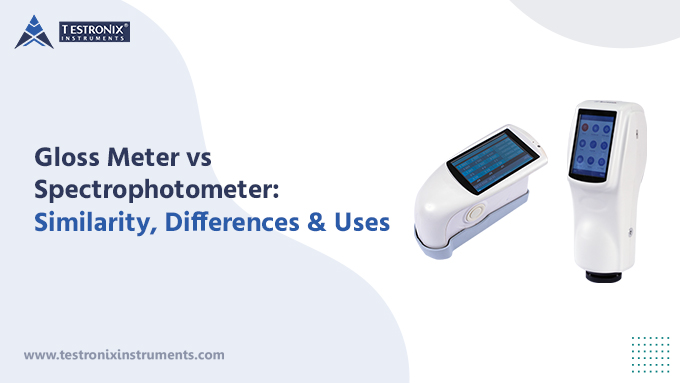
Gloss meters and spectrophotometers both measure surface qualities of a material; however, one measures the shine (gloss) and the other measures the shade (color). Confusing the two will lead to using the wrong piece of equipment and receiving incomplete quality reports.
This issue is commonly encountered in paint, plastics, packaging and automotive labs. A product could pass the color standard but fail due to the finish not being shiny enough or too shiny.
This article will explain the gloss meter vs spectrophotometer difference including what they are, how they work and their similarities. It will also show you how to choose the right equipment.
What is a Gloss Meter?
Gloss meter is an optical instrument that measures the amount of light reflected from a surface at a set angle to determine the shine (gloss). This is provided as a value in gloss units (GU). It will tell you if it is glossy, semi-glossy or matte. Highly reflective surfaces, for example, a mirror, will give a high value. Rough flat surfaces will give a low value.
When judging quality, people generally look at the product. If a car door doesn’t have an even shine, it will be seen as low quality. A gloss meter removes human error and provides a numerical value.
Most gloss meters have 3 angles of measurement. 20 degrees for high gloss surfaces, 60 degrees for medium and 85 degrees for very low gloss.
How do Gloss Meters Work?
A light beam is shone at the sample at a set angle. The amount of light reflected back at the same angle is measured.
Inside the Gloss Meter, there will be a light source, lens and receptor. If the surface is smooth, a large portion of light will be reflected and the receptor will receive a strong signal. If the surface is rough, the light will scatter and less will reach the receptor.
The value received will be compared to a calibrated reference. Usually, this is polished black glass with a known value. The meter must always be calibrated prior to testing, otherwise, the values will drift.
Angles are important. If a very shiny sample is tested at 60 degrees, the results will often be skewed to the high end of the scale. This is why a 20-degree geometry is available.
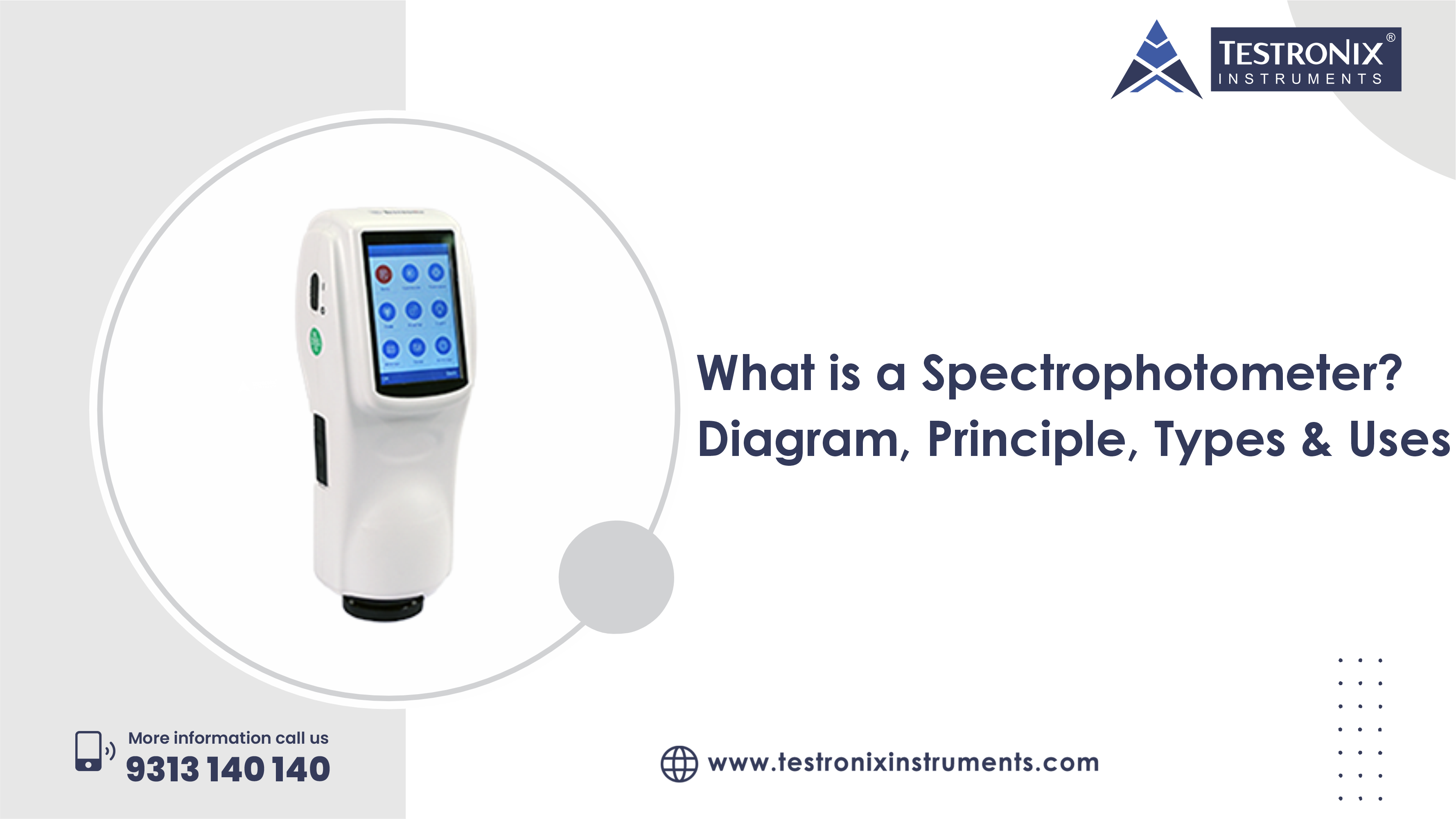
What is a Spectrophotometer?
Spectrophotometer is a laboratory instrument that measures the amount of light reflected or transmitted through a material at different wavelengths. This provides an accurate numerical value for the color.
Instead of saying a sample “kind of dark blue,” you will receive values for L, a and b. It will also provide a value for how different the sample is from the standard. Usually this is shown as Delta E.
Eyes can become drained and lighting can change. It is rare for 2 people to agree on a shade. A spectrophotometer will always provide the same results when measuring the same sample. This is very useful when production teams are making batches weeks apart. Some can also provide the Opacity, Whiteness and Yellowness Index.
How do Spectrophotometers Work?
A sample is illuminated and the reflected light is split into individual wavelengths. The intensity of each wavelength is measured to provide color values.
The sample is illuminated using a stable light source. The reflected light is passed through a diffraction grating or filter and splits into a spectrum, normally between 400 and 700 nm. The intensity of each wavelength is then captured by a sensor.
The data will then be converted into color coordinates using software. As it uses the whole spectrum, it is much more effective on tricky samples than a basic colorimeter.
Regular calibration is required using a white tile (sometimes black). The geometry of the unit can be 45/0 or d/8. This depends on whether you want to include gloss in your color. This can cause confusion for many beginners.
Gloss Meter vs Spectrophotometer: Similarities and Differences
Both these devices use controlled light to judge appearance and provide objective values. However, they provide different information.
Similarities In Gloss Meter & Spectrophotometer
Optical: Both devices shine a controlled light at a surface and measure the returned value. No human error or emotion.
-
Repeatability: Both gloss meters and spectrophotometers offer good repeatability. Values can be recorded in quality records. This makes auditing and complaints much easier.
-
Calibration: Calibration is an important part of every test and testing equipment. Both devices will drift if not calibrated. Both have their own reference standards.
-
Quality Control: Both devices are used in the process of quality control that includes inspection, running the process and final approval.
-
Industries: Interestingly, a gloss meter and spectrophotometer are both often used together in paint, plastics, ceramics and printing to approve a finish.
Gloss Meter vs Spectrophotometer: The Difference
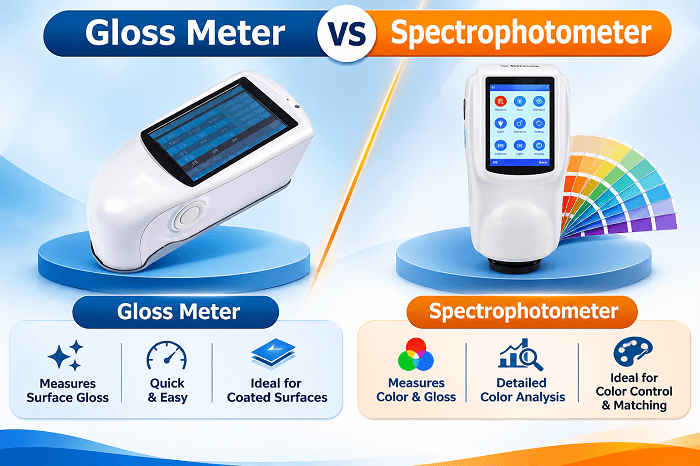
Measurement is the major difference between a gloss meter and a spectrophotometer. A gloss meter will measure shine at specific angles whereas a spectrophotometer will measure color throughout the visible spectrum. See below for a breakdown.
|
Parameter |
Gloss Meter |
Spectrophotometer |
|
What it measures |
Surface shine or reflectivity |
Color and spectral reflectance |
|
Output |
Gloss units (GU) |
L*, a*, b*, Delta E and more |
|
Light use |
Single angle beam (20, 60, 85 degrees) |
Full spectrum across visible wavelengths |
|
Main focus |
Surface finish and texture |
Color accuracy and consistency |
|
Calibration reference |
Black glass standard |
White and black tiles |
|
Question answered |
Is it glossy or matte enough? |
Does the shade match the standard? |
|
Complexity |
Simpler to operate |
More setup and software involved |
|
Cost |
Usually lower |
Usually higher |
For practical purposes, gloss impacts color. Two samples of the same pigment can look different shades if one is glossy and the other is matte. Many times, strange colors are the result of a wrong gloss value.
Applications
A gloss meter is used whenever surface finish is important. A spectrophotometer is used whenever color consistency is important.
Gloss Meter Applications
Gloss meters can be found in any industry where finish is important.
-
Paints & Coatings: To measure the level of finish in wall paints, wood coatings and industrial coatings.
-
Automotive: To test body panels, bumpers and interior trims to ensure they have an even shine.
-
Plastics: To control the finish of molded housings, appliance panels and toys.
-
Packaging & Printing: To ensure glossy labels and soft matte box lids are consistent with the brand.
-
Paper & Ceramics: To measure the shine of coated paper and quality of glazed tiles.
-
Furniture & Leather: To confirm the lacquered finish on wood and surface finish on leather products.
Spectrophotometer Applications
A spectrophotometer can be found in any industry where the customer will notice a color change.
-
Textiles: To ensure dye lots are matched to make fabrics look the same.
-
Paints & Inks: To formulate colors, approve batches and match shades.
-
Plastics: To ensure molded parts and masterbatch are within color tolerance.
-
Cosmetics: To check colors of lipsticks, foundations and nail varnishes.
-
Food & Drink: To monitor colors of sauces, oils, juices and baked goods.
-
Pharmaceuticals: To inspect tablet coatings for even appearance.
Choose Testronix for Advanced Gloss Meters & Spectrophotometers
Testronix provides reliable and easy-to-use Gloss Meters & Spectrophotometers.
Our gloss meters provide multi-angle measurements so you can test highly shiny coatings and low gloss finishes. Our Spectrophotometers provide accurate color data with easy to read software. Both have been designed to be easy to calibrate, saving you time.
If you are looking to start a new lab or upgrade old equipment, it is helpful to have a supplier with knowledge of testing standards. Testronix is supporting labs in paints, plastics, textiles and packaging for many years.
Conclusion
A gloss meter measures how shiny a surface is. A spectrophotometer measures the color. They are not competing devices and are often used together in most quality labs.
If your product relies on finish, you will need a gloss meter. If your product relies on color, you will need a spectrophotometer. If your product relies on both (very common) then you should have both to get a full picture and reduce the risk of rejection.
Testronix Instruments provides both devices with accurate and easy to use equipment. If you are planning on upgrading your lab, they are definitely worth considering.