In the plastic manufacturing industry, the procedure of quality assurance begins with approving raw materials to fight against spoiling or deterioration. This field has also constantly dealt with challenges such as variations in batches, size issues, and unexpected breakage of plastic parts. The professionals working in the industry must comply with prescribed testing techniques and follow guidelines regarding plastic quality control
Nowadays, plastics are used widely in various products, such as auto parts, medical items, food containers, and other everyday goods. In a scenario where a plastic object is damaged, it can provoke great troubles for the manufacturer, for example, the design of a fragile lid that may leak during transportation. A poorly molded gear breaks inside an appliance. A thin film tears on a high-speed packing line. These failures cost real money, ruin brand trust, and waste expensive raw materials.
In the plastic industry, quality control involves studying the behavior of the raw resin under varying temperature, pressure and humidity. In this article, we will go through the usability of plastic quality control in real-world applications. We will discuss the methods used for testing, typical defects, preventative measures and industry standards that are crucial in your plastic facility.
What is Quality Control in Plastic?
Quality control in plastic manufacturing is a structured process of inspection, monitoring, and testing to verify if products meet safety and mechanical standards and are free of defects. The entire process ensures that only high-quality and standard plastic products leave the factory floor and subpar plastic components are treated again.
In simple terms, plastic quality control starts long before a machine produces a finished item. It begins with incoming raw material inspection and continues right up to final box packaging. Melt flow rate, wall thickness, color consistency, and impact resistance all need careful tracking. Without a solid plan, you are basically guessing whether your product can handle real-world stress.
Why is Plastic Quality Control Important? First, bad quality leads to expensive product recalls and discarded stock. Second, regulatory bodies impose strict rules on plastics used in medical, toy, and food applications. A batch that fails safety limits can shut down an entire line. Keeping accurate test records protects your plant from legal trouble and keeps your buyers happy.
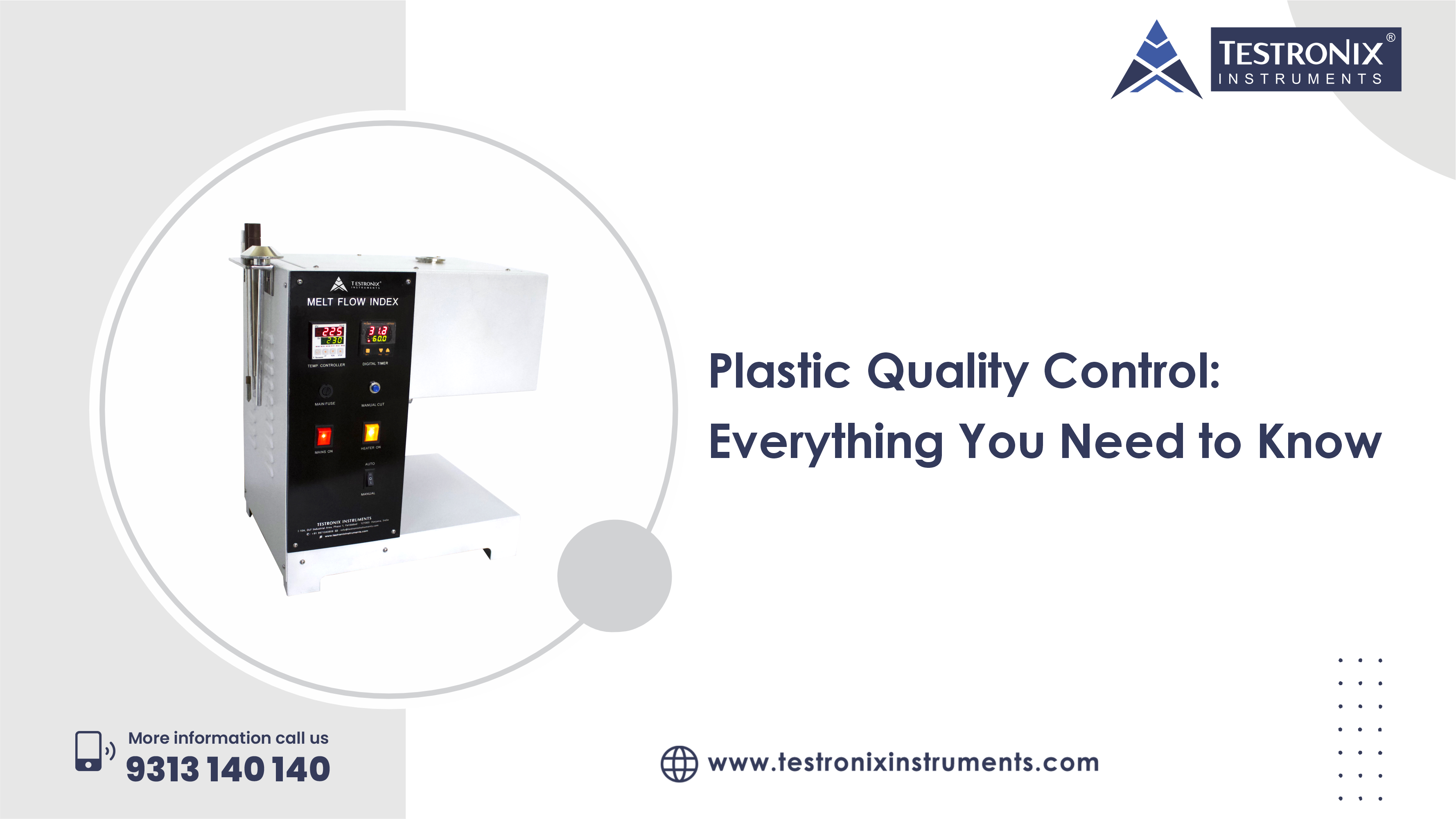
Testing melt behavior is one of the very first steps, and various testing instruments are used for the purpose. A melt flow index tester measures the flow rate, viscosity, and processability of melted plastic polymers to ensure they safely run through dies. If the flow rate is different from the supplier specifications, the plastic will not mold correctly inside the injection cavity.
Types of Quality Control in Plastic Manufacturing
Plastic quality control types are divided based on their physical properties, visual flaws, and mechanical strength. The common types are tensile analysis, process control, thermal cycle analysis, chemical testing, and more.
Raw Material Testing
The most basic step of quality control is testing the raw materials when they are sourced. Moisture content, density, flow properties, and any contamination in the raw material are thoroughly tested. These are checked for several reasons; for example, moisture causes bubbling and severe structural weakening during molding.
In-Process Quality Control
In-process quality control is the first important step to be taken when material is processed in a factory. Operators monitor barrel temperatures, cycle times, injection pressures, and cooling rates. When a temperature drift is caught early, it prevents hundreds of defective parts from reaching the customer.
Visual and Dimensional Inspection
Visual and dimensional inspection are the easiest ways of quality control in plastic to identify any defect. Workers inspect parts for sink marks, flash, burn marks, and warping. Digital calipers, profile projectors, and coordinate measuring machines verify critical dimensions against original CAD drawings.
Mechanical Strength Testing
Mechanical strength testing is a crucial part of plastic quality control in the manufacturing industry. Final products must handle dropping, pulling, bending, and twisting. Lab technicians put samples through tensile stress tests and impact trials. Using a reliable Testronix drop tester shows exactly how containers or packages handle accidental impacts during shipping.
How Plastic Quality Control is Conducted in the Manufacturing Industry
Quality control for plastics follows a process that begins by receiving the material, moves to checking machine parameters, and then to lab stress testing.
-
Each batch of production has a well-defined testing path. Upon receiving raw resin in pallets, the technicians obtain samples from the top, middle and bottom bags at random. They measure moisture content and melt viscosity. If the resin is good, it is discharged to production silos.
-
Initial inspection is followed by a small sample of the production batch that is produced during the active setup of the production machine. All these initial samples are completely dimensioned and physically tested. If approved, mass production of the product begins. Pressure and temperature readings are automatically recorded using machine sensors, but manual spot checks are made hourly.
-
After the components are completed, they are taken to the quality assurance laboratory quickly. Here, technicians check the integrity of the seals and the thickness of the walls for uniformity. A Testronix burst tester is used for rigid containers and bottles to check the highest pressure that can lead to any damage in the structure. In addition, pouches are also subject to heat seal strength testing to confirm the integrity of the package.
Quality Control Issues in Plastic and Prevention
Common quality control issues in plastic include warping, sink marks, short shots, and stress cracking caused by wrong temperature settings or wet raw material. Preventing these issues requires tight process limits and routine equipment maintenance.
-
A common problem that often occurs in plastic quality control which is labeled as warping. It typically occurs when different zones of a plastic part cool at different rates, causing internal stresses that cause the plastic to bend out of shape. This is easily corrected in a short time by adjusting flow through cooling channels and balancing mold temperatures. When the internal plastic pulls back from the outer surfaces, sink marks are formed on thick walls. The solution to the problem is to increase the hold pressure and decrease the wall thickness.
-
Shorts are due to the molten resin solidifying prematurely before the mold is filled. This headache is caused by low injection pressure, cold barrels, or blocked vents. To avoid short fills in plastic, increase temperature slightly and increase air vent opening.
-
Another major issue in plastic quality control is that of plastic parts used in contact with chemicals. It results in environmental stress cracking, and the same applies for outdoor environmental exposure. Environmental stress cracking tests and seal durability tests using a Testronix vacuum leak tester prevent leaky containers from getting lost in transit.
Common standards to be Followed in Quality Control for Plastic
The ISO/ASTM protocol is used worldwide to measure the performance, safety, and purity of the plastic across the world markets.
Adopting recognized standards means that your parts will satisfy the customer requirements anywhere in the world. ISO 9001 gives the framework for the overall quality management systems used in manufacturing plants.
ASTM D1238 is for plastic properties and refers to melt flow rate testing. ASTM D638 prescribes a range of standard procedures for testing the tensile properties of rigid plastics. Charpy impact strength measurements are covered by ISO 179. Compliance with these standards helps to ensure that buyers will be more confident in the product, and compliance audits will be easy.
Conclusion
To ensure high plastic quality, it is important to have consistent monitoring systems, testing equipment and factory processes from raw resin to finished product.
Plastic quality control is not only a problem of detecting defective parts at the end of the line. It's about creating a reliable process that has a low number of defects in the first place. Good test protocols can be a cost-saving investment, maintaining uptime and customer confidence.
When you equip your plastic processing facility with the proper testing machinery, it makes all the difference. The property of materials is measured with high-quality Testronix testing equipment to as high an accuracy as possible in the factory. Combined, the trusted operators, standardized testing procedures and accurate testing devices of Testronix Instruments are a competitive edge you can rely on for your quality control.