Introduction
When you are working with thermoplastic materials, one of the most common challenges is determining whether a polymer will actually behave the way you need it to during processing. Each of the injection molding processes, extrusion, blow molding requires a certain flow behavior of the material. In the absence of an effective method of gauging that behavior, the choice of the appropriate polymer is guesswork and errors during manufacturing are very expensive.
This is exactly where MFI and MFR come in. These two measurements provide engineers and quality control professionals with a convenient, standardized method of assessing the behavior of a polymer in terms of melting and flowing under certain conditions. They assist in estimating the processability and batch-to-batch consistency and serve as a quality gateway to the incoming raw materials.
While MFI and MFR are closely related and often used interchangeably in conversation, they are not technically identical. Knowing which one to use and when to use it can literally make a difference in how well you are able to make judgments of your material and the process decisions you make.
In this article, we will discuss what MFI and MFR differences are in terms of their formula, real world uses, and how these two are implemented differently.
What is MFI?
MFI full form is Melt Flow Index. It is a measure of the ease with which a molten thermoplastic polymer flows through a standardised die under a specific load and temperature.
MFI is expressed in grams per 10 minutes (g/10 min) and gives a single-number representation of a polymer's viscosity in its molten state. The greater the value of the MFI, the greater the freedom of movement of the polymer which tends to be lower in terms of molecular weight and melt viscosity. A smaller MFI value indicates a more viscous and stiffer melt that would be more appropriate in applications where structural strength is needed.
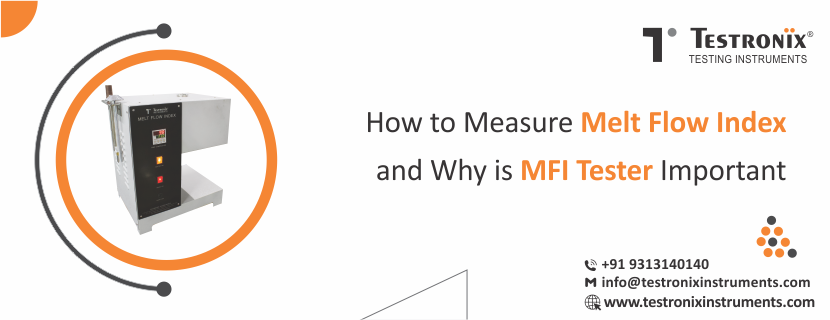
The test is carried out using an instrument called a melt flow indexer or plastometer. A known quantity of polymer is loaded into a heated barrel, allowed to reach a set temperature and then subjected to a defined weight that forces the melt through a standardised capillary die. The amount of material extruded over 10 minutes is collected and weighed and that weight becomes the MFI value. The test conditions including temperature and load, are specified by standards such as ASTM D1238 and ISO 1133 and these vary depending on the type of polymer being tested.
MFI Formula with Example
The MFI is calculated by measuring the mass of polymer that flows through the die in a set time and then normalising it to a 10-minute period.
| MFI (g/10 min) = (Mass of extrudate in grams / Time in minutes) x 10 |
Example: Suppose during a melt flow test, 2.5 grams of polyethylene are collected in 5 minutes.
| MFI = (2.5 / 5) x 10 = 5 g/10 min |
It can be determined that the polymer possesses a rate of 5 g/10 min MFI which is moderate. A processor who would be working with injection molding would determine whether this value is within the acceptable range of the grade being used.
What is MFR?
MFR full form is Melt Flow Rate.
Melt Flow Rate is the modern and technically preferred term used in international standards, particularly ISO 1133. It is used to describe the mass of polymer melt extruded per 10 minutes through a standardised capillary under defined conditions of temperature and load. Like MFI, the unit is grams per 10 minutes, and it is measured using the same type of melt flow indexer instrument. However, MFR is a more precisely defined term and is considered the standard designation in current technical and regulatory documentation.
MFI has been used loosely for volume-based measurements converted to mass via density while MFR refers directly to mass-based measurements. This makes MFR useful when working with polymers or blends where density may not be uniform or readily known. In modern material data sheets and international specifications, businesses are likely to encounter MFR as the reported value.
MFR Formula with Example
The MFR formula is:
| MFR (g/10 min) = (Mass collected in grams / Time of collection in minutes) x 10 |
Example: A polypropylene sample is tested and 1.8 grams are extruded in 3 minutes.
| MFR = (1.8 / 3) x 10 = 6 g/10 min |
This result shows that the polypropylene flows at a rate of 6 g/10 min of MFR under given conditions. The value is generally within acceptable limits that are defined by industries and global standards.
MFI vs MFR: What is The Difference?
Both MFI and MFR measure how freely a polymer melts and flows but MFI is the older industry term that was sometimes applied to volume-based flow measurements later converted using density. On the other hand MFR is the current internationally standardised term referring specifically to mass-based measurement. In the real world, the two values are numerically the same when measured in the same conditions. However, the difference is important in formal documentation, compliance to standards and dealing with complex polymer systems.
|
Parameter |
MFI (Melt Flow Index) |
MFR (Melt Flow Rate) |
|---|---|---|
|
Full Form |
Melt Flow Index |
Melt Flow Rate |
|
Measured In |
g/10 min |
g/10 min |
|
Standard |
ASTM D1238 / ISO 1133 |
ASTM D1238 / ISO 1133 |
|
Primary Focus |
Volume of melt extruded |
Mass of melt extruded |
|
Density Needed? |
Yes (to convert) |
No (direct measurement) |
|
Common Usage |
Older industry standard term |
Modern preferred term |
|
Result Type |
Derived (mass from volume) |
Direct mass measurement |
|
Polymer Suitability |
General thermoplastics |
Wide range incl. filled polymers |
MFI vs MFR Uses Difference
MFI Uses
MFI is most commonly encountered in older technical literature, legacy material specifications, and industries where the term became established before the widespread adoption of updated ISO standards. It is also common in the process of quality control where the processors compare the incoming batches of polymer to the past set of benchmark values.
The packaging industry, manufacturing of agriculture film and commodity plastics continue to use MFI widely since their systems were developed using this language and because their suppliers were contracted using this language. It is also used in initial material selection during product development when a quick relative comparison of polymer grades is needed. Since a higher MFI polymer will generally process more easily but may sacrifice some mechanical performance.
MFR Uses
MFR is the preferred term in all current ISO-compliant documentation, formal material data sheets, and regulatory submissions. It is the value reported by most modern testing instruments and cited in quality management systems that align with international standards. MFR is particularly important in the testing of engineering plastics, high-performance polymers and filled compounds where a precise, mass-based measurement is essential for accuracy. It is also a frequently used measurement when comparing materials across different suppliers. Automotive, medical device and electronics manufacturers tend to specify MFR values in their material qualification criteria.
Conclusion
MFI and MFR both serve the same fundamental purpose: giving a reliable and quantifiable way to assess how a polymer will behave when melted and processed. The difference between them is primarily in terminology and technical precision. MFI is commonly used in industries while MFR is the current standard-aligned term that provides a cleaner and mass-based measurement, particularly useful in regulated applications. Businesses must understand which one is required for material specs or quality systems that help them to make better decisions at every stage from supplier selection to process optimization.
For laboratories and manufacturers who need dependable, accurate melt flow testing, having the right instrument is just as important as understanding the measurement. Testronix instruments are created to provide accurate MFI and MFR results that comply with ASTM D1238 and ISO 1133 standards. Our instruments ensure that quality teams have the assurance needed when assessing polymer materials in actual production environments.