A spectrophotometer is a laboratory instrument used to measure how much light a sample absorbs or transmits at a specific wavelength. It is widely used for quantitative and qualitative analysis in pharmaceuticals, food and beverage testing, environmental monitoring, chemistry, biology, agriculture, and material science.
Spectrophotometers help determine the concentration of substances in a sample by measuring the interaction between light and matter. Depending on the instrument type and application, they can analyze liquids, solids, and other sample forms.
This guide explains what a spectrophotometer is, its diagram and components, working principle, Beer-Lambert Law, types, applications, calibration, accuracy factors, and common uses. It also covers the TP 800 portable spectrophotometer and its color-analysis features.
What is a Spectrophotometer?
A spectrophotometer is an analytical laboratory instrument that measures the amount of light absorbed or transmitted by a sample at a selected wavelength.
The instrument directs light toward or through a sample and measures the intensity of light before and after interaction with the sample. The difference between the incident and transmitted light is used to determine the sample's absorbance or transmittance.
Spectrophotometers are commonly used to determine the concentration of specific compounds in solutions. They are also used to identify substances, monitor chemical reactions, analyze colors, and perform quality-control testing.
What Does a Spectrophotometer Measure?
A spectrophotometer measures the interaction of a sample with light, primarily in terms of absorbance or transmittance at selected wavelengths.
The measured absorbance can be related to the concentration of an absorbing substance when appropriate analytical conditions are maintained. Spectrophotometers can therefore be used for applications such as:
- Measuring the concentration of chemical compounds
- Analyzing DNA and proteins
- Monitoring chemical reactions
- Testing water and environmental samples
- Measuring color and color differences
- Testing food and beverage products
- Analyzing pharmaceutical samples
- Studying materials and their optical properties
Spectrophotometer Diagram
A typical spectrophotometer consists of several components that work together to generate, select, direct, and measure light.
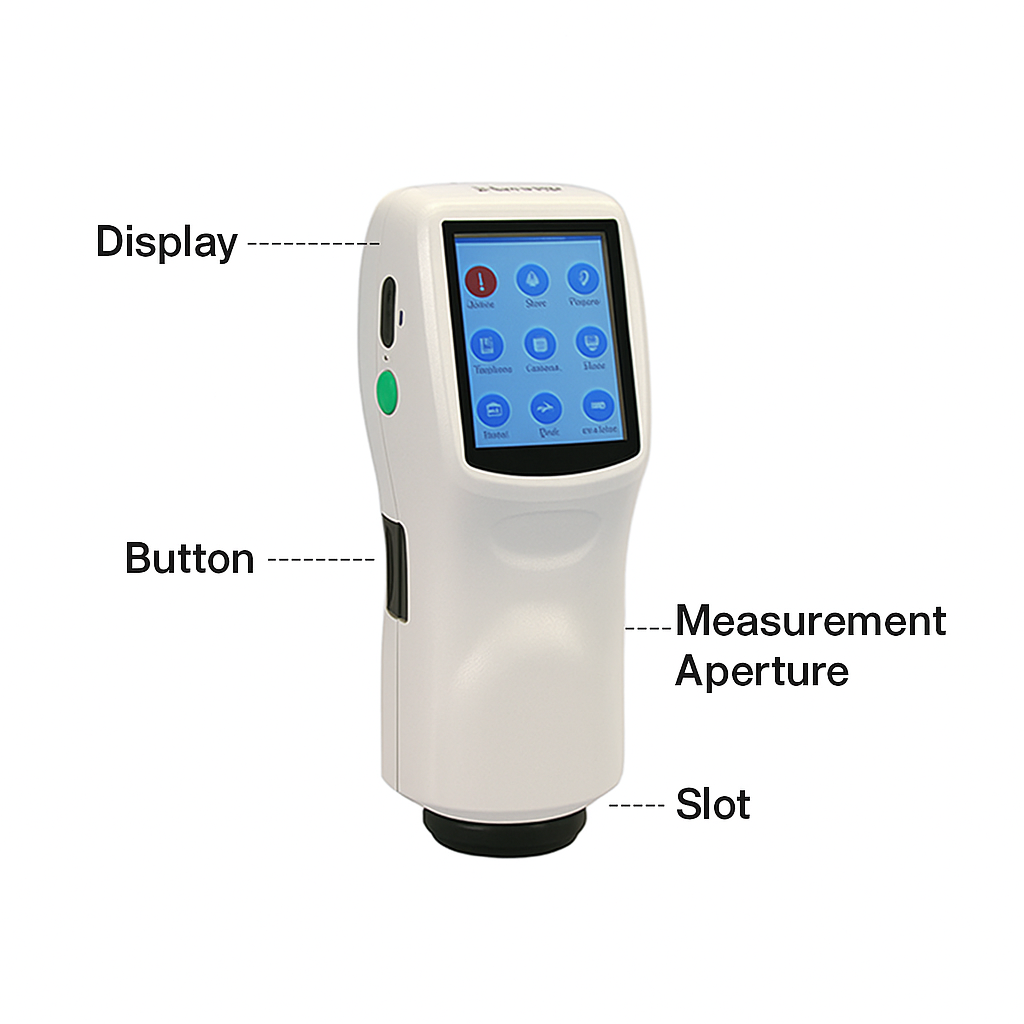
Main components shown in a spectrophotometer diagram include:
- Light source: Produces the light required for measurement. Depending on the wavelength range, the instrument may use different types of lamps or light sources.
- Monochromator: Separates light into individual wavelengths and allows the required wavelength to be selected.
- Slit: Controls the width and direction of the light beam entering the optical system.
- Sample holder: Holds the sample, commonly in a cuvette, so that light can interact with it.
- Detector: Detects the light transmitted through or emitted by the sample and converts the detected light into an electrical signal.
- Display/readout: Presents the measurement result, such as absorbance or transmittance.
- Power supply and control system: Provides power and allows the operator to select measurement parameters and operate the instrument.
The components operate as a sequence: the light source generates light, the optical system selects the required wavelength, the light interacts with the sample, the detector measures the resulting light intensity, and the instrument displays the measurement.
Components of a Spectrophotometer
Light Source
The light source provides the radiation required for spectrophotometric measurement. The appropriate source depends on the wavelength range and design of the instrument.
Monochromator
A monochromator separates light into different wavelengths and allows the instrument to select the wavelength required for a particular measurement.
Slit
Slits control the width of the light beam and help define the wavelength resolution of the optical system.
Sample Holder or Cuvette
The sample holder positions the sample in the path of the light beam. Liquid samples are commonly placed in cuvettes designed for the wavelength range being measured.
Detector
The detector measures the intensity of light reaching it after interaction with the sample. It converts the optical signal into an electrical signal that can be processed by the instrument.
Display and Control Panel
The display presents measurement results, while the control system allows users to select wavelengths, measurement modes, calibration options, and other instrument settings.
How Does a Spectrophotometer Work?
A spectrophotometer works by directing light at a selected wavelength toward a sample and measuring the light that remains after the sample interacts with the beam.
First, the instrument generates light from its light source. The optical system selects the required wavelength and directs the light toward the sample. When the light passes through the sample, part of the radiation may be absorbed by substances present in the sample.
The detector measures the intensity of the transmitted light. The instrument compares the incident light intensity with the transmitted light intensity and calculates the absorbance or transmittance.
When the analytical conditions satisfy the Beer-Lambert relationship, absorbance can be used to determine the concentration of the absorbing substance.
Working Principle of a Spectrophotometer
The working principle of a spectrophotometer is based primarily on measuring the absorption or transmission of light by a sample at a selected wavelength.
The relationship between absorbance and concentration is described by the Beer-Lambert Law.
Beer-Lambert Law
The Beer-Lambert Law states that, under suitable conditions, the absorbance of a sample is proportional to the concentration of the absorbing substance and the path length through which light travels.
The mathematical expression is:
A = εlc
Where:
- A = Absorbance
- ε = Molar absorptivity or molar extinction coefficient
- l = Optical path length
- c = Concentration of the absorbing substance
The relationship allows spectrophotometers to be used for quantitative analysis. If the path length and molar absorptivity are known or controlled, absorbance measurements can be related to the concentration of the analyte.
How Absorbance Is Determined
A spectrophotometer compares the intensity of incident light with the intensity of light transmitted through the sample.
The basic relationship can be expressed as:
A = -log??(T)
where T represents transmittance.
When a sample absorbs more light at the selected wavelength, less light reaches the detector and the measured absorbance increases.
Types of Spectrophotometers
Different spectrophotometers are designed for different wavelength ranges, measurement techniques, and applications.
|
Type |
Typical Range / Feature |
Common Applications |
|
UV-Visible Spectrophotometer |
UV and visible wavelengths |
DNA, proteins, chemical compounds and concentration analysis |
|
Infrared (IR) Spectrophotometer |
Infrared wavelengths |
Functional-group and molecular-structure analysis |
|
Fluorescence Spectrophotometer |
Measures emitted fluorescence |
Biomolecules, fluorescent dyes and trace analysis |
|
Atomic Absorption Spectrophotometer (AAS) |
Element-specific absorption |
Trace metal analysis |
|
Near-Infrared (NIR) Spectrophotometer |
Near-infrared wavelengths |
Food, agriculture and pharmaceutical quality control |
|
Double-Beam Spectrophotometer |
Uses sample and reference optical paths |
High-precision laboratory measurements |
|
Portable Spectrophotometer |
Compact design for field or on-site testing |
Color analysis and field measurements |
UV-Visible Spectrophotometer
A UV-Visible spectrophotometer measures the absorption of ultraviolet and visible radiation by a sample. UV measurements commonly cover approximately 200–400 nm, while the visible region extends approximately from 400–700 nm, although the actual range depends on the instrument.
UV-Visible spectrophotometers are widely used in chemistry and biochemistry to determine concentrations, study absorption spectra, and analyze compounds that absorb UV or visible radiation.
UV Spectrophotometer Principle
The principle of a UV spectrophotometer involves the absorption of ultraviolet radiation by molecules. UV radiation can provide sufficient energy to promote electrons from a lower-energy state to a higher-energy excited state.
The resulting absorption can be measured at selected wavelengths and used for qualitative or quantitative analysis of compounds that absorb ultraviolet radiation.
Infrared (IR) Spectrophotometer
An IR spectrophotometer measures the interaction of infrared radiation with a sample. Different molecular bonds absorb infrared radiation at characteristic frequencies, making IR spectroscopy useful for studying molecular structures and identifying functional groups.
IR instruments are used in chemical analysis, material science, pharmaceuticals, and related applications.
Fluorescence Spectrophotometer
A fluorescence spectrophotometer measures light emitted by a sample after the sample absorbs radiation at an excitation wavelength.
Fluorescence measurements are widely used in biochemical, molecular biology, clinical, and environmental applications where fluorescent compounds or labels need to be detected.
Atomic Absorption Spectrophotometer (AAS)
An atomic absorption spectrophotometer measures the absorption of light by free atoms at characteristic wavelengths.
AAS is commonly used for the determination of metals and trace elements in environmental, agricultural, food, and other samples.
Near-Infrared (NIR) Spectrophotometer
A near-infrared spectrophotometer measures radiation in the near-infrared region. NIR analysis is used in applications such as food, agriculture, pharmaceuticals, and material analysis.
Double-Beam Spectrophotometer
A double-beam spectrophotometer uses two optical paths, generally one for the sample and one for the reference or comparison measurement.
This design can help compensate for changes in light intensity and improve measurement stability, making double-beam instruments suitable for demanding laboratory applications.
Raman Spectrometer
A Raman spectrometer is based on Raman spectroscopy and should be distinguished from conventional absorption spectrophotometers. It analyzes changes in scattered light to obtain information about molecular structure and chemical composition.
Raman instruments are used in chemistry, pharmaceuticals, material science, and other analytical applications.
Uses of a Spectrophotometer
Spectrophotometers have applications across laboratories and industries because they can measure light absorption, transmission, fluorescence, or color characteristics depending on the instrument.
Common uses include:
- Measuring the concentration of chemical compounds
- Analyzing biological samples
- Testing pharmaceutical formulations
- Measuring color and color differences
- Monitoring water quality
- Testing food and beverages
- Analyzing agricultural samples
- Studying materials
- Supporting research and quality control
Types of Samples Tested by Spectrophotometers
Spectrophotometers can be used with different sample types depending on the instrument, optical configuration, and analytical method.
Liquid Samples
Liquid samples are commonly analyzed using cuvettes. Examples include chemical solutions, water samples, pharmaceutical solutions, and food extracts.
Biological Samples
Spectrophotometric analysis can be applied to biological samples such as serum and other prepared laboratory specimens when the appropriate method and instrument are used.
Food Samples
Spectrophotometers can be used to analyze food products and ingredients for applications such as concentration measurement and color analysis.
Solid Samples
Some spectrophotometric systems can analyze solid materials such as films, powders, coatings, and other materials using suitable sample accessories.
Material Samples
Spectrophotometric and related optical techniques can be used to study the absorption, transmission, reflectance, or other optical properties of materials.
Applications of Spectrophotometers in Different Industries
Pharmaceutical Industry
Spectrophotometers are used in pharmaceutical research, formulation analysis, quality control, and other analytical procedures where measuring the concentration or optical properties of substances is required.
Food and Beverage Industry
In food and beverage testing, spectrophotometers can be used for color analysis, concentration measurements, quality control, and assessment of selected nutrients or compounds.
Environmental Monitoring
Environmental laboratories use spectrophotometric methods to analyze water and other environmental samples. Depending on the analytical method, spectrophotometry can help determine concentrations of selected chemical substances and monitor water quality.
Chemical Industry
Spectrophotometers support chemical analysis by measuring the absorption of light by compounds and relating the measurements to concentration or other chemical properties.
Agriculture
Spectrophotometers can be used in agricultural research and testing to analyze soil, plant, and agricultural-product samples using appropriate analytical methods.
Cosmetics and Personal Care
Spectrophotometers can support color measurement and quality control of cosmetic and personal-care products.
Forensic Science
Spectrophotometric methods can be used in forensic laboratories to analyze substances and compare their optical characteristics as part of broader analytical procedures.
Portable Spectrophotometer
A portable spectrophotometer is a compact spectrophotometric instrument designed for measurements outside a traditional laboratory or where portability is important.
Portable instruments are useful for applications such as field testing, on-site quality control, material inspection, and color analysis.
The exact measurement capabilities of a portable spectrophotometer depend on its optical system, wavelength range, software, accessories, and intended application.
TP 800 Portable Spectrophotometer
The TP 800 portable spectrophotometer is designed for portable color analysis and measurement applications. It provides features intended to support repeatable measurements and convenient operation.
Key features described for the TP 800 include:
- Dual viewing angles for specimen assessment
- A stable light source for consistent measurements
- A 45° reflectance angle for color evaluation
- A 400–700 nm reflectance curve designed around the visible range
- SQT8 software for result tracking and operation
- Touchscreen and capacitive controls
- Color measurement outputs including L*, a*, b*, C*, and h*
These features make the TP 800 suitable for applications where portable color measurement and comparison are required.
How to Use the TP 800 Portable Spectrophotometer
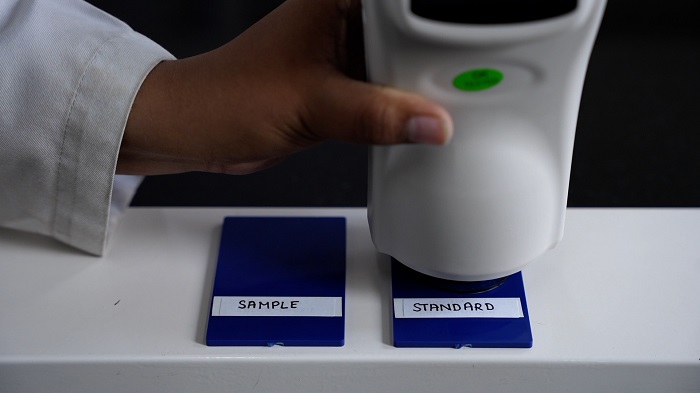
The TP 800 portable spectrophotometer uses white and black calibration before measuring a specimen.
First, switch on the instrument and wait for the digital LCD screen to start. Select the white calibration option and position the measuring aperture correctly over the white calibration standard. Press the OK/Testing button to complete the white calibration.
Next, perform the black calibration according to the instrument's operating procedure. After completing both calibration steps, profile the specimen according to the applicable testing standard.
Position the sample correctly and select Sample Measure to begin the measurement.
The TP 800 can then display color measurement data such as L*, a*, b*, C*, and h*. These values can be used to compare a measured specimen with a standard sample and evaluate color differences.
Spectrophotometer Price in India
The spectrophotometer price in India varies according to the instrument type, wavelength range, measurement technology, accuracy, automation, accessories, software, and intended application.
For example, a basic laboratory spectrophotometer and an advanced instrument designed for specialized analytical applications can have substantially different prices. Portable color spectrophotometers can also differ in price depending on their optical configuration, measurement geometry, software, and included accessories.
When selecting a spectrophotometer, price should therefore be evaluated together with measurement requirements, required wavelength range, accuracy, repeatability, sample type, application, after-sales support, and calibration requirements.
How to Calibrate a Spectrophotometer?
Spectrophotometer calibration or performance verification should be carried out according to the manufacturer's instructions and the requirements of the specific analytical method.
A typical measurement sequence may involve establishing a baseline using a blank or reference, followed by measurement of standards or reference materials where required.
The blank provides the baseline against which the sample measurement is evaluated. A standard with a known analyte concentration can then be used to verify instrument or method performance when the analytical procedure requires it.
For critical measurements, laboratories should follow their documented quality-control procedures and applicable standards rather than relying on a single universal calibration interval.
Factors Affecting Spectrophotometer Accuracy
Several factors can influence spectrophotometer measurement accuracy and repeatability, including:
Calibration
Incorrect or outdated calibration can produce inaccurate measurements. Instruments should be calibrated or verified according to their manufacturer's instructions and the requirements of the analytical method.
Wavelength Accuracy
Accurate wavelength selection is important because many substances absorb light differently at different wavelengths.
Cuvette Cleanliness
Dirty, scratched, or contaminated cuvettes can interfere with light transmission and affect measurement results.
Sample Preparation
Incorrect sample concentration, incomplete mixing, contamination, bubbles, or inconsistent sample preparation can affect the measurement.
Stray Light
Unwanted light reaching the detector can influence measurements, particularly at high absorbance levels.
Temperature
Temperature changes can affect certain samples and analytical reactions, potentially influencing spectrophotometric results.
Instrument Alignment
The optical components and sample position must be correctly aligned so that the intended light path reaches the detector.
Advantages of Spectrophotometers
Spectrophotometers provide several advantages for laboratory and industrial analysis:
- Quantitative analysis: Absorbance measurements can be related to analyte concentration under appropriate conditions.
- Wide range of applications: Different models can be used for chemical, biological, pharmaceutical, food, environmental, and material analysis.
- Precise wavelength selection: Instruments can measure samples at selected wavelengths.
- Repeatable measurements: Controlled measurement conditions can improve consistency between tests.
- Color analysis: Specialized spectrophotometers can provide objective color measurements and comparisons.
- Digital results: Modern instruments can display and store measurement data for analysis and quality control.
Frequently Asked Questions About Spectrophotometers
What does a spectrophotometer measure?
A spectrophotometer measures how a sample interacts with light, commonly by measuring absorbance or transmittance at selected wavelengths. These measurements can be used to determine concentration or other optical properties under appropriate analytical conditions.
What is the principle of a spectrophotometer?
The working principle of a spectrophotometer involves measuring the intensity of light before and after it interacts with a sample. The resulting absorbance can be related to the concentration of an absorbing substance according to the Beer-Lambert Law when the required conditions are satisfied.
What is the Beer-Lambert Law in spectrophotometry?
The Beer-Lambert Law describes the relationship between absorbance, concentration, and optical path length. It is commonly expressed as A = εlc, where A is absorbance, ε is molar absorptivity, l is path length, and c is concentration.
What are the main types of spectrophotometers?
Common types include UV-Visible, infrared, fluorescence, atomic absorption, near-infrared, double-beam, and portable spectrophotometers. The appropriate type depends on the wavelength range, measurement technique, sample, and application.
What samples can a spectrophotometer analyze?
Depending on the instrument and method, spectrophotometers can analyze liquid solutions, biological samples, food samples, water samples, powders, films, coatings, and other materials.
What is a UV-Visible spectrophotometer used for?
A UV-Visible spectrophotometer is commonly used to measure the absorption of ultraviolet and visible light by samples. Applications include concentration measurement, DNA and protein analysis, chemical analysis, and research.
How do you calibrate a spectrophotometer?
Calibration or performance verification should follow the manufacturer's instructions and the requirements of the analytical method. Depending on the instrument and application, the procedure may involve a blank, standards, reference materials, or wavelength verification.
How often should a spectrophotometer be calibrated?
There is no single calibration interval that applies to every spectrophotometer. The appropriate frequency depends on the manufacturer's recommendations, instrument usage, application, laboratory quality system, and applicable regulatory or testing requirements.
What factors affect spectrophotometer accuracy?
Calibration, wavelength accuracy, cuvette cleanliness, sample preparation, stray light, temperature, and optical alignment can all affect spectrophotometer measurement accuracy.
What is a portable spectrophotometer?
A portable spectrophotometer is a compact instrument designed to perform spectrophotometric or color measurements outside a traditional laboratory or where on-site testing is required. Its capabilities depend on the instrument's optical system and intended application.
Conclusion
A spectrophotometer is an important analytical instrument for measuring how samples interact with light. By measuring absorbance or transmittance at selected wavelengths, spectrophotometers can support concentration analysis, color measurement, research, and quality control.
The Beer-Lambert Law provides the foundation for many quantitative spectrophotometric measurements by relating absorbance to concentration and optical path length. Different types of spectrophotometers, including UV-Visible, infrared, fluorescence, atomic absorption, NIR, double-beam, and portable instruments, are designed for different analytical requirements.
For reliable results, users should select an instrument appropriate for the sample and application, follow the manufacturer's operating and calibration instructions, maintain clean sample holders and optical components, and use appropriate quality-control procedures. For portable color analysis, the TP 800 portable spectrophotometer provides a compact option with color measurement and comparison features for applications requiring on-site or portable testing.