In many industries, achieving consistently high temperatures that are free from contamination is a constant challenge. Small changes can affect test results, weaken materials, or lower product quality. Traditional heating techniques can create inadvertent exposure to combustion gases, flames or scorching from other heat sources which makes it difficult to reproduce and guarantee repeatability of the results.
To overcome these issues, modern laboratories and production units rely on specialized heating systems like a muffle furnace. It creates an isolated environment, delivers precise temperature control and supports demanding processes such as ash content analysis, sintering, and heat treatment. In this post, you will learn everything about a muffle furnace, its working, and its applications in various industries.
What is a Muffle Furnace?
A muffle furnace is a high-temperature heating device used for controlled thermal processing. It works by enclosing the sample within an insulated chamber, preventing direct contact with combustion gases or fuel. Due to their versatility, muffle furnaces are commonly used in material research, pharmaceutical testing, forensic analysis, and quality control processes.
These furnaces come in different sizes and designs to suit the varied requirements of laboratories and industrial use. Most contemporary models have programmable temperature controls, quick heating, and energy-saving insulation, providing precision and cost savings across a range of industries.
How Muffle Furnace Work?
Muffle Furnace works by enclosing the sample within an insulated chamber, preventing direct contact with combustion gases or fuel. Inside the furnace, heating elements placed around the walls gradually raise the temperature and distribute heat evenly, so the sample gets heated in a controlled way. A temperature controller constantly monitors the internal conditions and adjusts the power supplied to the heaters.
Step-wise working of Muffle Furnace
· The sample is placed inside the insulated inner chamber within a secured door.
· Required temperature and holding time are set on the temperature controller.
· Electrical power is supplied to the heating elements surrounding the chamber.
· The elements heat up and transfer heat to the inner chamber, raising its temperature uniformly.
· The controller continuously monitors the chamber temperature and adjusts power to maintain the set value.
· During heating, any fumes generated by the sample are removed through the exhaust outlet.
· After the set time, the furnace begins to cool and the sample is taken out once it reaches a safe handling temperature.
Muffle Furnace Diagram
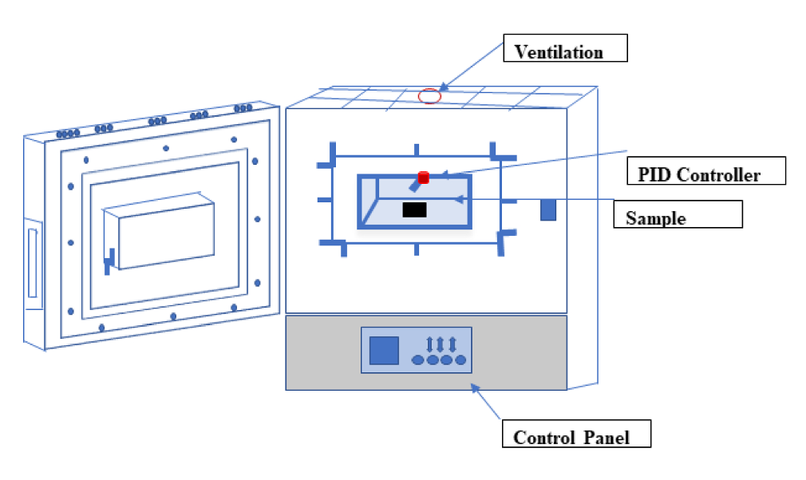
The muffle furnace diagram includes the key components: an insulated heat chamber, a heat-producing device that circumscribes the chamber, temperature control regulation, and electric connections. The heat-producing device generates heat, and the chamber keeps materials inside out of direct contact with the heat source, warming them indirectly with a stable temperature.
· A heated chamber: Assures heat transfer by avoiding temperature variation that could harm the test results.
· A temperature controller: It is used to maintain and control the temperature within the heat chamber. It instantly reduces the power if the temperature overtakes the set limit.
· A safety door switch for operator safety: A safety door switch in a muffle furnace is a protective concept used to safeguard the operator, assuring the furnace can only operate when the door is completely shut. This switch cuts off power or stops the furnace from heating if the door is open, minimizing the risk of contact with high temperatures or dangerous gases.
· High-quality heating system: A good quality heating system is important to maintain the temperature and minimize the risks.
· Temperature controller – Temperature up to a maximum of 1600 degrees Celsius.
· Exhaust pipe fitted with the rear side of the furnace.
Types of Muffle Furnace
Here are the most common types of muffle furnaces used in industries:
|
Type of Muffle Furnace |
Temperature Range |
Uses |
|
Gas-Fired Muffle Furnace |
Up to 1200–1400 °C |
Industrial heating, annealing, metal heat treatment |
|
Ashing Muffle Furnace |
500–1000 °C |
Ash determination in food, chemicals, materials |
|
Nichrome Muffle Furnace |
Up to 1000–1100 °C |
Routine laboratory heating and drying |
|
Kanthal Muffle Furnace |
Up to 1200–1400 °C |
General heat treatment and material testing |
|
Silicon Carbide Muffle Furnace |
Up to 1500–1600 °C |
Ceramic firing and high-temperature laboratory work |
|
Molybdenum Disilicide Muffle Furnace |
Up to 1700–1800 °C |
High-temperature research and ceramic sintering |
Muffle Furnace Working Principle
Muffle furnace work on the principle of indirect heating, where the heating materials are located outside the furnace chamber, and the material that needs to be heated is located inside the isolated chamber known as a muffle. The muffle is made up of a clay material like alumina, which can stand up to high temperatures and is opposed to chemical decomposition.
As soon as the muffle furnace is switched on, an electric current is passed by the heating elements, which then warm up and emit heat toward the muffle, the muffle takes in the heat and becomes a blaze.
The temperature that resists in the muffle is controlled by a temperature controller, which examines the temperature and modifies the strength transferred to the heating elements accordingly. This assures that the material is burnt to the given temperature without overheats.
Muffle furnaces are used for high-temperature applications such as glass fusion, making enamel coatings, and fusing.
The working principle of muffle furnace relies on the controlled heating of materials in a climate-controlled, deoxygenated environment, working of the muffle furnace includes:
· Heating Process: The furnace comprises a burning element, made from materials like nichrome, which manages heat when electrical current circulates through it. This heat is distributed inside the furnace chamber.
· Thermoregulation: The muffle furnace uses a temperature controller, linked to a digital or analog thermometer, to fix the crave temperature. Modern muffle furnaces are attached to programmable controllers, allowing users to fix accurate heating cycles (including ramp-up rates, hold times, and cooling periods).
· Muffle Chamber: The furnace’s interior chamber, or “muffle,” is enclosed to contain the heat and safeguard the material inside. The chamber averts the sample from face-to-face risk to flue gases, assuring no oxygen nature for processes like burning.
· Exhaust System: Some muffle furnaces are equipped with a channel to release gases generated during the heating process, ensuring safety and maintaining optimal conditions inside the furnace.
A muffle furnace works on the Law of conservation of energy and the principles of indirect heating and temperature control.
Muffle Furnace Used for
A Muffle furnace is used for processes like metal testing, ash content analysis, sintering, and annealing. Here is a detailed explanation of Muffle Furnace uses –
· Ash analysis in lab testing: Measures the ash left after burning food products, coal, or organic materials.
· Thermal processing of metals: Ideal for annealing, tempering, and hardening to enhance the structure of metal parts.
· High-temperature material evaluation: Evaluates the durability, performance, and composition of materials under controlled heat.
· Processing in ceramics and glass: Applied in steps such as sintering, firing, and vitrification to shape, densify, and finish ceramic and glass items.
· Safe burning of biological samples: Used to sterilize and completely break down biological waste and sensitive lab specimens.
· Temperature stress testing in pharma: Studying the stability of medicines and pharmaceutical products in extreme heat.
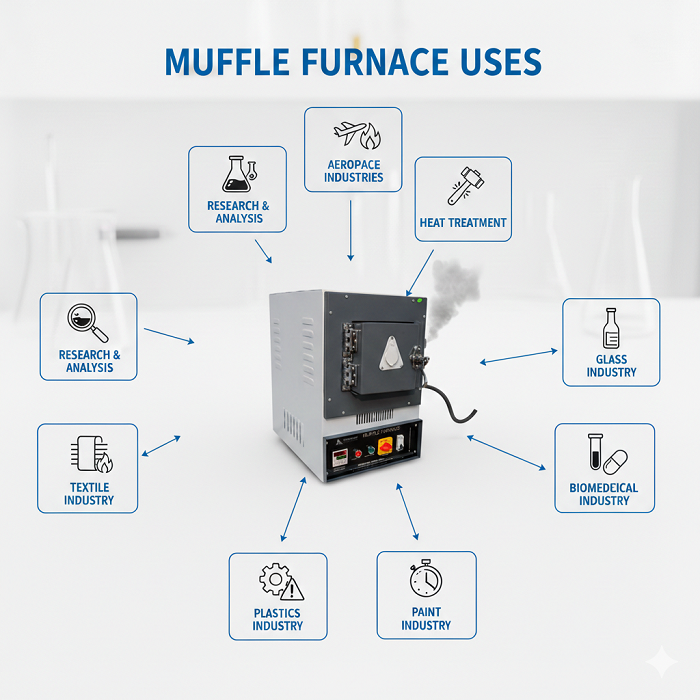
Muffle Furnance Application
- Research and Analysis: The instruments that are used in laboratories are typically used in
- doing research related to different materials and their functionalities. The instrument is used to transform the material into residue, and this residue is used for implementing the analysis of uncommon features of the material that are being evaluated.
- Aerospace Industries: These industries use muffle furnaces for evaluating the flame resistance of unique and different materials at very high temperatures that are to be furnished in the aircraft.
- Heat treatment: The device is used in different Metalworking and blacksmithing processes for the hair treatment of unique and different materials. The heat treatment is used for manufacturing a dramatic change in the materials.
- Glass Industry: Used to liquefy the glass for reuse and curving.
- Textile Industry: Used to analyze the cinder content of fabrics, wool, and fibers.
- Plastic Industry: Used to test plastics to check their strength.
- Paint Industry: Used to test rapid drying of paints and coatings.
- Biomedical Industry: Used for drug testing and the pre-treatment of medical samples.
Muffle Furnace Temperature
Muffle furnace temperatures range from 1,000°C to 1,800°C however, the ultimate temperature depends on the category of heating materials like metallic, silicon carbide, etc.
- Metallic wire heating elements: These elements are the most general type of elements and can achieve temperatures from 1000 degrees Celsius to 1200 degrees Celsius.
- Silicon Carbide heating elements: The temperature can achieve temperatures up to 1600 -degrees Celsius.
- Molybdenum disilicide heating elements: Here, the temperature can range up to 1,800°C.
Standard muffle furnaces generally have a temperature range between 300°C (572°F) to 1,200°C (2,192°F). These are appropriate for a broad range of applications, like burning, tempering, and basic heat treatment processes.
Collaborate with Testronix Instruments For Best Testing Experience
Testronix Instruments is one of the prominent companies in India that delivers quality-assured testing machines at the PAN India level. With the dedication and hard work of experts, and the R & D team, the company is efficient in bringing the best quality testing instruments with the custom facility. Muffle Furnace by the company is one of the best-selling testing tools that are available with a user-friendly operating system, quality material, and precise structure. Choose Testronix for the best experience in
- On-time delivery support all across the nation
- Certification from ISO & ASTM standards
- Experts’ assistance to learn the working and maintenance of the testing equipment
- Availability of technically advanced machines at competitive yet reasonable rates
conclusion:
In conclusion, muffle furnaces play an important and serious role in current industries, providing a trustworthy, accurate, and protective strategy for manufacturing materials at high temperatures. Their ability to create a separate and managed environment makes them essential for many applications, assuring reliable outputs and improving efficiency across sectors.
To know more about the features, working, benefits, and availability of Muffle furnaces in your area, connect with us. We are available at +91 9313140140 or mail us for a quotation at info@testronixinstruments.com.