The coefficient of friction is a key factor in determining how easily one surface moves against another. When the coefficient of friction value is higher, a higher force is required to slide one surface to another (like brake pads on a wheel). Similarly, lower friction means a low force requirement for the same task (like ice on metal). Understanding friction behavior is essential for designing safer, more efficient designs in engineering, manufacturing, and transportation.
What is Coefficient of Friction?
The coefficient of friction (COF) measures how much two surfaces resist sliding against each other. It is a dimensionless number measured as the ratio of friction force and normal force. A higher COF indicates greater resistance to motion, while a lower COF means surfaces slide more easily. It depends on material properties, surface texture, and external conditions, and applies to everything from industrial machinery to everyday tasks.
Coefficient of Friction Formula
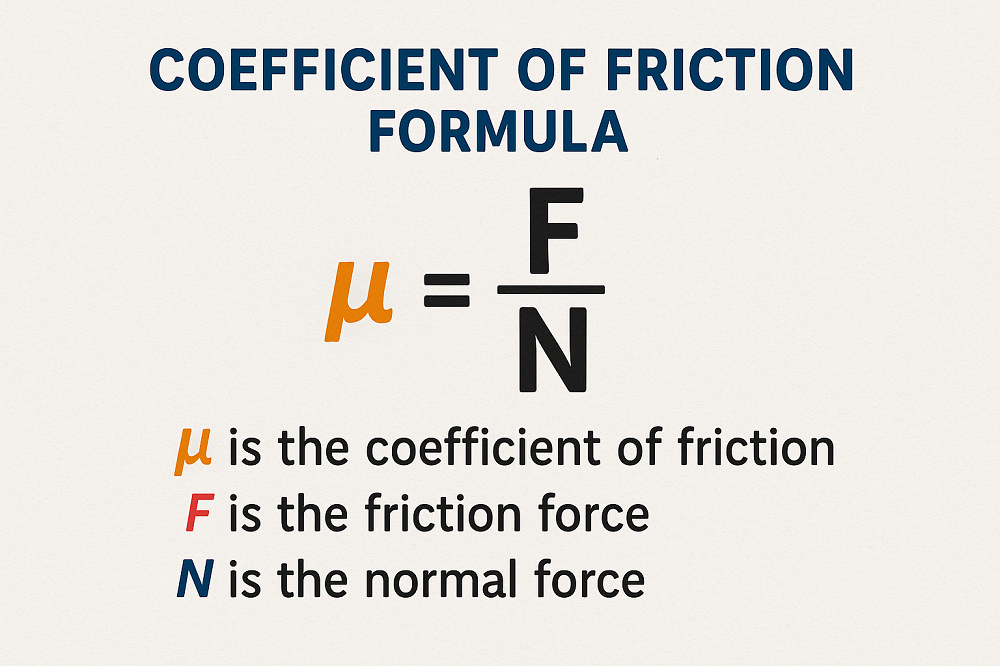
The formula for the coefficient of friction (μ) is the ratio of friction force to normal force and is written as follows –

Let's break down the basic formula used to calculate friction:
Here, μ (mu) is the coefficient of friction, it is a dimensionless number.
F is the force of friction existing between the surfaces.
N is the normal force or the force that acts perpendicular to the surfaces in contact.
The coefficient of friction is critical in plastic films; if too low, the film may be too slippery and, therefore, may cause handling problems during shipment. If too high, the film sticks both to itself and other surfaces, causing jams in machinery and therefore causing production slowdowns.
Different Types of Coefficient of Friction
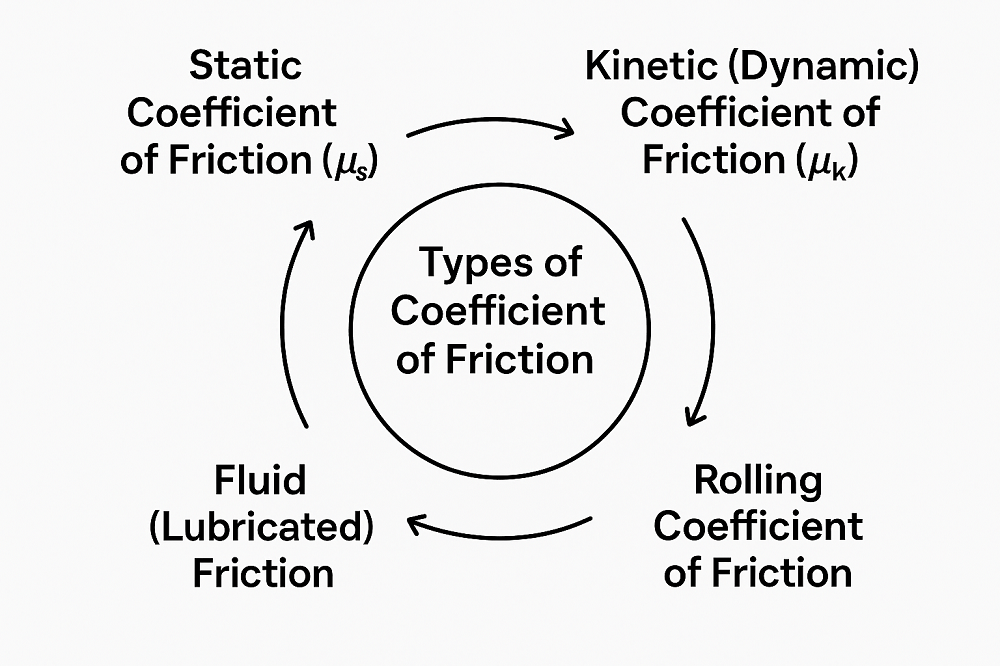
Primarily, the coefficient of friction is of four types:
-
Static Coefficient of Friction (μs)
The force necessary to overcome inertia and produce movement between two objects that are not in motion in relation to one another is a measurement of resistance to the initiation of movement. Static COF is generally greater than kinetic COF for two reasons. In starting, it takes more force to move an object into motion than in motion. And once an object is in motion, it usually does not take more force to keep it in motion.
Kinetic (Dynamic) Coefficient of Friction (μk)
It is the amount of resistance when two surfaces are already moving. A kinetic friction interaction is very stable after the contact has started and frequently it is less than the static frictional force at the start of the movement process.
Rolling Coefficient of Friction (μr)
It is found in rolling bodies such as wheels or ball bearings. It depends on the distortion at the contact points (the site of contact between two surfaces) and is much smaller than sliding friction.
Fluid (Lubricated) Friction
Occurs when a thin layer of fluid is placed between two surfaces and as such the surfaces do not come into direct contact with each other; thus friction is reduced. Very common in engines and hydraulic systems.
How to Calculate Coefficient of Friction
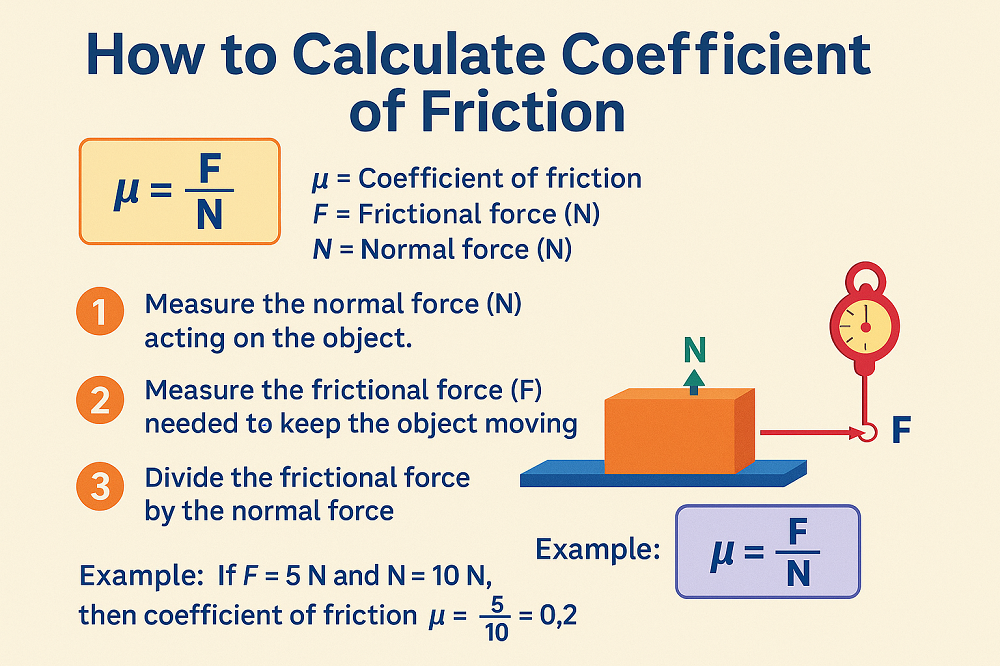
The Coefficient of Friction (μ) is calculated using the formula:
μ = F/N
Where:
-
μ = Coefficient of friction
-
F = Frictional force (N)
-
N = Normal force (N)
Step-by-Step Calculation:
1. In the first step you need to measure the normal force (N) which refers to the force acting on the object perpendicular to the surface.
2. Then measure the frictional force (F) which is required to keep the object moving (kinetic) using a force gauge or a spring balance.
3. Finally, use the formula to calculate the frictional force and the normal force. To get cof, divide the frictional force by the normal force.
Example:
If F = 5N and N = 10N, then coefficient of friction μ = 5/10 = 0.2
Applications of Coefficient of Friction Test
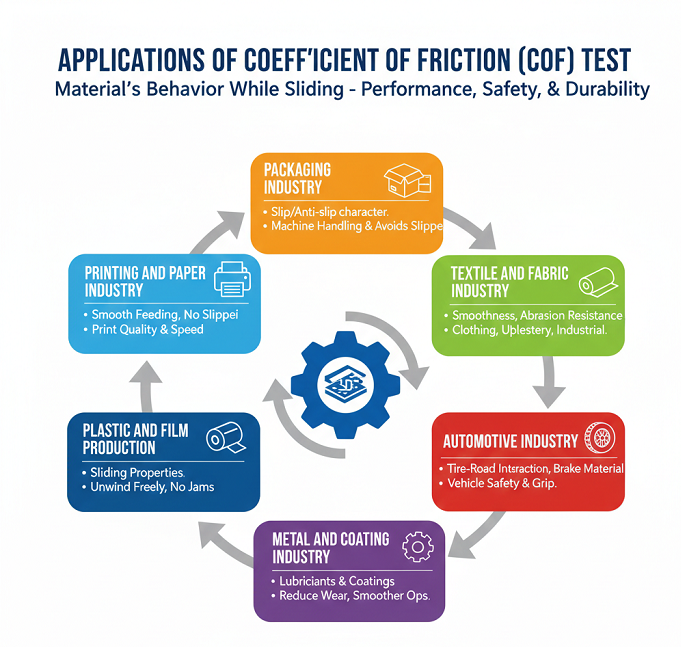
The Coefficient of Friction (COF) test is important for characterizing a material's behavior while sliding. As a dimensionless number, COF assists in the evaluation of surface smoothness or roughness, friction or grip, and fluid lubrication, which are important to maintain a level of performance, safety, and durability in many sectors including packaging, automotives, and textiles.
-
Packaging Industry
The COF test identifies the slip or anti-slip character of films, pouches, and cartons. The test is performed to ascertain that packaging materials neither slide nor stick inappropriately while manufacturing, during transport, or stacking. Having the appropriate COF value ensures proper machine handling and avoids product damage by slippage.
-
Textile and Fabric Industry
When it comes to fabrics, the COF testing involves working through the measurements of the friction of these multi-layered fabric surfaces. This ultimately will help ascertain a manufacturer's awareness of its softness, smoothness and resistance to abrasion.
All of that ensures the fabric chosen for a particular application will meet the performance and comfort expectations that owners desire in a fabric - an extremely significant application to specifically consider for clothing, upholstery, and industrial purposes requiring surface contact and wear resistance.
The COF test is used when investigating tire-road and brake material interaction. This test provides the optimal contribution to grip, lessens skidding, and ultimately improves vehicle safety. This coefficient of friction allows for testing of seat belt material, door seals and various other parts of the automobile that require an equal amount of frictional behavior to effectively perform their functions and suit the safety of automobile usage.
-
Plastic and Film Production
This test determines the sliding properties of plastic film and sheet. By determining the COF, makers can provide films that unwind freely from rolls, that perform efficiently on packaging machinery, and that have the proper slip properties. It enables making and packaging without delays from processing or packaging; without film wrinkles; or without film jams.
-
Printing and Paper Industry
With paper and print, COF testing is used to ensure sheets can feed smoothly into printers and packaging equipment. This will provide precise application of COF readings. There should be no slippage, misalignment or double feeding of the sheets. Accurate COF measurements also lead to high-speed print, print quality, and repeatable application of the paper both in production and end-use applications.
In metal forming and coating operations, COF tests evaluate the effectiveness of lubricants and coatings for reducing wear. COF testing is used in order to improve tool life, reduce energy use, and create smoother operations. It also helps in the proper selection of surface treatments for improved performance during high-friction conditions.
Coefficient of Friction Values with Table
Approximate COF values for common material pairs under dry conditions:
|
Material Pair |
Type of Friction |
Coefficient of Friction (μ) |
|
Steel on Steel (dry) |
Static |
0.74 |
|
Steel on Steel (lubricated) |
Kinetic |
0.16 |
|
Rubber on Concrete |
Static |
1.0 |
|
Wood on Wood |
Static |
0.4 |
|
Aluminum on Steel |
Static |
0.47 |
|
Teflon on Steel |
Kinetic |
0.04 |
|
Glass on Glass |
Static |
0.9 |
|
Ice on Ice |
Kinetic |
0.03 |
|
Plastic on Steel |
Static |
0.3 |
|
Leather on Metal |
Static |
0.6 |
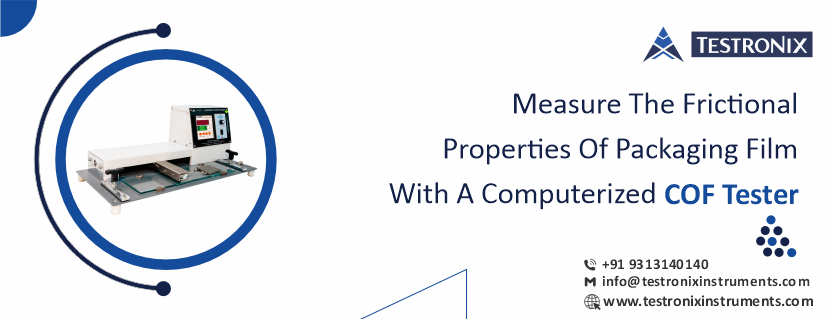
The Solution: Coefficient of Friction Tester
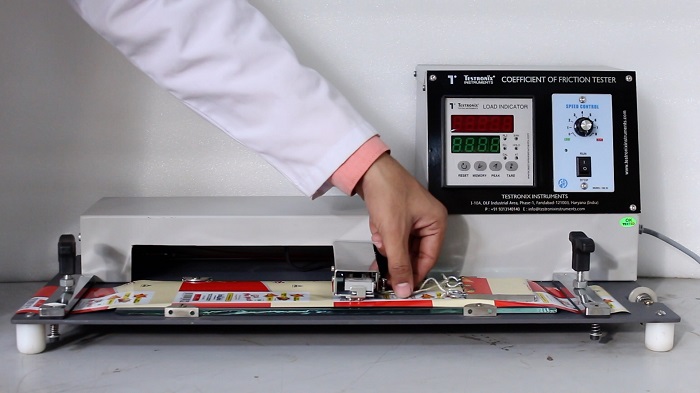
If you want to make sure your plastic films have the proper COF, then you should be measuring a proper one. Here, the Coefficient of Friction Tester comes into play.
A Coefficient of Friction Tester is a dedicated device for measuring friction between two bodies. It delivers the measurement known as the coefficient of friction, which quantifies the degree to which one surface causes or can resist friction relative to another. This tester is very important in industries where friction needs to be understood and controlled, like in automotive, packaging, textiles, and buildings.
Units: Keep It Simple
-
The beauty of the coefficient of friction is that it has no units at all because it's a ratio of two forces - measured in Newtons. Thus, the units cancel each other out.
-
In theory, this makes the COF just a pure number, easy to compare across materials and different scenarios.
Importance of a Coefficient of Friction Tester
The Coefficient of Friction Tester is a very important gadget for many industries, whose importance cannot be overemphasized. Here's why it is so vital:
Quality Control:
The COF tester ensures that materials possess uniform friction characteristics. The uniform friction characteristics are essential in ensuring the quality of a product remains the same in various batches of its production.
Material Performance:
The knowledge of the COF of materials helps manufacturers to optimize such materials for a specific application. Here, in the case of packaging, the appropriate COF would ensure that products cannot slide while in transportation to prevent them from being broken.
Cost-Effectiveness in Production:
-
Material with incorrect COF can jam or slow down machinery, leading to delays in forming products. Materials with COF pre-tested machinery compatibility ensure there is an assurance of smooth equipment operation, which improves the general efficiency scale.
-
There will be no material failure due to the COF test, and the production process will be streamlined, thus saving a great deal in terms of downtime, repair, and the material itself.
Prevention of Accidents:
In many applications, the wrong COF has a tendency to cause accidents such as a product slipping from its position, or even machinery malfunctioning. Regular COF checking saves the day in the prevention of such accidents.
Data-Driven Decisions:
Correct COF data will enable the engineer or designer to make better decisions on the selection of materials and design of improved products.
FAQ - Coefficient of Friction
What is Coefficient of Friction Unit
The Coefficient of Friction (COF) is expressed as a "unitless" quantity. This is because it is a ratio of frictional and normal forces - both in the same units (Newtons).
What is the Symbol of Coefficient of Friction
The Greek letter μ (mu) is used to denote the coefficient of friction universal unit. It is the μs when discussing static friction and μk when we are discussing dynamic or kinetic friction. Thus, it is dependent on what property we are measuring.
What is the Range of Coefficient of Friction
The range of coefficient of friction is between 0 and 1. In some cases, it can exceed 1 for example in the case of rubber or with sticky surfaces. A higher cof value means more friction while a smaller cof value means smoother or more slippery surfaces.
What is COF Value?
The value of COF is the quantitative value of the resistance between two contacting surfaces. It indicates how easily one surface can be made to slide over another. Smoother sliding is indicated by smaller values of COF, and greater resistance or grip is indicated by greater values of COF.
What is a Friction of Coefficient 1?
The friction of 1 indicates that the force of friction is equal to the normal force between two surfaces. This represents a very high level of grip or resistance to motion as in case of rubber on dry concrete.
How is Friction Coefficient Measured?
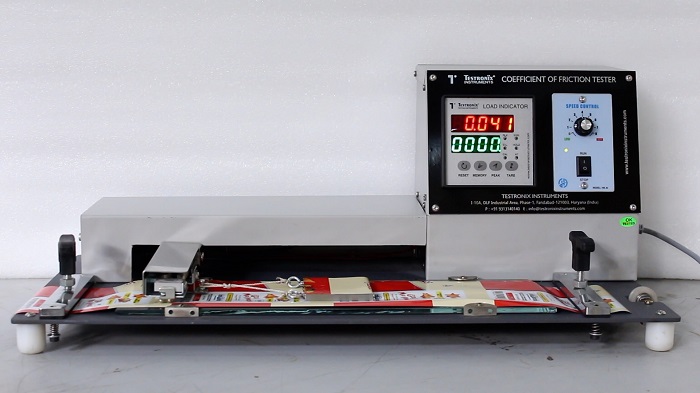
A coefficient of friction can be measured with the use of a coefficient of friction tester which measures static and kinetic friction between two materials. The device applies a known load and measures the resistance to sliding to compute COF precisely.
What can the coefficient of friction be influenced by?
The material, surface texture, temperature, and lubrication are probably the most common factors that may influence COF. Even small differences in any of these variables can be responsible for very big differences in the frictional behavior of a system.
Can the COF vary with time, or is it time-independent?
Yes, COF can vary with wear, deterioration, contamination, or changes in the surface condition. Testing is needed to ensure performance on a regular basis.
Can the same tester do both a static and kinetic friction test?
Most modern testers permit measurement for both static and kinetic friction, thus giving one the full picture of the friction behavior of one's material.
HERE’S A CHANCE FOR YOU TO SECURE YOUR SUCCESS!
Phone: +91 9313 140 140