The possibility of materials breaking due to sudden force is one of the primary concerns for many industries, including building construction, automobiles, and heavy mechanical engineering. Most materials work well under the conditions of constant loads; however, when a sudden force is introduced (through the work of dynamics or shock), the material could fracture.
Such failures can pose safety risks, cause property damage and result in thousands of dollars in financial damages. The manufacturing industries rely on standardization tests (e.g. the Charpy impact test) in order to minimize such incidents.
Charpy impact tests are a common method used to evaluate how tough a material is. This test allows manufacturers to verify that the material they manufacture will withstand the real-life impacts from forces and still meet the required quality level of the material.
What is Charpy Impact Testing?
Charpy Impact Test is a popular method of assessing the impact resistance of materials. The impact resistance of a material is measured by determining the energy absorbed by the material during the process of breaking under impact (sudden load or stress).
The steps taken to complete this type of impact test are as follows:
1. A notched specimen of a specified shape and dimension is prepared
2. A pendulum hammer strikes the specimen with a predetermined force
3. The energy absorbed (in joules) by the specimen during fracture is recorded
4. This will determine the material's resistance to an instantaneous impact.
Charpy impact testing is predominantly utilized for testing metals, alloys, laminated structures produced from structural steel, and other engineering materials. Charpy test is widely used to determine the physical properties of engineering materials due to its simplicity, low cost, and quick execution.
Concept Behind the Charpy Impact Test
The test determines a material's toughness by measuring the kinetic energy lost by a swinging pendulum as it breaks a standardized specimen. By calculating the difference between the pendulum's initial potential energy and its remaining energy after the strike, we can quantify how much energy the material absorbed during failure.
There is a difference between:
-
The initial amount of energy created by the pendulum prior to striking the sample
-
The amount of energy remaining (in the form of kinetic energy) once the sample has been fractured
The difference is based on using the energy absorbed by the sample as the reproducible value of toughness.
Impact Toughness: This refers to the ability of a material to absorb energy during impact loading.
Notch Sensitivity: These are flaws and cracks in a material that affect its strength.
Ductile-to-Brittle Transition Temperature (DBTT): It is the temperature at which a material transitions from having ductile to brittle behavior.
The introduction of a notch into the test sample creates a static concentration of stress. This simulates a defect that can be present on the outer surface of a component and will therefore be the basis for evaluating the reliability of the sample.
When Charpy Impact Testing is Required
Charpy Impact Testing is required when materials are supposed to encounter sudden loads or extreme environmental conditions.
Charpy testing is important to:
1. Evaluate material performance in low-temperature conditions
2. Evaluate material performance when subjected to dynamic or shock loads
3. Validate material performance for safety-critical applications
4. Select materials based upon toughness
Charpy testing is performed in many industries, including:
1. Construction and infrastructure
2. Automotive manufacturing
3. Oil and gas pipelines
4. Aerospace and defense
5. Power generation and heavy equipment
If there is a failure of the material in any of these industries, the consequences can be significant. Charpy testing ensures that the materials meet the specified safety and performance requirements.
Charpy Impact Test Procedure in Quality Control
The Charpy Impact Test is a methodical and uniform instructional technique that utilizes a controlled environment to obtain precision results.
1. Specimen Preparation
The preparation of a test specimen consists of making a sample as specified. The sample will then be notched at its center (e.g., V-notch or U-notch).
2. Conditioning the Specimen
The sample will then be conditioned to a specified temperature prior to administering the test. This will help aid in studying the characteristics of materials when they are subjected to different ranges of environmental conditions.
3. Positioning the Specimen
The test specimen will be placed in a horizontal position on the test supports. The notch must be placed on the opposite side of the hammer before the impact of the hammer.
4. Impact by Pendulum Type Hammer
The pendulum hammer will be dropped from a pre-established height onto the specimen at the location of the notch.
5. Fracture of the Test Specimen and Measurement of Fracture (Impact) Energy
After the hammer impacts an area located on the specimen at the notch (i.e., the fracture zone), the sample will break (i.e., fracture) due to the force of the impact. At the moment of fracture, the machine will electronically measure the available energy at the time of fracture.
6. Interpretation of Test Result
The electronic output displaying the amount of energy available is reported in joules. A high-energy value results in greater toughness and impact/abrasion resistance. The use of this procedure will result in repeatable/reproducible control measures relating to material consistency.
Mandatory Standards for Charpy Impact Testing
Charpy impact testing is performed under internationally recognized testing standards like ASTM E23, ISO 148-1, ASTM A370, and others. These standards ensure the material’s toughness under intense stress and sudden breaks.
1. ASTM E23 (Standard test method for notched bar impact testing): This standard outlines the dimensions and testing procedure for Charpy specimens and is widely used throughout the US.
2. ISO 148-1 (International standard of Charpy pendulum impact testing): This standard continues to ensure worldwide performance because it offers similarities in the manner in which Charpy impact testing is done on metallic materials.
3. ASTM A370 (Standard specification for mechanical testing of steel products): This specification provides guidelines related to Charpy impact testing.
4. IS 1757 (Indian Standard): This standard defines the testing method and specimen details for Charpy impact testing conducted in India.
5. EN ISO 148 (European Standard to Charpy impact testing): EN ISO 148 standard is a standard that is similar to the ISO 148 standard and is applied in Charpy impact testing by European Manufacturers.
Importance of Charpy Impact Testing in Quality Control
Manufacturers can identify weak material using Charpy tests before manufacturing it into a product. To ensure usable and safe products, Charpy Impact Tests have an important role in the Quality Control process.
1) Prevents catastrophic failure of materials
2) Ensures the safety & reliability of products
3) Helps in everlasting selection
4) Increases the quality of manufacturing
5) Helps meet industry standards
How Testronix Instruments Supports Charpy Impact Testing
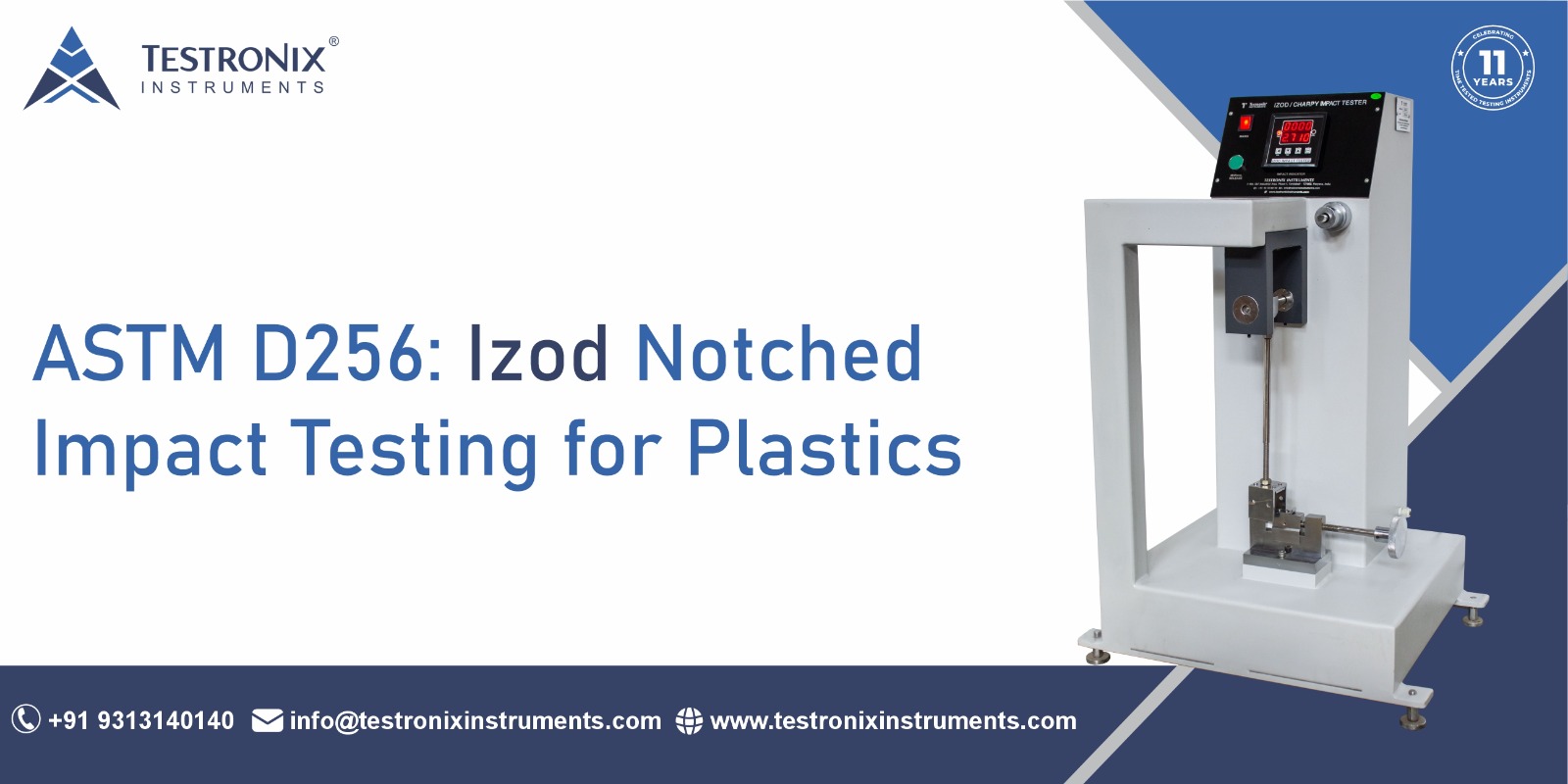
Accurate impact testing requires high-precision instrumentation capable of delivering repeatable results. Testronix Instruments makes advanced Charpy Impact Tester that is used to measure how tough materials are and how much energy they can absorb under sudden loads.
Testronix assists manufacturers in determining the brittleness of materials by offering laboratory testing equipment that complies with ASTM and ISO standards. Such an ability is vital in avoiding structural failures in the field.
Conclusion
The Charpy impact tests are a valuable tool that could be employed to determine the toughness and performance of materials in case of sudden impacts. Charpy impact tests enable industries to minimize the chances of product failure and to protect the product by ruling out the possibility of failure. Industries also use Charpy impact tests to determine the ductility and brittleness of materials.
Industry standards like ASTM E23 and ISO 148 must be adhered to in order to guarantee the accuracy of the data obtained from Charpy impact tests.