Leak testing is an important part of verifying the safety, reliability, and functionality of products from many different types of industries, such as packaging, automotive, medical device, and electronics, among others. Even the smallest leak in a product can affect its quality, contaminate it, or cause a total product failure when used in critical applications.
It is not necessarily straightforward to get accurate leak test results since numerous technical and environmental factors may influence the results of leak testing. These factors help a manufacturer to choose the most appropriate methodology, equipment, and conditions to achieve consistent and reliable results.
What is Leak Test?
Leak testing is an industrial quality control process that determines if a manufactured component is leaking (gaseous or liquid), as well as how much it is leaking. Leak tests are usually performed by subjecting the product to either a very high or very low atmospheric pressure to expose defects such as cracks or weak seals.
Conducting a leak test is very important from both a safety standpoint and an environmental standpoint, since several products produced by manufacturers create a potential hazard to consumers and the environment.
How is Leak Testing Done?
Leak Testing is done by following steps such as preparation, pressurization/evacuation, stabilization, detection, and depressurization.
-
Preparation
This step prepares the test sample by ensuring it can be accurately evaluated for leaks. This includes ensuring that all openings are sealed and cleaning the exterior surfaces of any dust or oils. Hence, attaching required fixtures to ensure there is no outside interference with the test results.
-
Pressurization/Evaluation
In this step, the test sample is tested by introducing a test medium (e.g., air, nitrogen, water, etc.) into it and subjecting the system to either a predetermined pressure or vacuum (evacuating). Either test method provides adequate stress to help to identify all possible leak paths within the system under consideration.
-
Stabilization
Once pressure and vacuum have been applied, time needs to be allowed for stabilization, ideally at least one hour. The purpose of this is to allow any temperature or material expansion effects to settle down to an equilibrium point where they no longer produce erroneous measurements due to elastic deformation or thermal fluctuations.
-
Detection
Leak detection is performed using the appropriate method of detection (e.g., bubble emissions, pressure decay measurement, electronic sensors). The instrument used detects either a continuous change in pressure or a visual display of pressure changes to accurately and consistently identify tiny leak points in the system.
-
Depressurization
Once testing has been concluded, the next step is to slowly reduce the amount of pressure in order to return the system to a normal condition. A controlled depressurization procedure minimizes any possibility of damaging the sample being tested, and it is usually performed with a witness, such as a customer or inspector of quality, for the purpose of verifying this process.
Factors Affect Leak Test Accuracy
Leak Test Accuracy has been affected by the following factors, such as Temperature Variations, Test Part Volume, Test Pressure, Proper Calibration & Standards, Environmental Stability, Part Cleaniness & Preparation, Seal & Fixture Design, Test Cycle Times, Material Elasticity, Operator Error & Training.
Here are the factors explained in detail:
-
Temperature Variations
Temperature changes are the main reasons why leak test results are inaccurate, especially concerning methods for measuring air pressure decay. If there is a change of just 0.018°F in temperature, the test could be a false fail. The causes of these temperature changes include lots of draughts from wind, parts that have recently been washed and dried, and the heat produced during the filling of the test part. Therefore, using a temperature-controlled environment or using temperature compensation software is very important for obtaining accurate results.
-
Test Part Volume
The internal volume of a part influences the sensitivity of a leak test. When constant leak rates are used, a part whose volume is large has a lower pressure loss rate compared to a part with a small volume. A bigger volume is more susceptible to thermal effects (e.g., adiabatic heating) than a smaller volume, and therefore stabilization times might be longer, and measurements can be less reliable. The best way to improve the sensitivity of detecting leaks is to reduce the total volume of testing system components.
-
Test Pressure
Increasing the test pressure leads to increased driving force of the gas and results in higher, more easily detected leak rates. However, with this increased driving force comes the potential for damage due to high pressure. For example, "ballooning" occurs when excessively high pressure leads to elastic deformation of a component made from plastic or thin-walled material. This can result in false failures by mimicking a leak and concealing leaked gas, as the part deforms to seal itself in a balloon shape.
-
Proper Calibration and Standards
In order to be able to properly determine the difference between good and bad parts in the system, it is essential that the leak test machine be calibrated using a traceable "leak master" (standard) and that the calibration standard be as close as possible to the expected rejection rate of the test. A one-point calibration is only accurate at one specific location; however, a two-point calibration (including zero and a known leak standard) can be accurately calibrated for multiple pressures.
-
Environmental Stability
To have reliable results, the conditions of the testing area need to be stable prior to performing the test. Air conditioning units, heater units, and open shipping doors all tend to create significant temperature changes that may affect either the test object or the test equipment; this could create an erroneous reading. Also, excessive humidity in the compressed air line may cause moisture to be introduced to the test and may have an effect on the pressure reading, potentially covering up a leak.
-
Part Cleanliness and Preparation
Defective items can generate incorrect passing answers due to contamination. Remnants of oils, cleaning agents, or manufacturing remains (including machining ones) can limit small or micro-leaks in a faulty product and create the illusion that what has been tested is functioning as expected. Thus, each component must be thoroughly dried and cleaned before being tested. The presence of water within a component could also create inaccurate readings because water vaporizes or freezes, affecting the gas behaviour expected, and could lead to a false fail result.
-
Seal and Fixture Design
Poor test repeatability, or failure to detect successful performance are caused by either defective or improperly designed seals and/or fixtures. If the seal fails to maintain integrity, then the tester interprets any loss of pressure as a leak and thinks that the part being tested has leaked. Moreover, if the test fixture permits the seal to "float", or move, then this can create a non-constant volume change (due to the moving seal) and mask any observed leak.
-
Test Cycle Times (Stability)
The inadequate amount of time (or cycle time) to stabilize may result in generating inaccurate measurements. Filling a component generates heat (adiabatic heat), and this heat must be dissipated before obtaining an accurate pressure measurement. If the fill and stabilize times are too short, the pressure drop due to the cooling process must be perceived as a leak. Adequate time must be given for the part to stabilize, especially with larger, complicated or plastic parts, to prevent false rejections.
-
Material Elasticity
A material's elasticity is a characteristic that can influence how accurately the pressure is measured while the material is under pressure. This occurs for flexible materials like plastic and thin-wall metal when pressures are applied to them, resulting in a decrease in pressure caused by the expanding (elastic) creep of the flexible material. Because it takes time for a flexible material to stabilize (due to pressure causing "ballooning"), applying pre-pressurization time reduces the effect of creep to ensure the measurement is an accurate reflection of the original pressure level.
-
Operator Error and Training
The errors associated with human factors are frequently unrecognized but they represent a major contributor to the accuracy of your test results. Operators must be trained on how to properly load a test sample, ensure that the test seals are clean, and avoid touching the test sample once it has been loaded, as the heat generated from their body during contact can cause a pressure change.
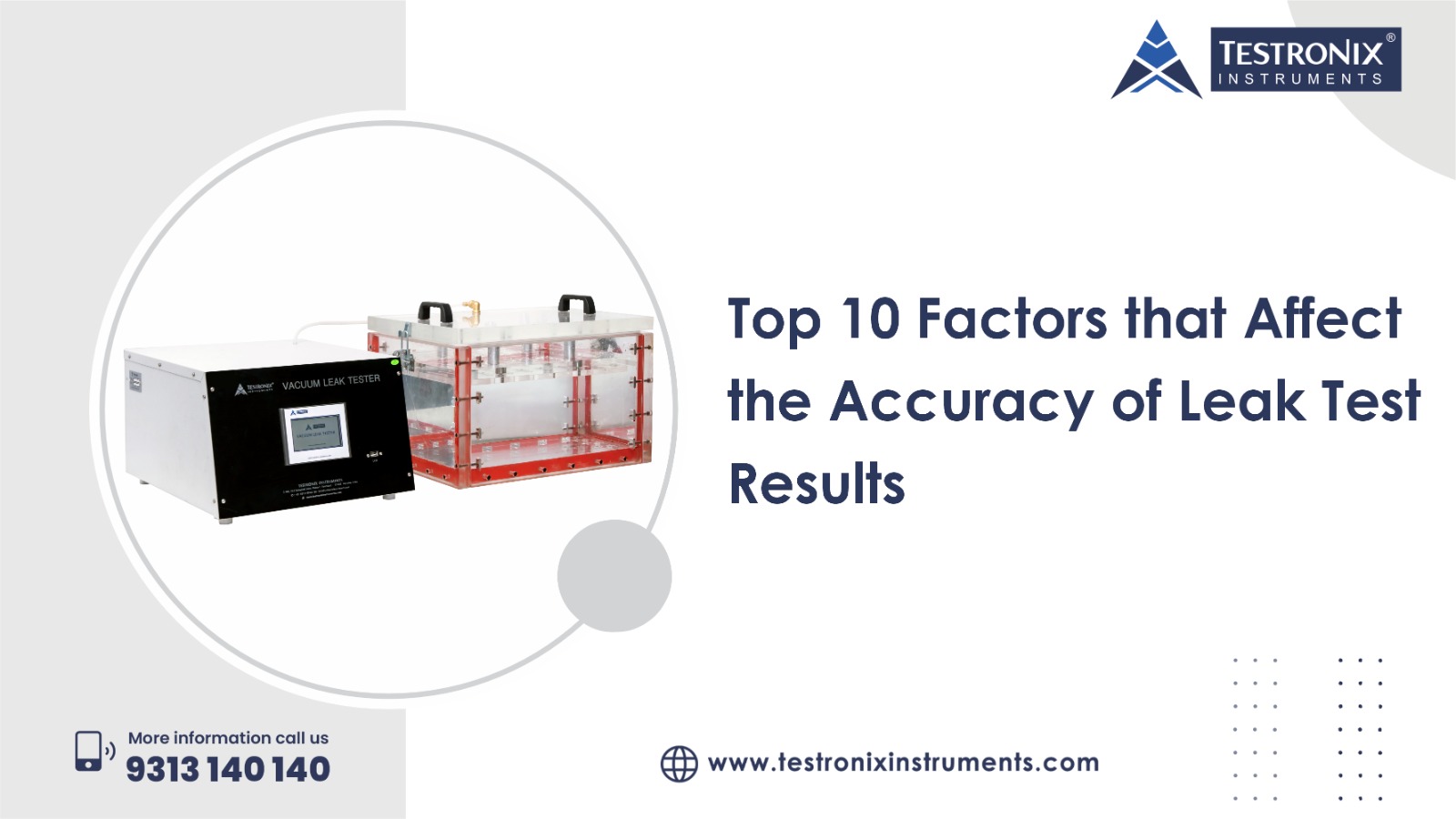
The Ultimate Solution: Testronix Leak Test Detector
Testronix Instruments produces sophisticated, extremely dependable, and exceptional-quality leak-testing devices that satisfy today's industrial standards. All of our equipment is developed utilizing precision sensors, easy-to-use software, and rugged fixtures that give you accurate, repeatable results.
Testronix leak testers apply to various products including bottles, pouches, medical devices, automotive components, and many other types of equipment. Our adjustable pressure control, electronic data logging capabilities, and customizable test program features reduce human error and improve the overall quality assurance of the production line.
Conclusion
Proper leak testing should also be done since safe products are supposed to be offered to the buyer without any holes. Test results can be influenced by too many factors, including the training of the operators, the condition of the testing environment and equipment calibration.
Thus, products might be denied or accepted wrongfully, which may result in losing funds and reputation. With an understanding of these factors and a quality test device such as the Testronix Leak Test Detector, manufacturers are able to obtain reliable results in the case of seeking leaks, meet the requirements, and work on their products for long periods of time.