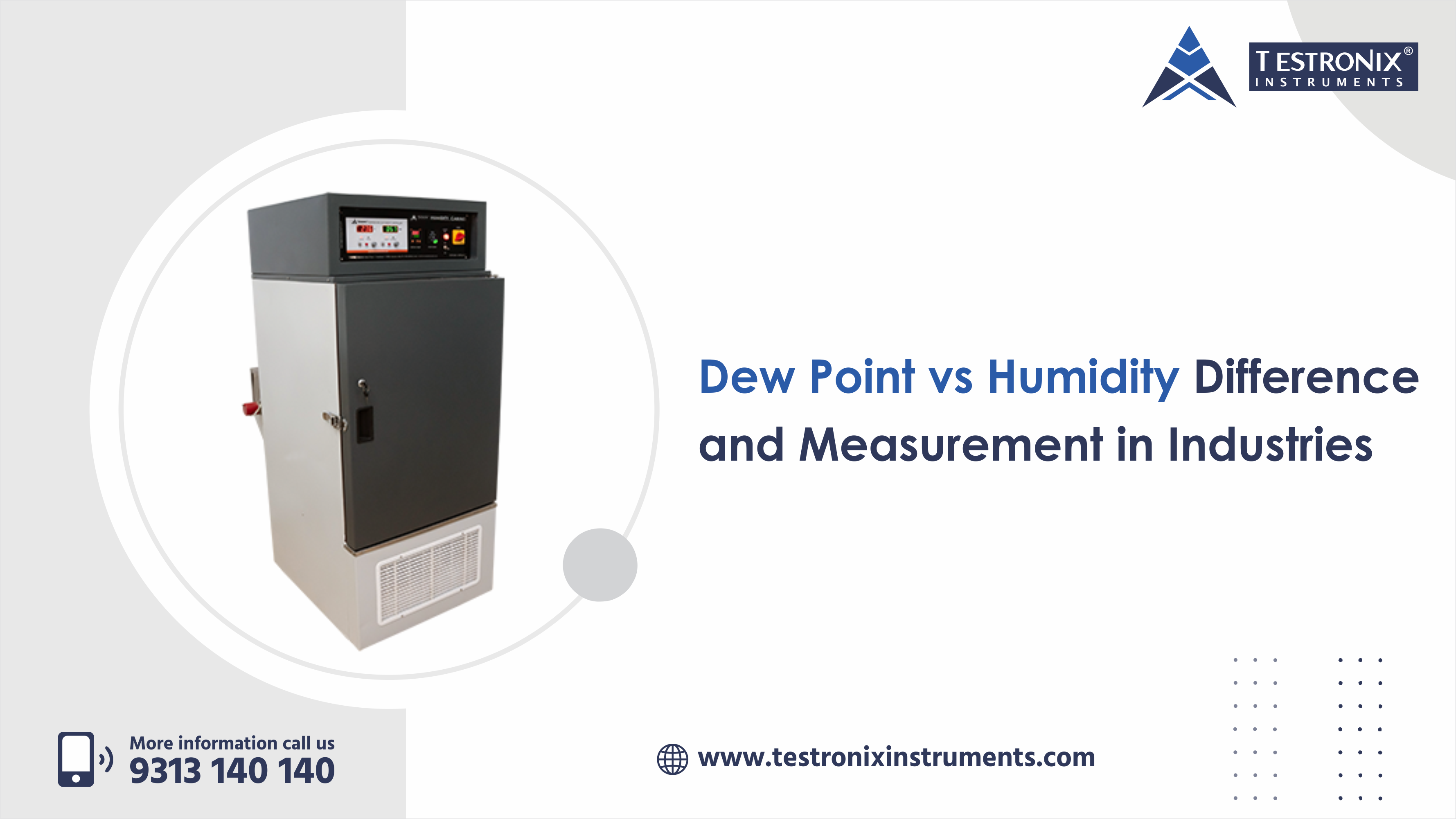
Dew point and relative humidity are the two most widely used instruments for measuring the level of moisture present in the atmosphere. The terms are often used interchangeably, yet they are totally different in their applications in industrial applications, meteorological applications, and environmental applications.
This difference is important to understand in order to design and operate moisture sensitive processes. Relative humidity is useful in determining the level of comfort, efficiency of drying and overall ambient factors but it varies along with the variation in the air temperature. Dew point is still related to the real quantity of water vapor and is therefore a more predictable indicator of when and where condensation will take place on pipes, tanks, delicate electronics or product surfaces.
What is Dew Point?
Dew point is the temperature at which the air becomes fully saturated with water vapor (reaches 100% relative humidity) and moisture starts to condense into liquid water. That is, it is the moisture content of the air at a temperature at which the water vapor condenses into liquid water at a relative humidity of 100 or dew point. On most occasions, the dew point has been expressed in Fahrenheit (°F) which gives a way of defining the availability of moisture in the air.
How is Dew point measured?
Chilled mirror hygrometers, dew point sensors and psychrometers are all types of devices that are used to measure the dew point. In particular, the instrument has a sensor with which measure and record precisely how much moisture there is in the air. The amount of water vapor present in the atmosphere does not change with temperature changes; it stays constant regardless of the ambient temperature.
What is Humidity?
Humidity is the quantity of water vapor (gaseous water) in the air which signifies the quantity of moisture in the air. It is commonly expressed as relative humidity (a proportion of the capacity the air has at a given temperature). With high humidity, the air can be described as sticky and damp and with low humidity, the air is dry and it is important in weather conditions such as rain, fog and dew.
How is humidity measured?
One of the gauges of humidity is the hygrometer, which gauges the level of humidity through various forms of detection, like evaporation measurements (psychrometer), material property change (hair/polymer sensor), and electric resistance and capacitance change. This encompasses such common hygrometers as psychometric (wet/dry bulb), electronic resistive, and capacitive. Sensors and dew point mirrors indicate the measurements of absolute relative humidity as a percentage.
Dew point vs humidity: What is the difference?
Relative Humidity and Dew Point are two different measures of a specific atmosphere. The Dew Point is defined as the temperature at which Air reaches 100% of Relative Humidity (RH) for that temperature; thus, chemical humidity determines Air Humidity Characteristics.
|
Basis |
Dew Point |
Humidity |
|
Definition |
The temperature at which condensation occurs |
Amount of water vapor in the air |
|
Dependency |
Independent of air temperature |
Dependent on air temperature |
|
Stability |
Remains stable with temperature changes |
Fluctuates with temperature |
|
Expression |
Degrees (°C or °F) |
Percentage (%) |
Dew Point vs. Humidity Chart
A dew point vs. humidity chart is an illustration that shows how the relative humidity changes with temperature at a given dew point. This chart assists industries in determining the risks of condensation and the comfort level in a very short time.
The chart showing dew point and humidity indicates that RH (relative humidity) drops with rising temperature because the dew point temperature remains constant (DPT) and a lower volume of air at a higher temperature contains the same amount of moisture as air at a lower temperature.
Dew point vs humidity: Formula Difference
-
Dew point: The dew point is defined as the temperature that the air achieves 100 percent relative humidity (which creates dew) when water vapor begins to condense into actual water.
-
Humidity: Humidity is the ratio of the amount of water vapor to the amount of total water vapor that the air can support based on its existing temperature, and this ratio has both a positive and negative relationship with temperature at different temperatures.
Dew Point vs Humidity: Uses Difference
-
Dew Point: The dew point is often used in the industry for controlling condensation such as with electrical equipment, pharmaceuticals, and compressed air systems.
-
Humidity: Humidity is important in HVAC (heating, ventilation, air conditioning), agriculture, forecasting weather and monitoring indoor comfort.
Dew point vs humidity: Temperature Difference
-
Dew Point: Dew point directly indicates moisture regardless of temperature changes.
-
Humidity: Humidity can be affected significantly by temperature fluctuations in that the humidity level may not produce condensation at high temperatures, but the same humidity level will likely produce condensation at low temperatures.
Why dew point and humidity differences matter
Industries need to have a precise understanding and differentiation of dew point and humidity as this information is very important for the management of moisture-sensitive processes. The precise and continuous monitoring of dew points and humidity prevents the corrosion of pipelines and tanks, the simulation of an environment conducive to mold and the deterioration of raw materials and finished goods.
In those factories that deal with medicines, food processing and compressed air systems, poor humidity control can lead to product failures, unscheduled shutdowns, and expensive repairs. Controlling the dew point as well as the humidity in the right way guarantees the performance of the processes to be reliable, machines to be safe and workers health to be protected and at the same time, it also helps in meeting environmental and industry regulations which are very strict.
Conclusion
While dew point and relative humidity both provide the water content of the air, they are often used in different contexts within the industry. Relative humidity (often abbreviated as RH) is expressed as a percentage that represents how much water vapor exists at that particular temperature relative to how much water vapor at the same temperature. Dew point temperature on the other hand is an absolute value and indicates when all water vapor has condensed into a liquid at 100% RH which is referred to as 'dew' point.