The use of laboratory incubators is important in the provision of an environment that best facilitates the carrying out of biological and chemical experimentation. Applications of microbiological testing, cellular culture testing, and environmental testing all demand incubators of that type. There are two kinds of laboratory incubators: BOD (Biochemical Oxygen Demand Incubator) and CO?2(Carbon Dioxide).
What is BOD Incubator?
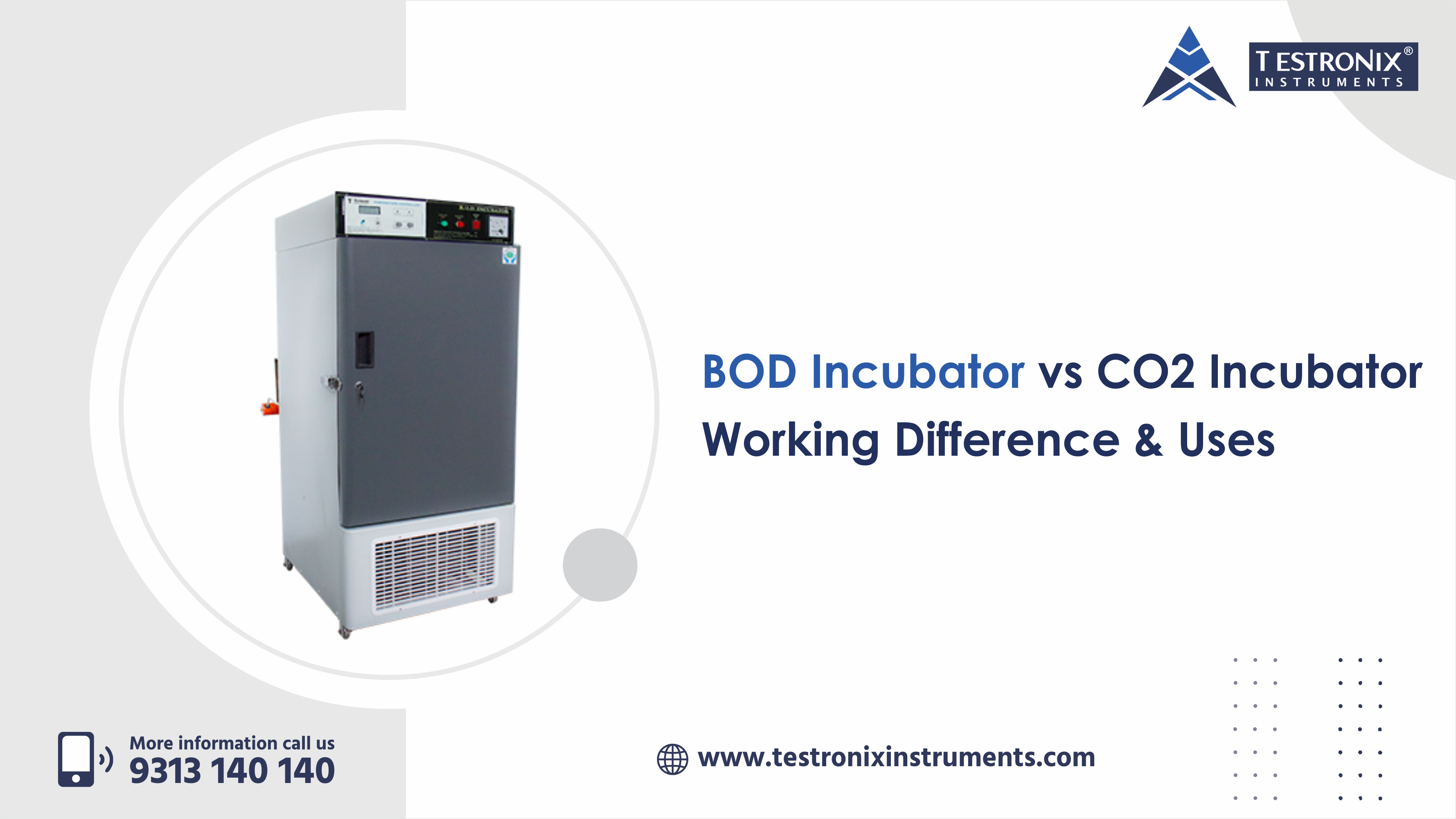
A BOD incubator is a laboratory device to maintain a controlled temperature environment for testing Biochemical Oxygen Demand (BOD) in water samples. It keeps a steady, cool temperature—usually about 20°C—so that tiny living things can break down organic material over a set time, usually five days, making it possible to measure how much oxygen they use.
These incubators are special lab tools designed to measure how much oxygen is used by tiny living things when they break down organic material in wastewater samples. This is done by a predetermined test, called the BOD test. It is among the most common methods of assessing the extent of pollution in a body of water and the efficiency of the treatment procedures.
BOD Incubator Working Principle
A BOD incubator works on the principle of keeping a low and stable temperature condition, normally 20°C, within which microbial activity may occur. In the five days of incubation, the microorganisms use the oxygen in the water samples to decompose organic matter.
In the unit, the heating and cooling systems, air circulation fans, and insulation are included to ensure that temperature conditions and environmental conditions remain constant.
What is a CO2 Incubator
A CO2 incubator is a scientific device that offers a regulated platform in which cell cultures flourish and survive. It also carefully controls the temperature, the carbon dioxide level and humidity to recreate physiological conditions. The optimal conditions of growth that are maintained in these incubators are constant temperature, humidity, and the controlled CO? concentration (usually 5%).
CO2 incubators control all the important parameters of your cell culture environment, such as temperature, moisture content, CO2 level, and oxygen level. Among the key parameters to control for are CO2 concentrations for maintaining pH balance in the culture medium. Many of the CO2 incubators will use CO2 sensors to monitor the concentration of CO2 throughout the incubation process.
CO2 Incubator Working Principle
In cell culture, a temperature, humidity, and carbon dioxide incubator is used to offer an excellent controlled environment through the bicarbonate buffer principle. The bicarbonate buffer operates by producing carbonic acid-carbon dioxide, which enables one to neutralize the culture medium to about 7.2-10.4 pH.
This incubator uses temperature and humidity sensors with heating elements to maintain the parameters where cellular metabolism and proliferation of the cells occur.
BOD Incubator vs CO2 Incubator: What is the Difference
Difference between BOD and CO2 incubators:
|
Feature |
BOD Incubator |
CO2 Incubator |
|
Primary Purpose |
Biochemical Oxygen Demand testing and microbial studies |
Cell and tissue culture applications |
|
Temperature Range |
5°C to 60°C (commonly operated at 20°C) |
Typically maintained at 37°C |
|
CO2 Control |
Not provided |
Available (usually 3–10% CO?) |
|
Humidity Control |
Basic or optional |
High humidity to prevent culture drying |
|
Application Area |
Environmental and water testing laboratories |
Biomedical, pharmaceutical, and biotechnology labs |
|
Cost |
More cost-effective |
Comparatively expensive |
BOD Incubator vs CO2 Incubator Differences
Temperature Range Difference
BOD Incubator - A BOD Incubator is able to cooler and warmer than a CO2 incubator. This is the normal range of 5 degrees Celsius to 60 degrees Celsius.
CO2 Incubator- A CO2 incubator has a more limited and warmer range, usually approximately the body temperature of a human being (37 degrees Celsius), needed to grow cells.
Uses Difference
BOD Incubator: A BOD (Biochemical Oxygen Demand) incubator is a laboratory device that keeps the temperature at a low (usually 20°C) temperature. It allows microorganisms to grow and quantifies the quantity of oxygen that is used to oxidize a given sample of water.
CO2 Incubator: A CO2 incubator is made to deliver the most preferred state in terms of the presence of CO2 and humidity at a higher temperature of 37°C, which is similar to the in vivo state of mammalian cells.
Price Difference
BOD Incubator: They tend to be less expensive and have simpler control systems; thus, they are cost-effective and simple to use in the laboratories. The BOD incubator prize varies from Rs. 30,000 and goes up to Rs. 100,000.
CO2 Incubator: These are pricier due to sophisticated gas control, sensors, and humidity equipment, and they usually have HEPA filters and safety alarms. The CO2 incubator prize varies from Rs. 60,000 and goes up to Rs. 3,000,000.
Conclusion
To recap, there is a difference in the applications of the BOD incubator and CO2 incubator. A BOD incubator is also an environmental incubator and is mostly utilized in cultivating organisms in the laboratory under stable, low temperatures. The temperature, humidity, and carbon dioxide environment in the CO2 incubator are highly regulated and of great importance for the growth of tissues and cells in life sciences and biotechnological laboratories.