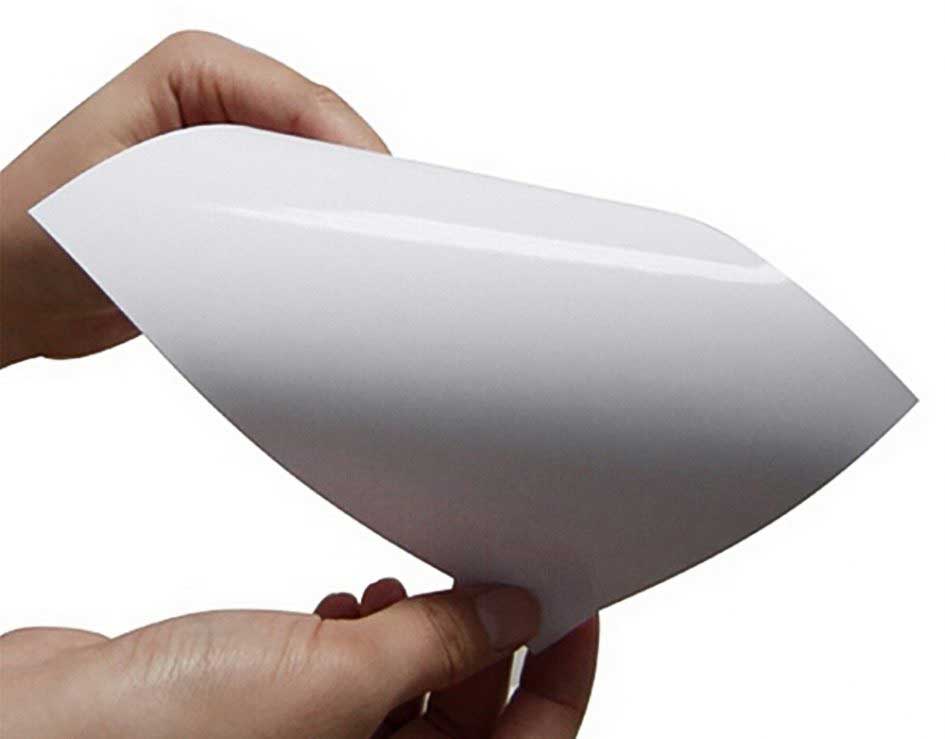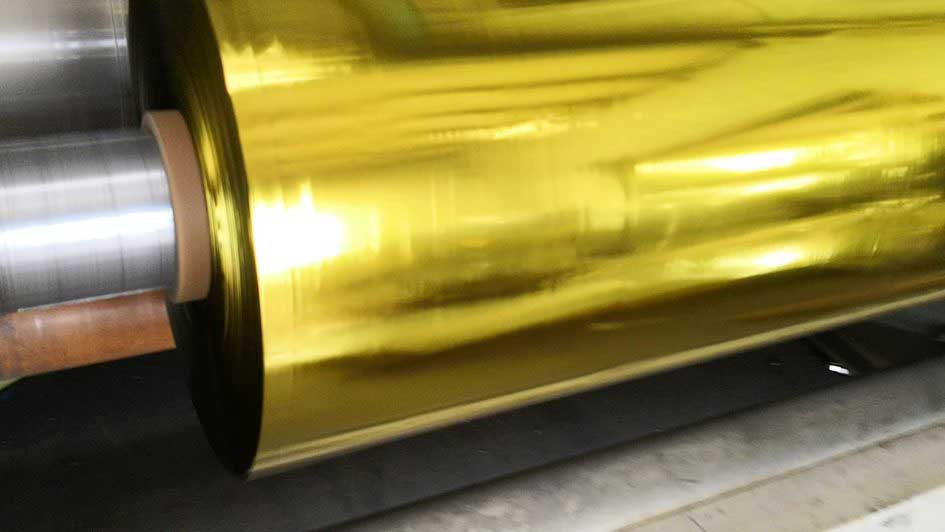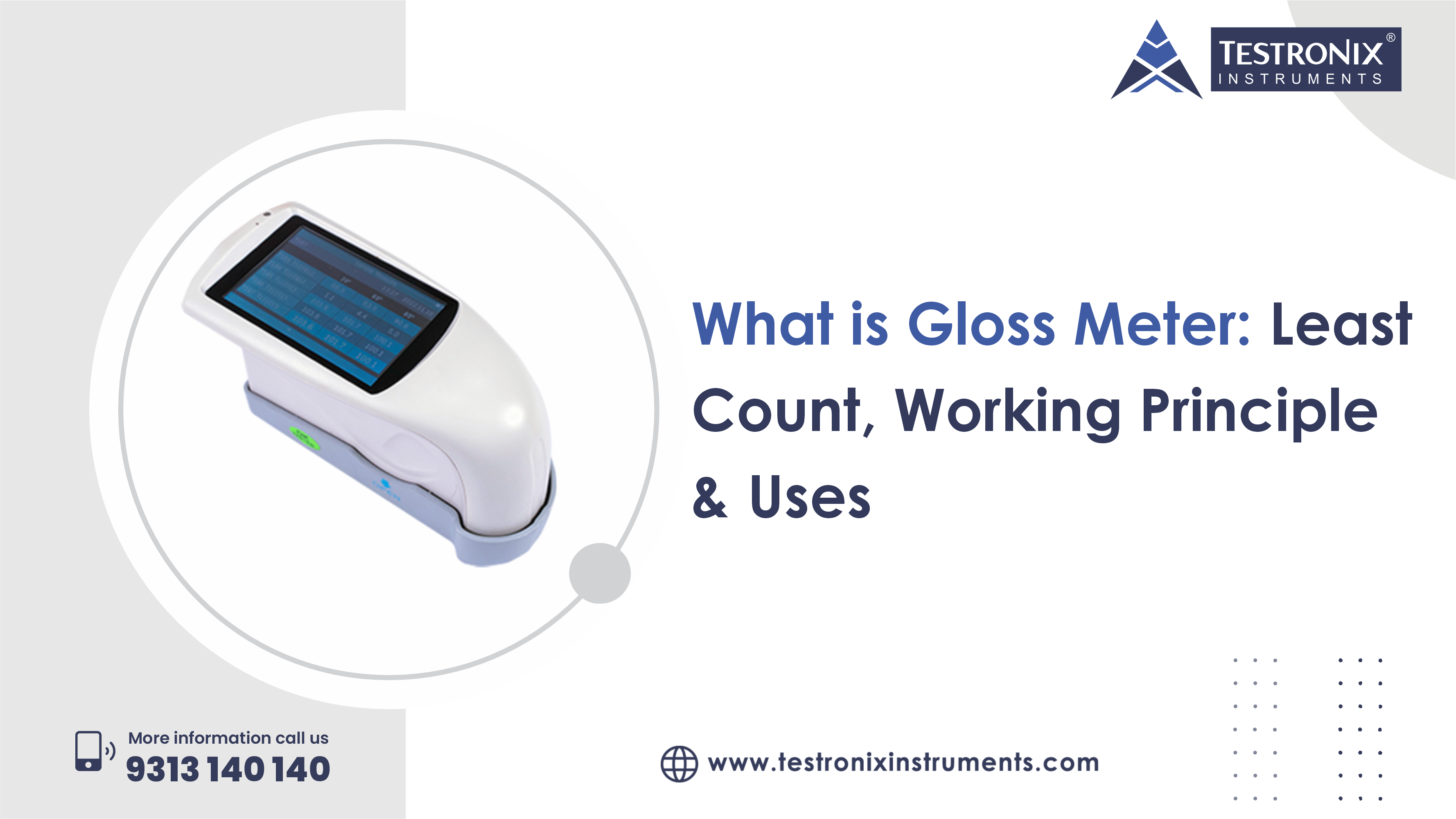
Manufacturers consider the appearance of the surface when determining the quality of products like paint, plastic (automobiles), ceramic products, and printed products. Gloss is one of the most important visual properties of a surface, and this means the ability of the surface to reflect back the light of the surface in a specular (mirror-like) manner. In order to assess the gloss, a gloss meter could be used.
The gloss meter gives an objective quantitative value which allows manufacturers to have consistency, quality requirements and relative comparisons of finishes of different batches.
What is Gloss Meter?
A gloss meter is used to measure the shine of a surface by measuring the amount of reflective light (the gloss) of the surface under measurement at a set of angles (20, 60 or 85 degrees).
A single example of a glossmeter is the Elcometer 480 gloss meter, a high-precision glossmeter in a handheld form. Therefore, it can capture a maximum of 10 readings on coating, plastics or metal.
Gloss Meter Diagram
A Gloss Meter diagram consists of a light source, a source lens & aperture, a sample surface, a receptor lens & aperture (detector), a photodetector/sensor, a data processor/signal processor, a display/LCD screen and a calibration standard.
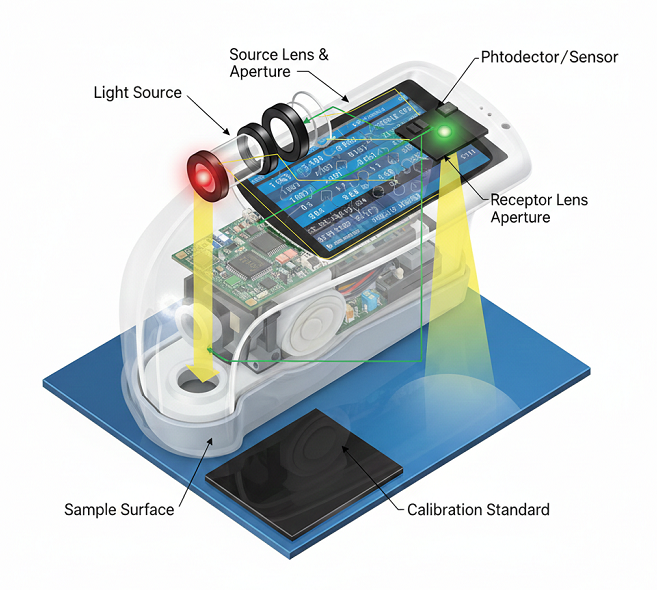
Here are the components described below:
-
Light Source: Generates a stabilized, parallel beam of light.
-
Source Lens & Aperture: Guides the light beam toward the test surface at a precisely defined angle of 20°, 60°, or 85°.
-
Sample Surface: The material or the test sample being measured.
-
Receptor Lens & Aperture (Detector): Refrayed light is caught at the corresponding angle of the specific angle.
-
Photodetector/Sensor: Changes the intensity of the reflected light into an electrical signal.
-
Data Processor/ Signal Processor: Analyzes the detector signal to determine the numerical gloss value.
-
Display/LCD Screen: Displays the gloss readings and available menu settings.
-
Calibration Standard: A polished black glass standard (refractive index ≈ 1.567) used for instrument calibration.
Gloss Meter Working Principle
A gloss meter works on the principle of specular reflection and measures how much of the light is being reflected off the surface back to the instrument at a specific angle equal and opposite to the beam that comes from the instrument. The surface to be tested is illuminated by a controlled lighting source, and the intensity of the light reflected can be measured by a photodetector at three standard angles of 20°, 60°, or 85°. The measured value is to be reported in gloss units (GU).
Gloss Meter Working Procedure
Gloss meter consists of several steps such as preparation and calibration, selecting the measurement angle, taking measurements, and recording data.
-
Preparation and Calibration
To have good measurements of the gloss meter, the gloss meter and the test sample must be dry and without dust or dirt. In order to obtain accurate measurements, the gloss meter should be adjusted to a certified reference tile of black glass, where the repeatability, stability, and reliability of measurements are met according to the international standards (ASTM and ISO).
-
Selecting the Measurement Angle
The angle of measurement is chosen according to the finish of the workpiece: 20° for high gloss finishes, 60° for medium gloss finishes, and 85° for flat finishes. A correct choice of angles helps ensure that you are more sensitive to a given finish when compared with other finishes and that you are producing consistency and accuracy within the standards of gloss measurement.
-
Taking Measurements
It is important to position the gloss meter securely against the surface being tested so that there is no possibility of light escaping. You may need to press the button that takes a reading to get as many sample points around the test site as possible. This could provide better results and subsequently establish an acceptable average gloss value for the purpose of judging the surface's condition.
-
Data Recording
The instrument can record measured gloss values as either a manual or electronic entry in its memory. Data can then be transferred to a program for evaluation, reporting, and documentation of quality. This feature enables the comparison of different production runs, ensures consistent quality, and complies with industrial regulations for quality control.
Gloss Meter Least Count
In reference to gloss meters, the 'least count' is defined as the smallest change in a gloss value that can be measured by using the instrument.
-
Commonly used gloss meters typically have a least count of 0.1 GU (gloss units).
-
Higher-quality or more accurate gloss meters may have a least count of 0.01 GU.
Top Uses of Gloss Meter
Gloss meters are necessary equipment used across various industries such as automotive finishing, paint & coating quality control, plastic and polymer production, printing & packaging, metal finishing and polishing, and furniture and woodwork.
Here are the top uses of a gloss meter:
-
Automotive Finishing
Gloss measurement tools ensure a consistent sheen across the body of a car, including the body, bumpers, dashboard, and clear coat. The instrument also provides the user with a way to compare color from panel to panel, spot any problems with polishing, and confirm the quality of the finish on coated surfaces—all of which are necessary to achieve a car that has the appearance of having a factory-applied finish.
-
Paint & Coating Quality Control
Gloss meters are employed in the paint area to assess drying characteristics, determine the efficiency of the adjacent processes, and quantify how finishing looks. Gloss meters can determine whether the customer should expect a matt, semi-matt or high-gloss finish. Hence, verify that a paint or varnish or powder coating has met their product specifications and the expectations of the customer.
-
Plastic & Polymer Production
Manufacturers utilize gloss meters to evaluate molded plastic parts, films, and bottles' surface-level quality. This tool helps verify that the texture and sheen are in accordance with design specifications. This aids in the adjustment of molding settings and ensures uniform product appearance throughout all manufactured batches.
-
Printing & Packaging
Gloss measuring is key to ensuring uniform gloss or sheen on printed brochures, cartons and labels after the application of ink, varnish, or laminating. Gloss measurement enables printers to monitor the thickness of coatings and helps to avoid dull patches while maintaining both brand aesthetic and visual quality during mass production of packaging materials.
-
Metal Finishing and Polishing
Gloss meters measure the finish of anodized, brushed, or polished metal surfaces to determine the amount of luster or shine achieved after finishing processes have taken place. An accurate determination of luster is important for verifying the quality of surface treatments on aluminum, stainless steel, and decorative metal surfaces. Surface treatment quality is fundamental for the corrosion protection and visual appearance of finished parts.
Conclusion
An essential element for quality control and measuring surface gloss accurately and scientifically is the gloss meter. It is important to understand the operation of the device, the least count value, and the correct procedure for determining it so that reliable results can be produced.
More advanced testing equipment such as the Testronix Elcometer 480 Gloss Meter, are able to produce quicker, smarter and more precise measurements via digital connectivity and the ability to measure at multiple angles.