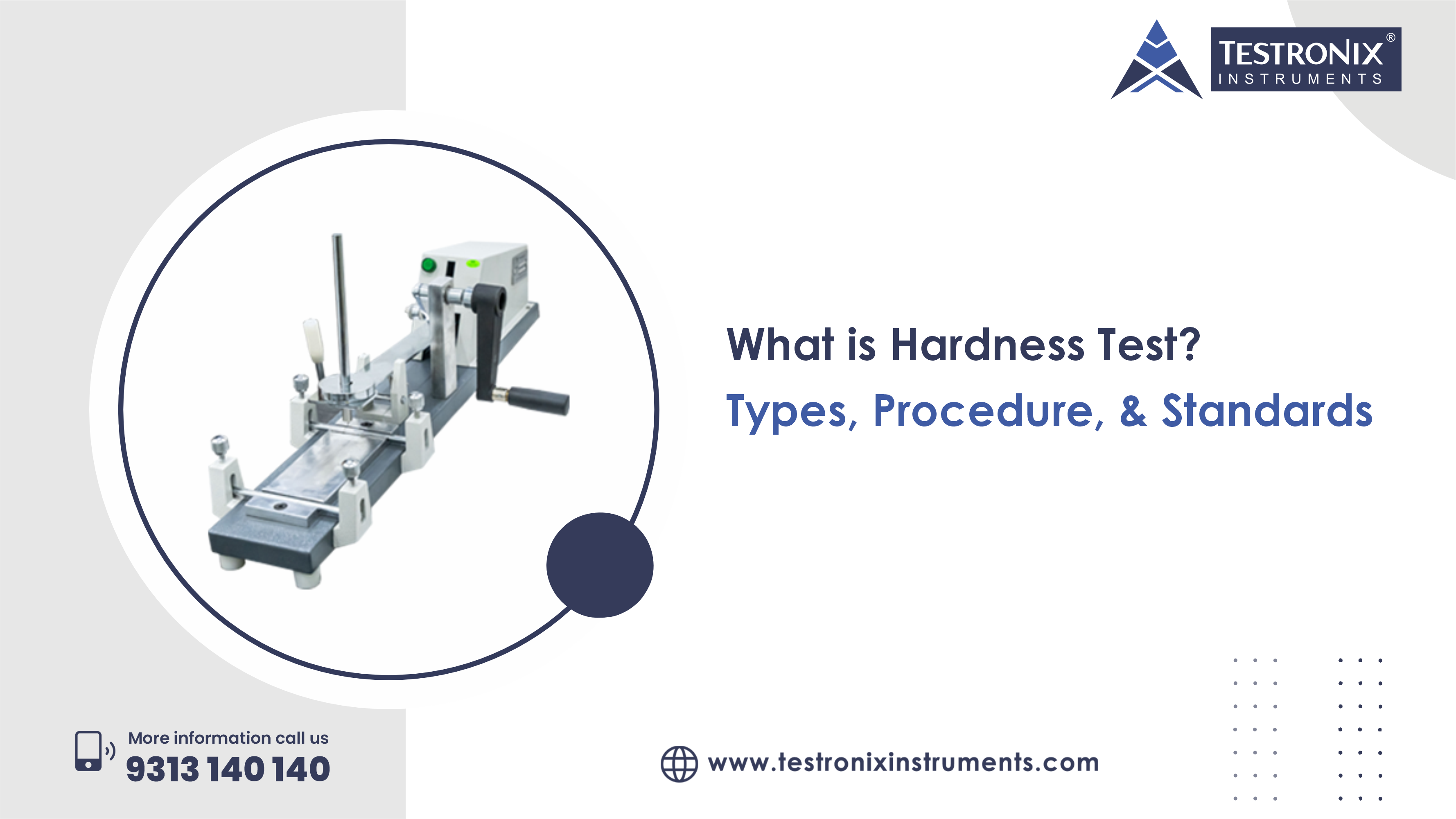
Hardness testing is one of the most important mechanical tests used by researchers in the sphere of materials science and also in laboratories focused on quality control. This testing is used to determine the capacity of an object to withstand deformation, indentation, scratching, and wear resistance. Hardness testing plays a vital role in determining the functionality of all the materials, including metals, plastics, rubber, and composite materials, throughout their service.
Industries that use hardness testing to ascertain compliance of products that are to be used by other industries, such as automotive, aerospace, construction, packaging and manufacturing, want to ensure that the products will be used in accordance with the globally accepted quality standards.
What is Hardness Testing and Why Does It Need?
Hardness testing is a method of determining the resistance of a material to permanent change in shape at the top surface when another harder material is pushed against it.
Hardness testing has been used extensively throughout many different industries as a means of comparing and selecting materials, as well as for quality control of the production or hardening of those materials.
The hardness test utilizes specifically manufactured indenters, which have specific dimensions and are pushed into the material under test with a predetermined amount of pressure for a predetermined amount of time.
Hardness Testing Methods
Here are several methods of hardness testing described below:
-
Rockwell Hardness Test
The Rockwell hardness test is a fast and non-destructive method of determining the hardness of metals and polymers through an assessment of the depth of an indentation created by either a diamond cone or a steel ball using a two-stage indentation load.
Principle
The Rockwell hardness tester is based on the principle of measuring the difference between the two depths of indentations. This indicates the amount of permanent indentation that will remain after applying a major load to the sample versus what would occur if only a minor load were applied first.
Standard
-
ASTM E18: Standard test method for metallic materials (Rockwell hardness).
-
ISO 6508-1/2/3: Test methods for metallic materials (Rockwell hardness).
-
JIS Z2245: Rockwell hardness, Japanese industrial standard.
Applications
The Rockwell hardness test is applied in most industries, like manufacturing, metallurgy, and engineering, to determine the characteristics of materials, like hardness and quality. Uses are most frequent in the measurement of heat-treated steels and automotive and aerospace components, and these are all produced using this technique of measurement.
-
Brinell Hardness Test
In the Brinell hardness test, a large portion of pressure and force, up to 3,000 kgf, is applied, and an impression of a ball (usually 10 mm) of hardened steel or tungsten carbide is made on the surface of the material and allowed to stay in place between 10 and 30 seconds.
Principle
The Brinell hardness test relies on the ability of a material to resist the ability to change shape permanently by inserting a highly hard object (a tungsten carbide ball 10 mm in diameter) during a given period of time against its surface under a given heavy load.
Standard
The Brinell hardness test is indicated in ASTM E10 and ISO 6506 and involves pressing a carbide ball (diameter ranging between 1 mm and 10 mm) into a material with a specified amount of load to ascertain the hardness of a specific material, depending on the diameter of the formed indentation.
Applications
The hardness of the surface of a rough or coarse piece of metal (such as a casting, a forging product, or a steel product) can be determined by the diameter of an indentation produced by means of a deep, heavy carbide ball, the Brinell hardness test. This test has become one of the most widely used methods for quality control as well as inspecting and controlling the manufacturing of large industrial parts.
-
Vickers Hardness Test
The Vickers hardness testing system is an accurate method of determining material hardness using an indentation method. The method utilizes a diamond indenter (the shape of a square pyramidal configuration) with a 136° angle across the face to create an indentation on the polished surface of the test material.
Principle
Vickers hardness is calculated using the capacity of the material to withstand permanent deformation under the influence of the diamond that is pressed against its surface at an angle of 136 degrees (the bottom of the pyramid). The hardness number is calculated by the amount of force applied on the surface divided by the area of the indent made on the surface by the diamond indenter.
Standard
The international standards ISO 6507 (1-4) and ASTM E384/E92 set forth the use of a pyramid-shaped diamond indenter for the Vickers hardness test. The testing is performed by applying a measured force between 0.001 kg and 120 kg (typically between 0.001 kg and 100 kg) for 10 to 15 seconds.
Applications
The Vickers hardness test is a very reliable, non-destructive way of determining the hardness of materials (metals & ceramics and plastics) by means of a diamond pyramid-shaped indenter under different forces/sizes (micro to macro). This test is used in applications such as testing welds, coatings and the investigation of microstructure.
-
Knoop Hardness Test
A Knoop hardness test measures the heat of brittle/thin materials such as ceramics, metals, and coatings, using a pyramidal indenter that is pressed into the surface at low weight (between 1 gf and 2 kgf).
Principle
The principle behind the Knoop hardness test is micro-indentation. The test uses a diamond indenter that has a rhombic base with a pyramidal shape. The diamond is pressed into the surface of the material with a known, light load (less than 1 kilogram). The hardness of the material can be calculated by measuring the long diagonal of the impression made by the diamond indenter.
Standard
ASTM E384 (for microindentation) and ISO 4545 (for metallic materials) are the main standards which regulate the Knoop hardness test. They both provide specific ways of assessing the hardness of thin, fragile materials, coatings or localized areas with an indenter in the shape of a rhombus, made from diamond.
Applications
A microhardness procedure with less than one kilo force (1 kgf) that tests brittle and thin materials by producing shallow indentations is called Knoop hardness (HK). Uses include evaluating several types of material, including glass, ceramic, coating, foil, electronic cross sections, and surface hardness gradients.
Conclusion
The hardness test is one of the basic quality control procedures employed in any industry to assess the strength, durability and wearability of the materials. The different hardness testing processes – Rockwell, Brinell, Vickers, and Knoop – are all applicable to a particular purpose with regard to the type of material tested and the purpose.
Manufacturers provide accuracy, repeatability and international compliance by adopting international standards which include ASTM and ISO. The choice of the hardness testing technique not only enhances the performance of the product but also prevents risks of failure and also improves customer satisfaction.
To have the best and most efficient hardness testing solutions, such companies as Testronix provide the companies with detailed and high-quality and precision-engineered testing equipment that is relied on and satisfies the international standards and industrial needs.