The products can be easily spoiled by environmental factors such as extreme hot weather, cold weather, humidity or quick fluctuations of the temperature before the product is ever sold to the customer. This is a significant issue for the manufacturers since it may result in failures, safety concerns, and expensive recalls. Climatic testing assists in addressing the problem by subjecting products to such harsh conditions in a controlled manner; therefore, companies can know how well their products will perform under real-world conditions.
In this paper, we are going to discuss the various categories of climatic testing, the method of testing, and the main advantages of climatic testing to product reliability and quality.
What is Climate Testing?
A climate test is a type of environmental stress test where the product is subjected to various controlled conditions. The managed conditions are extreme heat, cold, humidity, and pressure, to determine how the product would perform in various environments and survive.
Climate testing involves testing of your product in controlled chambers to replicate the realistic situation your product would endure in the various stages of its life cycle, including when storing, transporting, and real use of the product.
What are the Different Types of Climatic Tests?
The climate test encompasses a wide range of environmental conditions, including temperature, humidity, winds, and more. Here, products and materials are subjected to various types of tests to study their performance.
-
Temperature Tests
The temperature tests check the performance of a product under extreme heat and cold conditions. Thermal stress, material deformation, electric failure, or performance changes are noticed while products are exposed to high and low temperatures by the manufacturers. Tests would simulate fluctuations in the natural environment to ensure product reliability in varied climate conditions.
-
Humidity Tests
Humidity testing assesses the performance of a product in high-moisture situations. The product is subjected to a controlled humidity environment to measure numerous corrosion, mold, electrical leakage, and material degradation-related problems. The process helps the manufacturer to forecast the expected impacts of exposure to moisture with time, durability, safety, and performance problems.
-
Wind Tests
Wind tests will range in all ways from a gentle airflow to strong gusts, and these tests are essential for equipment, structures, and vehicles intended for outdoor use. They help identify weaknesses related to stability, structural integrity, and resistance to wind pressure by ensuring that a product can face up to the real wind of the world.
Climatic testing ensures that products withstand a variety of environmental challenges before they are delivered to the customer. Climatic testing is not new. Climatic testing uses real-world conditions of heat, cold, humidity, and wind to help the manufacturer find potential failures in the early design phase. This results in better product quality, increased safety, longer life, and a higher level of customer satisfaction relative to products in all industries.
How does Climatic Testing Work? Test Procedure
Placement and setup
The product is placed in the climate test chamber to expose it uniformly to the simulated environment. Sensors or thermocouples can be attached to monitor their specific performance during the test. Proper spacing for airflow is important.
Chamber programming
The test chamber is programmed to the specific temperature, humidity, and time cycles needed according to the applicable testing standard. It is calibrated for accuracy in terms of the values set.
Test cycle execution
The test cycle is applied, and the chamber measures and controls the environmental variables automatically. Such a cycle model stresses (e.g., thermal shock—surge in temperature) or other environmental conditions to test performance, degradation, or failure.
Monitoring and data analysis
During the test, internal systems in the chamber and sensors attached gather data with regard to the performance of the product under the simulated stresses. This data is analyzed after the cycle for any weaknesses or failures.
Post-test analysis
This involves removing and examining the product and searching for indications of physical degradation, such as corrosion and structural breakages, or electrical breakdowns. Such an evaluation of the product guarantees the quality, reliability, and safety of the product.
Why Industries Require Climatic Testing
Basically, industries perform climatic testing to achieve the safety, reliability, and durability of their products in various environmental conditions during storage, transport, and use.
Assuring Product Reliability and Long-Lasting Performance
During the life of the products, they experience extreme temperatures that may be either extremely hot or cold, and humidity, among other stressors. The climatic testing is used to replicate the conditions to identify possible weaknesses and material degradation, including cracking, expansion or contraction, and design weaknesses that enhance field operations and service life.
Industry Standard/Regulatory Compliance
The vast majority of industries are regulated by a set of strict national and international regulations, including MIL-STD-810 and RTCA DO-160 of aerospace, IEC 60068, and ISO 16750 of automobiles. They must be fulfilled in case the products are to be legally sold and accepted in the market. Testing makes certain that safety and performance standards are achieved.
Safety Enhancement
It helps to expose the products to extreme conditions and ensure the safety limits and functionality. It is required most in high risk applications like medical devices, aerospace parts and automotive systems where a failure would result in severe injuries or even death.
Cost Savings
It is much less costly than trying to rectify issues that arise once a product has been released to the market, and early identification of possible failures during the design or development phases by using controlled lab tests is much cheaper. This reduces their costly recall, warranty replacement, and maintenance.
Quality Assurance and Customer Satisfaction
Strict testing aids the manufacturers to ensure that quality products are consistently produced to reach the expectations of customers with regard to reliability and longevity and to gain brand reputation and customer loyalty.
Benefits of Conducting Climatic Test
Ensure Product Reliability
Climatic tests assist in confirming that a product will be able to deliver in different environmental conditions such as heat, cold, humidity, and wind. This means that the manufacturer can identify the weaknesses early enough and ensure that the product is stable, durable and functional over time during the lifecycle it is supposed to run, even when in a harsh climate.
Compliance with Industry Standards
Many industries have strict environmental performance standards that products must meet before approval. Climatic tests will help the companies follow these regulations by confirming the quality and safety of their products. These ensure that the product meets required certifications, thereby guaranteeing smooth access to markets, and they reduce legal or regulatory risks.
Prevents Material Degradation
Factors of temperature fluctuation, moisture exposure, and UV radiation eventually weaken materials. Tests of a climatic nature simulate these conditions in order for one to find corrosion, cracking, fading, or even deformation. This helps manufacturers in deciding on better materials and enhancing product durability under real-world stress.
Reduces Costs From Failures and Recalls
Early product testing prevents expensive failures after the product has reached customers. Environmental stress-related defects, if identified, reduce a company's risk of recalls, warranty claims, and dissatisfied customers. It thus achieves long-term cost savings while strengthening the brand's reputation for quality and reliability.
Testronix Environmental Test Chambers for Climate Testing
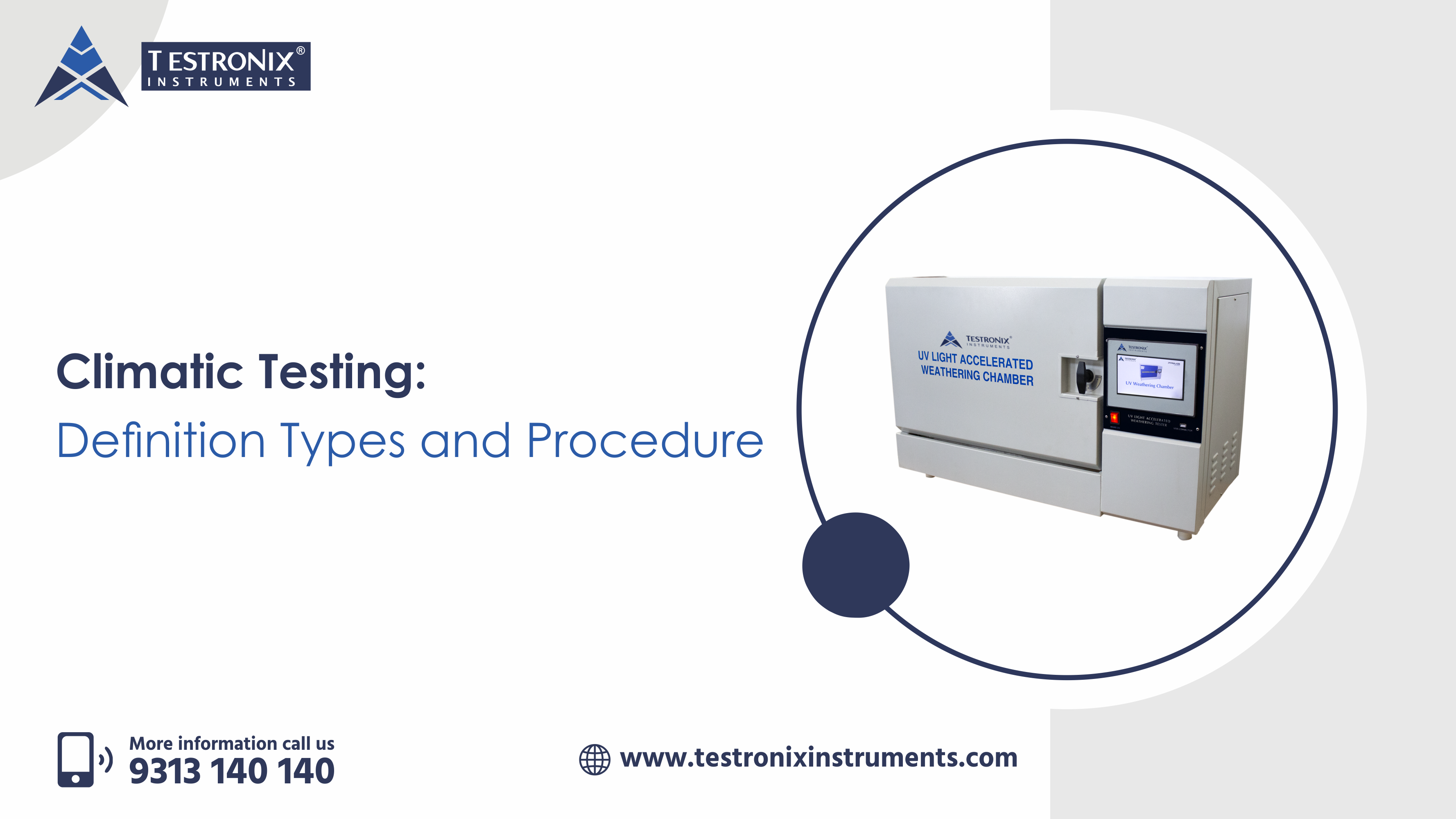
Testronix offers a wide range of environmental test chambers for corrosion testing to mimic environmental conditions such as temperature, humidity, UV exposure, and corrosion. The chambers are provided with control systems and protection, a solid design, and user-friendly interfaces. They are meant to be reliable in environmental testing in the automotive, electronic, packaging, and materials industries. Testronix intends to give users accurate results and a better quality product and to be able to comply with relevant testing standards.
Climatic testing plays a very crucial role in ensuring that products do not break under environmental pressure that they might face in the actual location. Storing materials and parts under controlled conditions, with temperature, humidity, UV, and wind being some of the conditions that organizations employ for materials and components to enhance reliability, minimize failures, and meet industry requirements.