

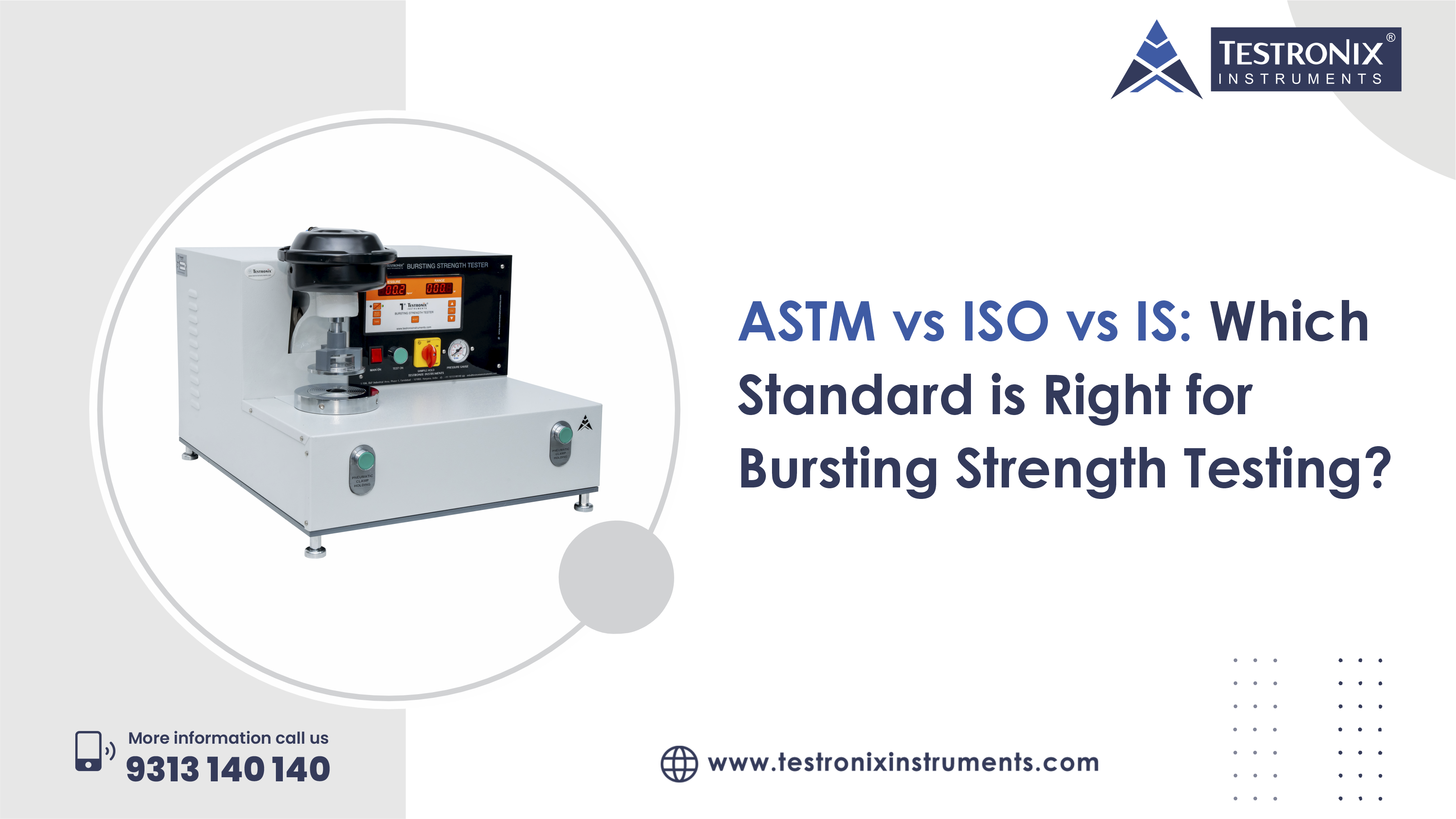
Testing on bursting strength is a significant quality control process on a wide range of materials, such as paper, corrugated cardboard, textiles, leather, and plastic packaging. Being aware of the maximum pressure that the above products can withstand before breaking can help manufacturers to know the specifics of each material and how they may be utilized in the production and distribution of their products.
To ensure consistency of testing methods between different industries, several different standards have been established (the most common being ASTM, ISO, and IS). A proper standard provides the most accurate information, which is then accepted globally by producing a reliable product.
What is Bursting Strength Testing?
Bursting Strength Testing indicates the maximum hydraulic or pneumatic pressure that a material can withstand before breaking. The material is tested for strength and ability to endure the transit and stress of shipping. Generally, bursting strength is expressed in psi or kg/cm².
ASTM vs ISO vs IS: The Difference
-
ASTM - American Society for Testing and Standards
-
ISO - International Organization for Standardization
-
IS - Indian Standard (Bureau of Indian Standards—BIS)
Here is the difference between ASTM, ISO, and IS:
|
Feature |
ASTM |
ISO |
IS |
|---|---|---|---|
|
Region |
USA & Global |
International |
India |
|
Acceptance |
Highly accepted in American markets |
Globally accepted |
Mainly in Indian industries |
|
Test Method |
Defined procedures with equipment specs |
Harmonized global method |
Adapted from ISO/ASTM |
|
Units Used |
psi/kPa |
kPa |
kg/cm²/kPa |
|
Application |
Paper, board, textiles |
Paper, packaging, fabrics |
Paper, corrugated, textiles |
ASTM Standards for Bursting Strength Testing
Key ASTM Standards for bursting strength testing primarily include ASTM D3786, ASTM D6797, ASTM D774, and ASTM D3787.
-
ASTM D3786: Standard Test Method for Bursting Strength of Textile Fabrics Diaphragm Bursting Strength Tester Method.
-
ASTM D6797: Standard Test Method: Bursting strength of fabrics, constant-rate-of-extension (CRE) ball burst test.
-
ASTM D774: Standard test mechanism of bursting strength of paper.
-
ASTM D3787: Standard test method for measuring bursting strength via a ball burst mechanism.
Benefits of ASTM Standards Bursting Strength Testing
Quality Assurance & Safety
Bursting strength testing is used to test packaging, paper & fabrics to determine if the materials meet predetermined performance and safety standards. Burst testing reduces the likelihood of consumers receiving subpar materials, thus protecting consumers and ensuring consistent product quality across production runs.
Related: Quality Control vs Quality Assurance: Know the Difference
Durability Assurance
Durability tests ensure that the packaging materials can withstand shipping pressure, stacking, vibration from shipping, and handling. Durability tests minimize the chances of damaging the product during transit and/or storage until it can be delivered to the end-user without the packaging material failing.
Design Optimization
By using test results, manufacturers can improve their design processes based on choosing appropriate material thickness and construction. This minimizes trial and error throughout the development process and speeds up overall cycle times by 10%-15%, lowers production costs, and optimally improves the overall performance of the material.
Material Selection
Evaluation of the bursting strengths of each of the materials enables manufacturers to compare their choices across multiple types of materials. Hence, allow them to utilize only high-strength materials in their final production applications. This supports the minimization of low-grade input usage, rejects as little as possible, and minimizes waste.
ISO Standard for Bursting Strength Testing
Key ISO standards for bursting strength testing primarily include ISO 2758, ISO 2759, and ISO 13938.
-
ISO 2758: Standard test method of measuring the bursting strength of a paper bearing bursting strength between 70 kPa and 1,400 kPa, by hydraulic pressure.
-
ISO 2759: Includes corrugated and solid fiberboard and paper of increased strength (to 5,500 kPa).
-
ISO 13938: Defines the hydraulic and pneumatic (air) method of testing the bursting strength and bursting distension of fabrics.
Benefits of ISO Standards Bursting Strength Testing
Enhanced Quality Assurance
ISO standards offer reliable and standardized ways of determining maximum pressure capacity, which allows manufacturers to utilize quality, reliable, and durable materials.
Optimized Packaging Design
The outcomes of the testing give manufacturers the information necessary to settle on the necessary thickness and the building content of packaging material to attain a balance between its performance, economic viability, and sustainability.
Prevention of Shipping Damage
Standards are utilized to ensure that the products are not broken or ruptured or suffer any form of loss or damage during the shipping process, and thus, one of the options to cut down costs during shipping is to ensure that your materials are of the required standards.
Global Compliance
Having your products comply with internationally accepted standards such as ISO 2758 and ISO 2759 meets global market requirements and, in the case of textiles, also meets the needs of many different buyers.
IS Standard for Bursting Strength Testing
Key IS standards for Bursting Strength Testing include IS 1966-1 (2009) and IS 1060 (Part 1): 1987.
-
Textiles: IS 1966 (Part 1):2009 (identical to ISO 13938-1) covers the hydraulic method for bursting strength and distension.
-
Paper & Board: IS 1060 (Part 1):1987 is typically used for paper and paperboard.
Benefits of IS Standards Bursting Strength Testing
Preventing Product Failure
Nevertheless, it is necessary to know the final pressure limit of the material being shipped or stored to avoid the destruction of this material. This will reduce the chances of damage to goods in transit. This kind of information can enable manufacturers to choose the right strength of the packages depending on the changing conditions of the loads.
Cost-Efficiency & Waste Reduction
Early testing of materials enables a manufacturer to save time making a product using materials that are too weak. In this way, the cost of production is decreased, as well as the rate of the number of products recalled or subject to complaints.
Accurate Data & Standardized Results
IS standard provides repeatable, correct, and reliable information about the material strength (in kilopascals (kPa) or other similar units) by measuring the pressure of a diaphragm when it is deformed.
Process Optimization
Gives the instruments and expertise required to streamline the choice of materials and manufacturing operations to make high-quality products. It also aids manufacturers in lowering the cost of production, decreasing defects, and having a uniform performance of each batch.
ASTM vs ISO vs IS: Which Standard is the Best for Bursting Strength Testing
The best standard for bursting strength testing depends on the target market and customer requirements. The ASTM standard is ideal for products supplied to the US and North American markets due to its detailed methodology and wide industrial acceptance.
The ISO standard is preferred for global trade as it offers internationally harmonized procedures and easier comparison of results across countries. IS standards are best suited for Indian domestic industries and government tenders. All three are reliable—the right choice should be based on export region, buyer specification, and regulatory compliance needs.
Testronix Bursting Strength Tester: Best Equipment to Use
To comply with ASTM, ISO, and IS standards, high-precision equipment is essential. The Testronix Bursting Strength Tester is designed to meet global testing requirements with advanced features such as:
-
Microprocessor-based digital display
-
High-accuracy hydraulic system
-
Auto peak hold facility
-
Interchangeable diaphragms
-
Calibration traceable to international standards
-
Suitable for paper, board, textile, and packaging
The choice between ASTM, ISO and IS is not only a technical choice but also a business choice. You not only retain your brand and reduce losses but also make sure that every shipment gets to the customers in the appropriate position they want and Testronix Instruments is the best choice in this case.