

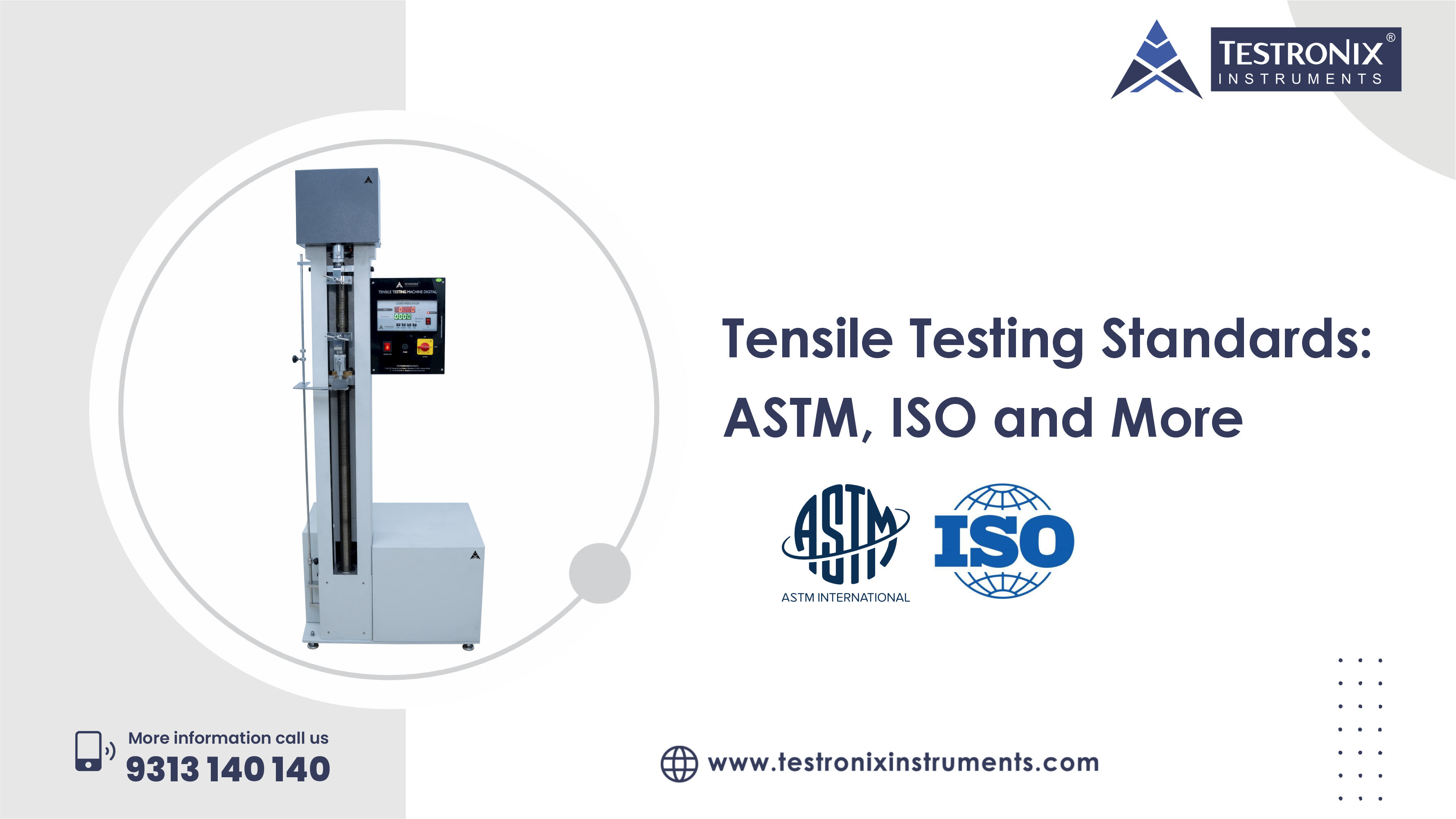
Tensile testing is considered one of the most important testing and evaluation techniques for materials. This testing method is used for testing the strength, flexibility, and durability of materials. In order to ensure accuracy and uniformity in the results of the tests, these tests are conducted in a specific way.
The most commonly used guidelines for performing the tests on different materials are given by ASTM (American Society for Testing Materials) and ISO (International Organization for Standardization). It is very important for industries to get knowledge about the complete guidelines given by ASTM and ISO for performing tensile testing on different materials.
What are International Standards and Why They Are Important
International standards are a set of guidelines that are accepted all over the globe and are developed by different organizations, e.g., ASTM and ISO, for maintaining uniformity in testing, measurement, and quality in different sectors. In tensile testing, international standards specify how testing should be done, i.e., how the specimen is prepared, how testing is done, and how results are interpreted.
The significance of international standards is based on the need for maintaining reliability and accuracy in testing. Without international standards, testing results may not be reliable, and results may be based on incorrect data. ASTM and ISO standards provide a common platform for all sectors, which is very useful for maintaining accuracy.
International standards are also very useful for maintaining quality and compliance. Organizations need to follow different standards for ensuring that their products are not only safe for use but also comply with international standards.

List of Tensile Testing Standards
Standards for tensile testing specify the procedures and conditions necessary for precise material strength measurement. The following is a list of the top standards used for tensile testing, based on ASTM and ISO standards:
ASTM E8/E8M
The standard procedure for determining the properties of plastic materials when subjected to tension is ASTM D638. Testing rubbers and elastomers for their material properties can be accomplished by following this standard. The procedures project the properties of elasticity, elongation and tensile strength of materials in controlled testing environments using standard testing samples.
Importance
ASTM D638 is a standard procedure for evaluating the suitability of plastic materials by the manufacturing industry. This standard is important to the quality of products made from plastic materials.
Testing Procedure
1. Prepare a plastic material in accordance with the standard.
2. Ensure that the material has the correct thickness.
3. Mount the material in the grips.
4. Set the speed.
5. Apply a tensile force.
6. Measure the stress and strain.
7. Measure the elongation.
8. Break the material.
9. Measure the elongation.
10. Measure the strength.
ASTM E21
The ASTM D412 standard is a tensile testing standard. The standard is common in industries to test the properties of materials like rubbers and elastomers. It outlines procedures for tensile testing strength, elongation, and elasticity of materials at controlled testing conditions using standard test specimens.
Importance
This standard is important since it helps to ensure the performance of products made of rubber. The standard ensures the flexibility and elasticity of products such as rubbers. The standard ensures the quality of products such as rubbers by ensuring they are not stretched while in use.
Testing Procedure
1. Prepare a rubber specimen as per standard.
2. Use dumbbell-shaped test samples.
3. Mount the specimen carefully.
4. Apply tensile force gradually.
5. Maintain a uniform testing speed.
6. Record the values of elongation and stress.
7. Observe the stretching of the sample.
8. Continue the test until rupture.
9. Measure the final elongation and strength.
10. Analyze the results and check elasticity performance.
ASTM D638
ASTM D638 is a standard test procedure that measures the tensile properties of plastic materials. It defines the test specimen requirements, test conditions, and test methods for measuring tensile strength, elongation, and modulus of elasticity for various plastic materials.
Importance
ASTM D638 is a standard that enables plastic material manufacturers to test their products to ensure quality. The standard is widely used in the packaging industry, automotive industry, and consumer products industry to compare the material’s performance.
Testing Procedure
1. Prepare a plastic material specimen according to the standard.
2. Ensure that the material is of proper thickness.
3. Mount the specimen in the grips.
4. Determine the speed for testing.
5. Apply a tensile force.
6. Measure the stress and strain.
7. Measure the elongation.
8. Continue the test until the material breaks.
9. Measure the elongation at break.
10. Document and analyze results.
ASTM D412
ASTM D412 has been developed for testing tensile behavior of rubber-type {material properties} and provides the specifications that must be followed in order to determine the tensile strength; the elongation; and the elastic properties of flexible materials when tested in accordance with the specified environmental conditions with the testing of standard material samples.
Importance
This standard is crucial for the assessment of the performance of various products made from rubber. It is essential for the assessment of the flexibility and durability of the products. It also assesses the elasticity of the products by evaluating their ability to stretch.
Testing Procedure
1. Prepare the rubber specimen as per the standard.
2. Use dumbbell-shaped rubber samples.
3. Mount the rubber specimen carefully.
4. Apply tensile force to the rubber.
5. Maintain the testing speed.
6. Record the elongation and stress data.
7. Observe the stretching of the rubber.
8. Continue the testing procedure until the rubber ruptures.
9. Measure the elongation and strength.
10. Analyze the data to determine the elasticity performance.
ISO 6892-1
ISO 6892-1 is the international standard that defines the procedure for the testing of the properties of metals at room temperature, that is, the tensile properties of metallic materials, along with the preparation of the samples and the rate of strain.
Importance
The importance of ISO 6892-1 lies in its contribution to global standardization of testing metals. The standard enables comparison of results from different countries and industries. The standard is vital to quality, compliance, and validation of materials used globally.
Testing Procedure
1. Prepare specimens as per ISO standards.
2. Ensure correct dimensions and finish of specimen.
3. Fix specimen in testing machine.
4. Impose load at controlled strain rate.
5. Observe stress-strain response.
6. Record yield and tensile strength.
7. Continue testing until fracture.
8. Record elongation at break.
9. Calculate reduction in area.
10. Record and verify results.
SO 6892-2
ISO 6892-2 is a standard that provides requirements for the tensile impact testing of metallic materials at high temperatures. It also defines the procedures that can be adopted to determine the strength of materials at high temperatures.
Importance
ISO 6892-2 is an essential standard for the testing of high-temperature materials. This standard is required for the power plants and aerospace industries. This standard is required for the performance and reliability of the material under high-temperature conditions.
Testing Procedure
1. Prepare the specimen as per ISO standard.
2. Place the specimen in a heated chamber.
3. Heat the specimen up to a certain temperature level.
4. Provide stable temperature conditions for testing.
5. Place the specimen in a testing machine.
6. Provide tensile stress to the specimen slowly.
7. Measure stress and strain data.
8. Continue testing until the specimen fractures.
9. Measure elongation and strength of the specimen.
10. Test the performance of the material in high-temperature conditions.
ISO 527
ISO 527 is an international standard that defines the procedure for determining the properties of plastics during tension tests. It also defines the conditions, types of samples, and tests to be performed on plastics.
Importance
ISO 527 is important as it helps to ensure that the testing of plastics is carried out uniformly in different industries. It also helps to evaluate the quality of plastics and plastics-based materials in different products.
Testing Procedure
1. Prepare a plastic specimen according to the ISO standard.
2. Make sure the plastic specimen has the appropriate size and thickness.
3. Fix the plastic specimen in the testing machine.
4. Select the appropriate testing speed.
5. Apply tensile force on the plastic specimen.
6. Note the stress and strain values.
7. Observe elongation behavior.
8. Continue applying tensile force until the plastic specimen breaks.
9. Note the final properties.
10. Document the results.
ISO 37
ISO 37 is a standard for tensile impact testing for use with rubber and elastomeric products. This standard outlines the procedures for determining the tensile strength, elongation, and stress properties for standard specimens under specific conditions.
Importance
This standard is crucial for assessing the performance of rubber. This standard guarantees the consistency of the assessment and the maintenance of quality and flexibility for products made from rubber.
Testing Procedure
1. Prepare the rubber specimen according to the ISO standard.
2. Use a standard shape for the sample.
3. Fix the sample to the testing machine.
4. Apply a tensile force to the sample.
5. Ensure a constant speed.
6. Measure the stress and elongation.
7. Observe the sample's stretching.
8. Apply the stress until the sample ruptures.
9. Measure the final elongation.
10. Analyze the sample.
ASTM A370
ASTM A370 standard states that the mechanical properties of steel products include tensile properties, as defined in this standard, which includes a procedure for determining ductility and strength in steel products.
Importance
This standard is important in ensuring the quality of steel products, as it ensures that the needs of the industry are met by the manufacturers of steel products, thereby ensuring the safety of the steel products for use in the construction industry, among others.
Testing Procedure
1 Prepare the steel specimen as per the standard.
2 Ensure that the dimensions of the specimen are correct.
3 Mount the specimen on the testing machine.
4 Ensure that the specimen is correctly aligned to the testing machine to avoid errors.
5 Apply the load on the specimen.
6 Record the data.
7 Determine the yield and tensile points.
8 Continue the testing procedure until the fracture.
9 Measure the elongation of the specimen.
10 Document and analyze results.
ISO 7500-1
ISO 7500-1 is a standard that specifies the requirements for the calibration and verification of tensile testing machines. This standard is used to ensure that testing equipment is providing accurate results.
Importance
This standard is crucial for the determination of the precision and reliability of the testing machines. This standard is aimed at ensuring the precision and reliability of the results obtained from the tensile test.
Testing Procedure
1. Check the testing machine calibration.
2. Verify the accuracy of load measurements.
3. Use standard devices for calibration.
4. Apply a predetermined load on the testing machine.
5. Compare the results with actual values.
6. Adjust the testing machine, if necessary.
7. Repeat the verification process again.
8. Ensure that the testing machine is within the limits of the standard.
9. Record the calibration data for accuracy verification.
10.Maintain documentation for accuracy verification.
Conclusion
Tensile testing standards such as ASTM and ISO play a crucial role in accurate and reliable evaluation of material properties. These standards provide guidelines for testing properties of different materials such as metals, plastics, and rubber. Industries ensure quality control and safety which is not only important for the end consumer but also for brand's reputation.
Testronix Instruments is a leading manufacturer that follows all these international standards and guidelines, producing high-quality tensile testers to ensure that products achieve full compliance with tensile testing standards.
Moreover, these internationally recognized standards enable the evaluation of material properties for different materials using different tests in different parts of the world. It is important for engineers to understand the entire list of tensile testing standards for precise evaluation of material properties.